Follow Us on Google
By Henry Akubuiro
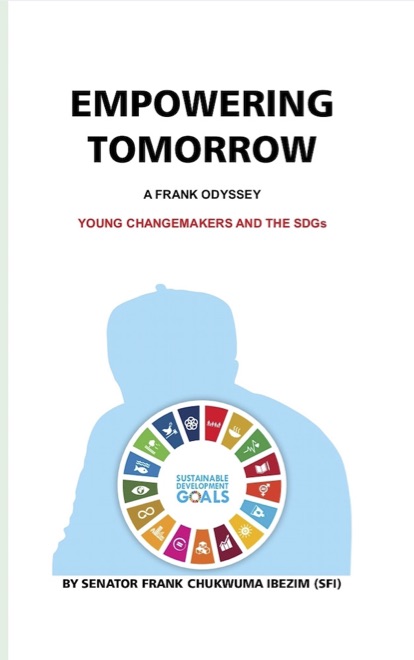
Empowering Tomorrow: A Frank Odyssey, Frank Chukwuma Ibezim Foundation, Abuja, 2024, pp. 171
The art of appearing candid and open isn’t associated with many politicians. Senator Frank Ibezim, a Nigerian politician and current senator representing the North Senatorial District of Imo State in the National Assembly of Nigeria, has chosen the path of candour and wisdom, which explains his recourse to writing a book, where everything is laid bare about his predilections. Empowering Tomorrow: A Frank Odyssey is, thus, a reflection on his experiences, challenges, and triumphs as a political leader in Nigeria, with a focus on guiding the next generation to take up the mantle of leadership and making a difference in their communities.
The Canadian based philosopher, Matshona Dhliwayo, once said that thinkers are leaders and true leaders are thinkers. Part of Nigeria’s leadership deficits emanates from a philistinic political class that is pedestrian in articulation, rigid in ideas and given to rabble-rousing. It is encouraging that Senator Ibezim has elected to wear the binoculars of a thinker to look different. A book like Empowering Tomorrow: A Frank Odyssey allows a wider audience the ease to assess his political maturity and mental acuity.
The inspiration for Empowering Tomorrow…, he says in the opening pages, stems from his unwavering belief in the power of young people to transform society. He has witnessed, firsthand, the impact that dedicated, passionate, and informed leadership could have on a community, and “convinced that our future depends on nurturing such leadership among the youths.” In thirteen chapters, the author covers a variety of topics, including the basics of democracy, party primaries, the power of generational shift, political campaigns, new political vision, building trust and handling political corruption. The book also treats how to become an informed voter, the future of politics, driving community initiatives, achieving sustainable development, etcetera. Thus, this book sets itself apart as a book for every voter, aspiring politicians, young visionaries, political scientists, the informed public, as well as those sitting on the political fence. It not only educates and informs everybody but it enkindles the zeal to serve without ulterior motives.
The senator justifies the youths’ involvement in politics by echoing: “Young people should care about politics because the decisions made today will significantly impact their future. Whether it’s about climate change, education, job opportunities, or human rights, young people have a stake in these issues and can play a vital role in shaping the policies that govern them. By becoming politically aware and engaged, young people can ensure their voices are heard and contribute to creating a society that reflects
their values and aspirations.” I isolate this as a succinct point. In Nigeria today, young people are left in the peripheral margin of political relevance, aspiring only as personal assistants and thugs to big politicians. This is a wakeup call for more political engagement – one that aspires for the highest positions – for it is a given to say the leaders of tomorrow are the youths.
The author, in the first chapter, furnishes us the election process in Nigeria, from voter registration to announcement of results. He also treats the organisation of political parties, spelling out the roles of each stakeholder. Party primaries and campaigns take the front burner in the second chapter. Also, he uses his personal experience for illustration: “During my campaign, I made it a priority to personally visit all 64 wards and numerous communities within Imo North. This exhaustive effort was not merely a campaign strategy but a reflection of my deep commitment to the people I aimed to represent. I wanted to go beyond the typical approach of addressing large gatherings or relying solely on media outreach; I believed in the power of personal connection and face-to-face interaction. By engaging directly with the residents of each area, I gained invaluable insights into their unique challenges, needs,
and aspirations, which I knew were crucial for effective representation” (p 18).
The author in the next chapter discusses generational change: “As a politician,” he remarks, “I’ve always believed in the power of generational change. I’ve seen first-hand how new ideas and perspectives can transform a community. When I finally became the senator for Imo North, I knew I wanted to bring fresh energy and new ways of thinking to my role. I wanted to focus on what really mattered to the people-education, empowerment, agriculture and community development.” It is important to note that you don’t need to hold a high office to make a difference. The senator is categorical that change often starts in the small, everyday actions and choices we make. Hence, “Whether you’re involved in your school council, participating in a community group, or simply engaging in discussions with friends about important issues, you can start making an impact right now” (p.27). He uses the example of anti-apartheid crusade by young South Africans as a case in point when youths redirected the country’s socio-political trajectory.
He follows this up by highlighting the tools for change in the fifth chapter, including the use of the media, building alliances, and working in concert with influential politicians. The author also sells the view that emphasises that, to create a brighter future, we must be willing to imagine a new vision for politics – one that embraces inclusivity, diversity, and the encouragement of new voices. For him, imagining a better The future for politics begins by rethinking the kind of society we want to live in. All you need to know to become an informed voter is also contained in the ninth chapter, while ways young people can get involved in politics is contained in the tenth chapter. This chapter is very important to today’s youths who often complain they are not being carried along by older politicians.
In the thirteenth chapter, the author enlightens us on how the seventeen Sustainable Development Goals apply to young future leaders. Impressively, each chapter in this engrossing read comes with questions and answers to swell your repository of knowledge, especially for the young changemakers. This book could have been written by an egghead in the ivory tower. It is detailed, commendable, and highly recommend