Follow Us on Google
Burning disused tyres for scrap wires raises alarm over health, environmental risks in Kaduna
From Noah Ebije, Kaduna
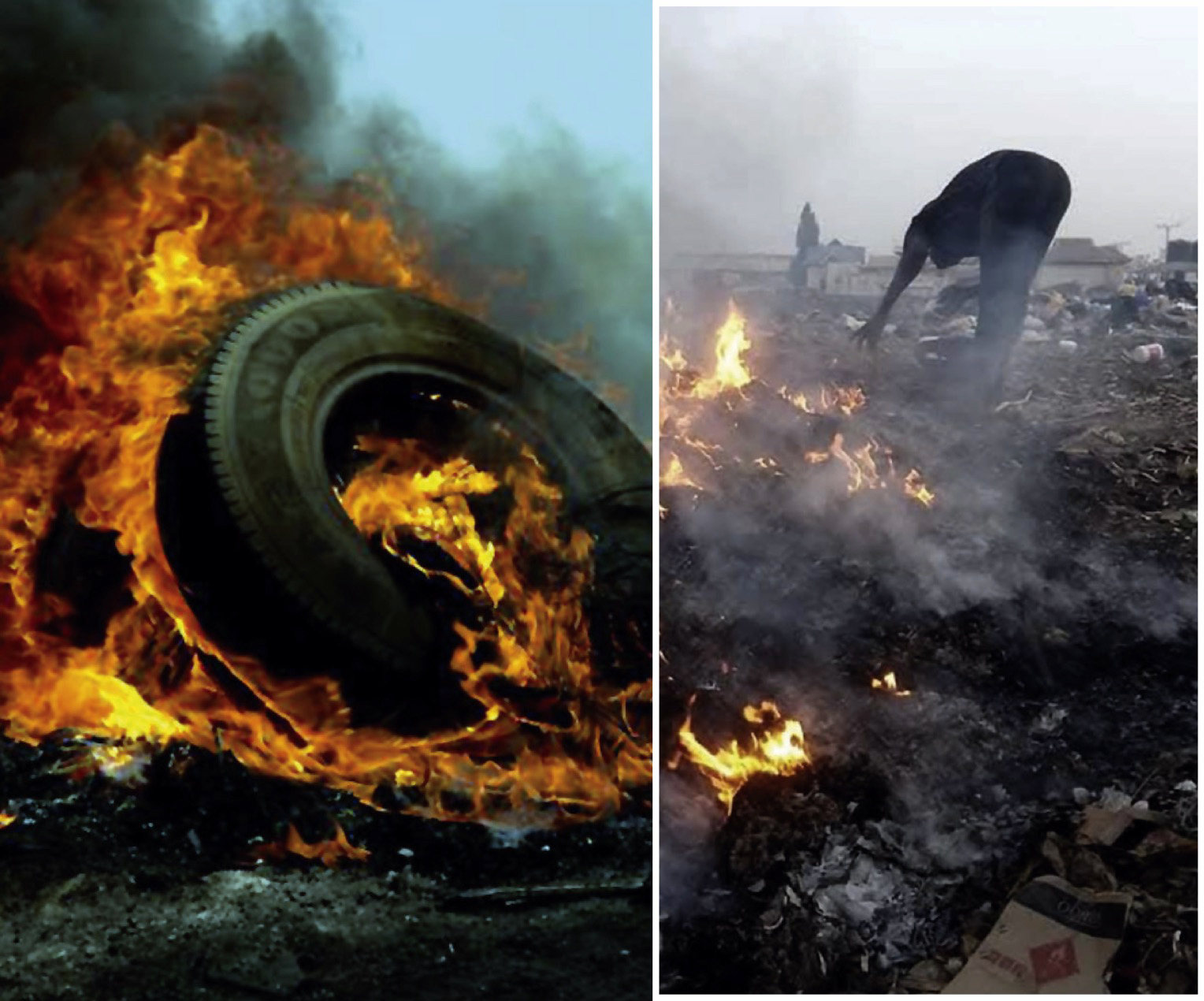
The thick black smoke rises steadily into the sky from a makeshift dumping ground in the outskirts of Kaduna. Around the smouldering heap of burning tyres, a group of children and young men watch patiently as flames consume the rubber, exposing the steel wires hidden inside.
For many of them, the exercise is not merely a routine activity but a means of survival. The extracted metal cables are sold to scrap dealers and market vendors for a few hundred naira, providing income in difficult economic times.
But environmental experts are sounding the alarm, warning that the growing practice is exposing participants and surrounding communities to dangerous pollutants with potentially devastating long-term consequences.

Investigations by Daily Sun reveal that the burning of discarded tyres to recover steel wires has become increasingly common in several communities across Kaduna State and other parts of Northern Nigeria, particularly around informal waste disposal sites.
While the youths involved see it as a source of livelihood, scientists and environmental advocates say the hidden costs to public health and the environment are enormous.
Speaking on the development, a science and environmental lecturer at the African Institute of Waste Management and Environmental Studies, Ibrahima Yakubu, described the practice as a serious public health threat.
“The burning of waste tyres releases a complex mixture of toxic pollutants into the atmosphere,” Yakubu said.
“Many of these young people are unaware of the danger they are exposing themselves to. The smoke contains hazardous substances and fine particulate matter that can penetrate deep into the lungs and cause serious health complications.”
According to him, vulnerable groups such as children, infants, pregnant women, asthmatics, the elderly and people with weakened immune systems are particularly at risk.
“Exposure to these pollutants can aggravate asthma, trigger respiratory infections and increase the risk of cardiovascular diseases,” he explained.
“Over time, continuous inhalation of tyre smoke may contribute to chronic respiratory illnesses and other severe health conditions.”
At one of the sites visited by Daily Sun, several young men were seen tending burning tyres while waiting for the steel cords to emerge from the charred remains.
One of them, who identified himself simply as Abdul, admitted that he had never considered the health implications of the activity.
He said: “We burn the tyres because that is how we make money. After removing the wires, we sell them to buyers in the market. Some women also buy the wires and use them during cooking. Honestly, I did not know the smoke could be dangerous to our health.”
After being informed about the environmental and health consequences, he expressed regret.
“If it is harmful to people and the environment, I will stop doing it. I don’t want to contribute to pollution or put my health at risk,” he said.
Another youth, Musa, said the business had become an important source of income for many unemployed young people.
“There are not many opportunities available,” he said. “Sometimes, this is the only way we can earn money to support ourselves and our families.”
However, environmental experts insist that economic hardship cannot justify practices that endanger public health.
Yakubu noted that tyres are never designed to be burned because of the toxic substances used in their manufacture.
“Tyres contain extender oils derived from benzene, styrene and 1,3-butadiene, which are chemicals associated with serious health risks, including suspected carcinogenic effects.
“When these materials are burned, they release harmful toxins into the environment. Some of these pollutants attach themselves to fine particulate matter that can travel deep into the respiratory system,” he explained.
He added that residual metallic components and other contaminants from tyre combustion can also pollute surrounding soil and water sources.
Beyond the activities of scrap wire scavengers, the practice of burning tyres has also found its way into some slaughter facilities.
Daily Sun observed that in several abattoirs across Kaduna State, tyres are frequently used by butchers to roast animal hides and carcasses, including goats, cows and rams.
The process often produces thick clouds of acrid smoke and offensive odours that spread through nearby communities.
Environmental authorities have repeatedly warned against the practice, citing serious risks to consumers.
According to officials, toxic chemicals released during tyre combustion can contaminate meat and animal hides intended for human consumption.
At this year’s World Environment Day, experts urge Nigerians to embrace environmentally responsible practices.
“Let us plant and nurture trees, protect our forests and waterways, and support policies that safeguard our environment and livelihoods,” they said.
Kaduna State Commissioner for Environment and Natural Resources, Dr. Abubakar Buba, said environmental sustainability remains a key priority of governor Uba Sani administration.
He observed that Kaduna State continues to grapple with climate-related challenges, including flooding, land degradation, plastic pollution, climate variability and heat-related health risks, all of which have implications for economic growth and public well-being.
Buba said the state government has responded through climate policy development, afforestation programmes, environmental safeguards, climate-smart agriculture and renewable energy initiatives, while calling for stronger institutional collaboration, increased financing and greater community participation in environmental governance.
“Environmental sustainability is not a sectoral issue; it is a national priority that underpins economic resilience and social stability,” he said.
The Kaduna State Ministry of Environment and the Kaduna Environmental Protection Authority (KEPA) classify the open burning of tyres as an environmental and public health offence.
The agencies have consistently carried out awareness campaigns aimed at discouraging the practice among butchers, waste handlers and the general public.
Environmental officials warn that tyre smoke contains dangerous substances including heavy metals such as zinc and lead, dioxins and other cancer-causing compounds.
“The smoke generated from burning tyres severely degrades air quality and poses a direct threat to human health,” an environmental officer familiar with the ministry’s campaigns said.
“People exposed to the smoke may suffer respiratory infections, asthma attacks and other long-term health complications.”
Authorities have also expressed concern over the practice of burning tyres directly on roads.
According to the ministry, such activities damage asphalt surfaces, weaken road structures and accelerate the formation of potholes, thereby increasing maintenance costs for government.
Yakubu urged stakeholders at all levels to intensify public enlightenment campaigns and provide alternative livelihood opportunities for vulnerable youths.
He said: “We need sustained awareness programmes in communities so that people understand the dangers involved.
“Government agencies, traditional institutions, religious leaders, civil society organisations and the media all have important roles to play.
“Parents must pay attention to where their children go and the activities they engage in,” he said.
“Many young people become involved in tyre burning without fully understanding the consequences.”
As economic pressures continue to push more young Nigerians towards informal means of survival, environmental advocates say urgent intervention is needed to prevent a practice driven by poverty from evolving into a wider public health crisis.
For now, the black smoke continues to rise from dumpsites and abattoirs across parts of Kaduna, carrying with it not only the promise of quick income for a few, but also an invisible cloud of danger for entire communities.