Follow Us on Google
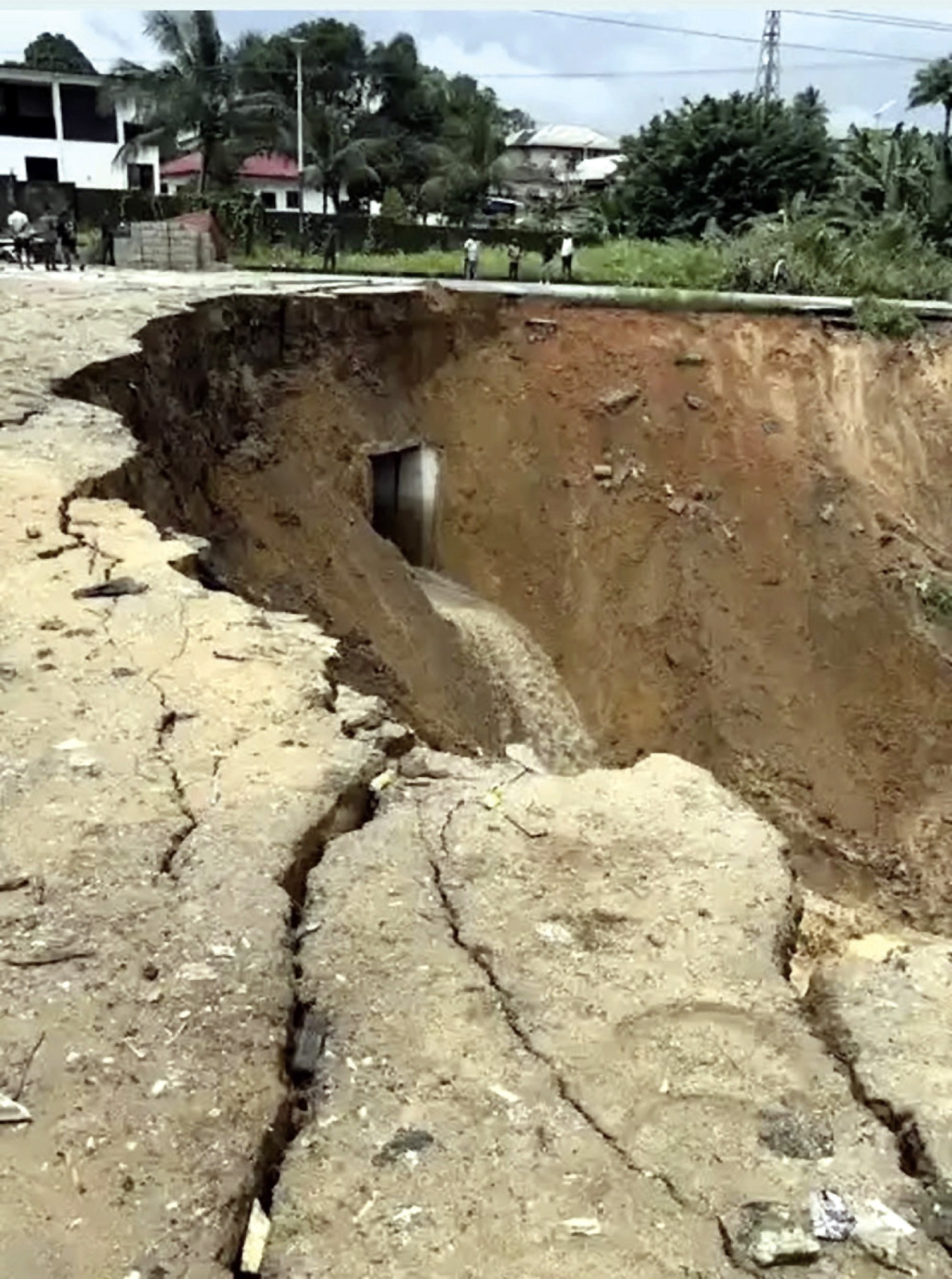
How the brutal July deluge swallowed eight persons, triggered landslides and shattered homes in Cross River
From Aniekan Aniekan, Calabar
Mrs. Mercy Edu painted a pathetic picture. She was so disoriented, looking vacantly into space.
Indeed, her world had crumbled and will never be the same again. Never again.
She was in a state of profound grief, having lost four children during a landslide at Ikot Awatim, in Calabar Municipality in July. In pain and tears, she narrated: “It rained for days without stopping. That led to the death of my children, one female and three males.
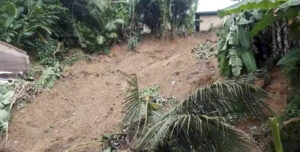
“It is a very painful situation. You can imagine sleeping in your mother’s house to rest and relax, and then another house collapses and hits your building.
“The rain was too much. The ground became soft, and the hill could not hold any more. Our house was at the foot of the hill. When the landslide came, it pushed the wall down. The building did not have a strong foundation to withstand that kind of water.

“I watched everything I loved, cherished and treasured disappear within the blink of an eye. It is very painful. To think they went home to rest and a building from the hill came down on them is heartbreaking.”
Mrs. Edu’s children were identified as Bright, 18, Godswill, 12, Daniel, 11, and 10-year-old Richard.

Indeed, July will be remembered in Calabar, the capital of Cross River State, as the month the rains turned deadly. And it exposed decades of drainage failure, poor urban planning and climate vulnerability.
At least eight residents have been confirmed dead, three major landslides recorded and properties worth millions of naira destroyed across Calabar metropolis following intermittent torrential rainfall lasting the whole month.
It was the same story in Satellite Town, Etta Agbor, Anansa Road, Webber Street and parts of Ikot Effanga Mkpa, where entire homes were swallowed by the earth, roads were cut off and were families displaced as floodwaters and mudslides ravaged communities in Calabar.
Government officials, emergency responders and residents say the scale of destruction in July surpasses any recorded in recent years, raising fresh concerns about drainage, urban planning and climate impact in the Canaan City, as it is also called.
The rain kicked off in the first week of July 2026 and poured consistently day and night over the next two weeks.
Besides Mrs. Edu’s children, the Ikot Awatim tragedy also claimed the life of one Mr. Udo, a driver.
The second major landslide occured in Borrow Pit Community in Satellite Town, also in Calabar Municipality, where a nine-year-old boy lost his life. Recounting the incident, Mr. Namson Effiong, father of the victim, described it as the worst day of his life as the landslide not only killed his only child but swallowed everything he owned.
The devastated father said he lost his only child and all his belongings in the landslide, and had to borrow the clothes he wore to receive a visiting government delegation.
He said: “The landslide claimed my only child and destroyed virtually all my belongings, leaving me with nothing.
“I had to borrow clothes to receive the delegation and this is the darkest moment of my life.”
A third landslide occurred at Anansa Road, Diamond Hill near the Calabar Jetty. The disaster destroyed a major road and properties but claimed no life.
Flood victims in Webber, Calabar South local government area of the state are counting losses running into millions of naira after flash floods submerged homes, destroyed properties and claimed two lives. The July downpour overwhelmed the Calabar drainage channel and left several families displaced in that area alone.
Etim Bassey Edet, an indigene of Nkakad Ikot Ekriba, who resides on Atamunu Road, said he had to carry his five-year-old child on his shoulders to prevent them from drowning.
He said: “At 3am on that Thursday, water got into my house and destroyed every household item. Chairs, a flat-screen television, beds, a fridge, and even my clothes were destroyed.
“The water got to my neck and I carried my five-year-old child on my shoulders. If the water got to my neck, you can imagine what would have happened to a five-year-old child.”
Etim estimated that he lost household items worth over N5 million.
Another resident, Oscar Daniel, said the flood destroyed vital appliances and infrastructure.
“All our appliances are damaged, and over 30 families were affected within this vicinity alone. Over N20 million worth of items have been damaged in this place alone,” Daniel said.
He called for urgent government intervention, including the construction of underground drainage and the covering of the entire stretch of the Calabar channel to check overflow of flood water.
“The water level has risen significantly, and if measures are not taken immediately, this is what we will be experiencing often, and more damages will occur,” he warned.
The heavy rains also ripped open parts of the canal along Mayne Avenue. Beyond property damage, two lives were lost where the floodwater overflowed the channel.
The downpour intensified within the month across the city and wrecked several communities, with properties worth millions of naira destroyed. The rainfall unleashed floods in several parts of the city, including 8 Miles, MCC Road, Atimbo, Goodluck Johnathan Bypass and Arab community all in Calabar.
The downpour caught residents unprepared, forcing many to flee their homes while struggling to rescue their children and salvage valuables from the rapidly rising floodwaters.
One of the worst affected places was Arab Community in the outskirts of Calabar. The chairman of the eommunity, Ntufam Alphonsus, sympathised with affected residents and lamented the recurring flooding in the area. He said the present flooding affected at least 100 houses.
Ntufam, a retired civil servant, said: “We sympathise with families who have lost their properties today because of the heavy rainfall, which has destroyed properties worth an estimated N27 million.
“The community leadership has done everything within its power to engage the government to intervene in Arab community, but nothing has been done.
“Unfortunately, year after year, we continue to live at the mercy of floodwaters without government’s assistance that could have helped mitigate this disaster.”
Richard Fomba, a victim in the community, explained that the rainfall initially appeared harmless but quickly turned destructive.
He listed items destroyed in his house to include furniture, sound systems, books, certificates, clothing, kitchen utensils, air conditioners and electric fans, among other valuables.
Residents have appealed to the Cross River State Government to urgently construct proper drainage channels and implement permanent flood control measures to prevent future disasters.
In addition to destroying properties, several public infrastructure were also impacted as part of the Calabar drainage channel caved in and exposed communities along its path to severe flooding. Parts of the Ibesikpo Road where a drainage also runs through split into two thus preventing movement of vehicles along the axis.
At Elijah Henshaw Street, panic gripped residents following the discovery of a decomposing body floating in the flooded water channel. The body was eventually wedged against a large stone, drawing crowds of onlookers who kept a terrified distance, fearful of triggering a police investigation.
Governor Bassey Otu visited victims of the flood disaster in Calabar, describing the scale of destruction and loss of lives as heartbreaking, while assuring residents of government’s intervention to mitigate future occurrences.
The governor, who toured some of the worst hit communities in the Calabar metropolis, stated that his heart was “deeply burdened by the magnitude of the devastation and the tragic loss of lives.
“I visited victims of the recent flood disaster in Calabar, and my heart was deeply burdened by the magnitude of the devastation and the tragic loss of lives.
“No words can truly compensate for the precious lives we have lost, and I extend my heartfelt condolences to every family affected by this unfortunate tragedy.”
Governor Otu assured residents that the state government remained committed to taking decisive steps to reduce the risk of future disasters besides strengthening flood mitigation and emergency response systems in the state.
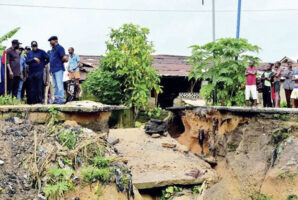
Deputy Governor of the state, Peter Odey, also inspected the site of the landslide at Diamond Hill, near the Calabar Jetty, as a grim reminder of the state’s environmental vulnerability. He said the magnitude of the destruction has surpassed the state’s capacity and requires immediate deployment of federal technical expertise and ecological resources.
He directed the commissioner for works to mobilise immediately because the government cannot afford to delay in responding to a disaster of this magnitude, saying priority is to secure the area, prevent further destruction and protect lives and property.
Odey lamented that the Diamond Hill landslide was only one among several ecological disasters triggered by recent heavy rains across the state, assuring citizens that the Governor Bassey Otu-led administration was committed to responding promptly to every affected community.
Similarly, the Director General of the Cross River State Emergency Management Agency (CRSEMA), Efa Nyong, alongside officials of the National Emergency Management Agency (NEMA) conducted an assessment visit to the impacted communities within Calabar municipality.
NEMA’s Acting Head of Operations, Mr. Awoji Austin, said the assessment was to gather accurate reports for necessary action. He urged residents in disaster-prone areas to heed early warnings and evacuate unsafe buildings.
The team also assessed flood damage in Ekorinim 2, where more than five buildings were affected and over 15 households displaced after a blocked drainage channel forced water into homes.
At Federal Housing Estate and parts of Calabar South, including Goldie Street and Target Street, the team documented collapsed fences and flooding caused by blocked drains and waste disposal.
Executive Secretary of the Calabar Urban Development Authority, Chief Etim Ayi, warned against dumping refuse on the drainages to mitigate adverse consequences from the unrelenting rainfall. He also disclosed plans by the government to construct a new drainage to curb the effects of flooding in Calabar South, particularly along the flood ravaged areas of Idim Ita and Efut Efio Ene behind the Cross River University.
July has come and gone, leaving Calabar poorer, grieving, anxious, counting its dead, its losses, and its broken promises. Eight lives gone. Three communities swallowed. Millions in property washed away.
For Mrs. Edu, there will be no more bedtime stories for Bright, Godswill, Daniel and Richard. For Mr. Effiong, there is no home to return to in Borrow Pit. For hundreds in Webber, Arab Community and beyond, the next downpour brings fear, not relief.
The government has promised new drainage, stronger response, and “decisive steps.” The question now is not whether it will rain again in Calabar. It will. The question is whether the city will be ready when it does, or whether July 2026 will simply be the first chapter in a longer story of pain, destruction and deaths.