Follow Us on Google
By Beifoh Osewele
Most people seeking to understand a country begin with its economy. They pore over GDP figures, unemployment rates, inflation statistics and government policy documents. Others turn to political speeches, election manifestoes or newspaper headlines in search of answers.
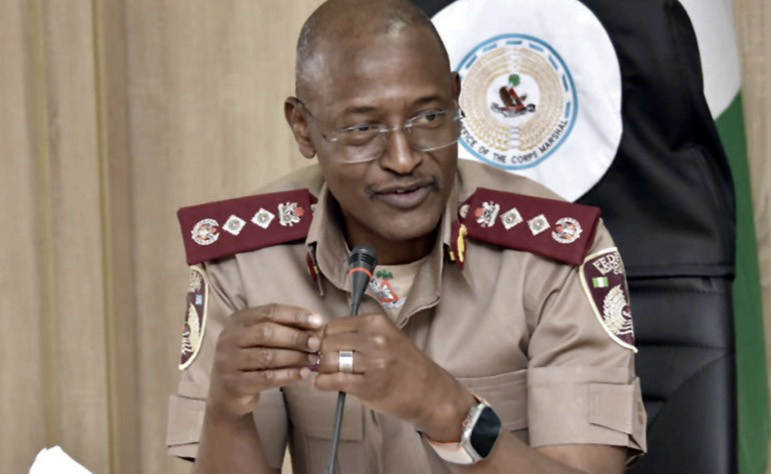
But Corps Marshal of the Federal Road Safety Corps (FRSC), Shehu Mohammed, has a different proposition. According to him, forget the statistics for a moment, watch the roads, observe how motorists behave at traffic lights, notice whether pedestrians are given the right of way at zebra crossings, pay attention to how commercial drivers treat speed limits and, perhaps, most revealing of all, watch how public officials conduct themselves when the traffic signal turns red.
For the Corps Marshal, the road is far more than a network of highways connecting cities and communities. It is a mirror reflecting the soul of a nation, its discipline, respect for the rule of law, the strength of its institutions and the values that shape everyday life.
“If you want to know the discipline and the rule of law of any country, just study the road traffic culture of that country. Anywhere you go, once you come out of the airport, observe what is happening on the road. You will know whether that country is doing well in terms of discipline and the rule of law.”
It is a profound observation, delivered almost casually, yet it forms the philosophical foundation of Mohammed’s approach to road safety and public administration.
Appointed Corps Marshal on May 20, 2024, Mohammed, a Fellow of the Institute of Chartered Accountants of Nigeria (ICAN), heads one of Nigeria’s most visible public institutions. Every day, the Federal Road Safety Corps confronts speeding motorists, overloaded vehicles, dangerous highways, inadequate infrastructure, poor driving habits and thousands of preventable crashes.
But Mohammed is convinced that road safety is only the visible layer of a much deeper national challenge.
For him, the country’s roads reveal far more than traffic patterns. They expose the consequences of poverty, the quality of education, the effectiveness of public institutions, the standard of leadership and the willingness of citizens to respect laws that exist for the common good.
Road safety, he insists, cannot be reduced to enforcement alone.
“Road safety is a shared responsibility. It’s not about just FRSC. Everybody is involved because when a crash occurs and death happens, it is not only FRSC personnel that are affected. It is the citizens of Nigeria.”
He believes that road crashes are rarely isolated incidents caused by careless drivers alone. More often, they are the visible consequences of deeper structural problems.
“In Europe and America, they have gone beyond socialisation and public education. They don’t need to educate motorists every day because literacy is high, people are enlightened and the quality of life is better. There, it is simply enforcement—obey the law or face sanctions.
“Here in Nigeria, we must continue to socialise. We must continue public education. FRSC has been doing that for over three decades.”
His comparison is not intended to glorify developed countries or diminish Nigeria. Rather, it highlights the relationship between education, economic well-being and public behaviour.
According to him, societies where citizens enjoy better living standards and higher levels of education naturally develop stronger compliance with traffic regulations. In contrast, countries battling poverty and illiteracy must invest continually in public enlightenment alongside enforcement.
Nowhere, he argues, illustrates this contradiction more sharply than Abuja. As Nigeria’s Federal Capital Territory, Abuja ought to represent the country’s highest standards of order, discipline and civic responsibility. Instead, Mohammed believes it often projects the opposite image.
“Abuja is supposed to be an elite society. Government has expanded roads almost everywhere. There are more traffic light points. But instead of the road traffic culture improving, it is getting worse.
“You see overspeeding. You see dangerous driving. You see people violating traffic lights. You see route violations. You see all kinds of anti-social driving culture.”
His disappointment is unmistakable.
“This is the capital where the image of Nigeria is supposed to be projected. Is this what we want visitors to see?”
For Mohammed, the condition of Abuja’s roads is not merely a traffic issue. It is a question of national identity.
If the capital city cannot model respect for the rule of law, what message does that send to the rest of the country?
His analysis extends even further.
Driving culture, he argues, is deeply influenced by socio-economic realities.
“Anywhere you see good or bad driving culture, two factors are at play: the economic condition and the quality of life.”
He points to overloaded vehicles travelling from parts of northern Nigeria as evidence.
“You see a vehicle meant for five passengers carrying fifteen. You see trucks conveying over one hundred passengers from Kano, Katsina, Jigawa or Zamfara to the South-West. You hardly see that in the South. That disparity reflects literacy levels, poverty and quality of life.”
To him, these are not simply traffic offences. They are symptoms of deeper national challenges.
The roads, once again, tell the story; they tell the story of inequality, inadequate transportation, poverty and ultimately tell the story of governance.
That is why Mohammed believes saving lives requires much more than deploying marshals to highways. It requires building institutions, educating citizens, improving public transport, embracing technology, strengthening enforcement and, above all, demonstrating leadership by example.
Since assuming office, Mohammed says his priority has been rebuilding public confidence in the Corps. “The objective is to save lives. That is the ultimate objective.”
His strategy rests on three pillars vis:
Operations, training and welfare.
“Operation is the bedrock. We must reform our operations in a way that builds public trust. When people see FRSC officers, they should say, ‘Yes, we trust these people.’ If you want to build trust, you must continue to train. Capacity building remains a priority. And you cannot expect personnel to perform when they are hungry, unpaid or have no motivation. Welfare is not optional.”
Across the country, officers are undergoing continuous professional development as part of what he describes as institutional sustainability.
“Whatever we build today should outlive us. Whoever succeeds me should inherit an institution that continues to grow.”
Other News
While many members of the public blame the FRSC whenever traffic laws are violated, Mohammed says few understand the enormous operational constraints under which the Corps functions. The figures are sobering.
“Nationwide, we have about 28,000 personnel. Ideally, we need between 40,000 and 50,000.
“In Abuja, we have less than 400 personnel. Yet the traffic light points alone are running into thousands. Even if we deploy everybody to traffic junctions, how many points can they cover?”
Road expansion, he notes, has not been matched by a corresponding increase in personnel or logistics. To illustrate his argument, he points to the strategic Airport Road linking the Abuja city centre with the Nnamdi Azikiwe International Airport.
“That entire stretch is covered by just one Unit Command, one ambulance point and a small outpost with only a few operational vehicles.”
For an agency expected to project Nigeria’s image to international visitors, he says, the resources simply do not match the responsibility.
Leaders must also obey
Mohammed becomes noticeably reflective when the conversation turns to public officials. He believes Nigerians take behavioural cues from those in authority. If leaders ignore traffic laws, ordinary citizens are unlikely to respect them.
“Anywhere I go, once the traffic light turns amber and then red, I stop. We cannot preach what we do not practise.”
Then comes one of the interview’s most pointed observations.
“How many heads of agencies stop at traffic lights? How many VIPs obey traffic regulations? Many say it is because of security. But if those at the top are not obeying the rules, why should those below obey?”
He insists that leadership by example remains one of the most effective forms of public enlightenment.
The Corps Marshal also speaks candidly about the dangers confronting FRSC personnel. Many Nigerians see officers standing on highways every day. Few appreciate the risks they face.
“Sometimes when our officers stop offenders, they are knocked down deliberately.
“Some sustain brain injuries. Some suffer multiple fractures. Some die.”
He reveals that the Corps spends enormous sums treating injured personnel.
“You can have hospital bills running into tens of millions of naira for one officer.”
There are even more disturbing cases.
“There have been occasions when officers from other security agencies assaulted our personnel while carrying out their lawful duties.”
Such experiences, he says, partly explain why the Corps is advocating the establishment of a specialised armed intervention squad—not for routine patrols, but to respond when officers come under attack.
“We are not saying every marshal should carry a firearm. What we are saying is that there should be a trained intervention squad available whenever our personnel are in danger.”
Technology as a game changers
Rather than relying solely on patrols, Mohammed has pushed a technology-driven approach to road safety.
Under his leadership, the Corps launched the FRSC Mobile App, enabling motorists to verify licences and vehicle documents, receive emergency alerts, report crashes and monitor traffic in real time.
His administration also established the National Road Traffic Crash Information System (NACRIS) to improve crash reporting and evidence-based policy decisions, while digitising several internal processes, including inventory management and electronic salary-slip distribution.
He believes digital innovation will strengthen transparency, improve service delivery and make the Corps more responsive.
From Zaria to Lagos
As the conversation momentarily drifts from official matters, Mohammed recalls arriving in Lagos as a young corps member in 1990.
It was his first journey far from home.
“I came to Lagos for my NYSC. That was the first time I left my village.”
The memory still makes him smile.
“When I arrived, I saw people everywhere. I had never seen that kind of crowd in my life. I was confused. It felt like another world.”
Returning home months later was equally unforgettable.
“When I got back to my village, it looked empty. I said to myself, ‘Oh, I have come from Lagos.’”
Then he laughs.
“Lagos doesn’t tell you ‘Welcome.’ Lagos simply tells you, ‘This is Lagos.’”
The humour briefly lightens a conversation dominated by serious national issues.