Follow Us on Google
From Noah Ebije, Kaduna
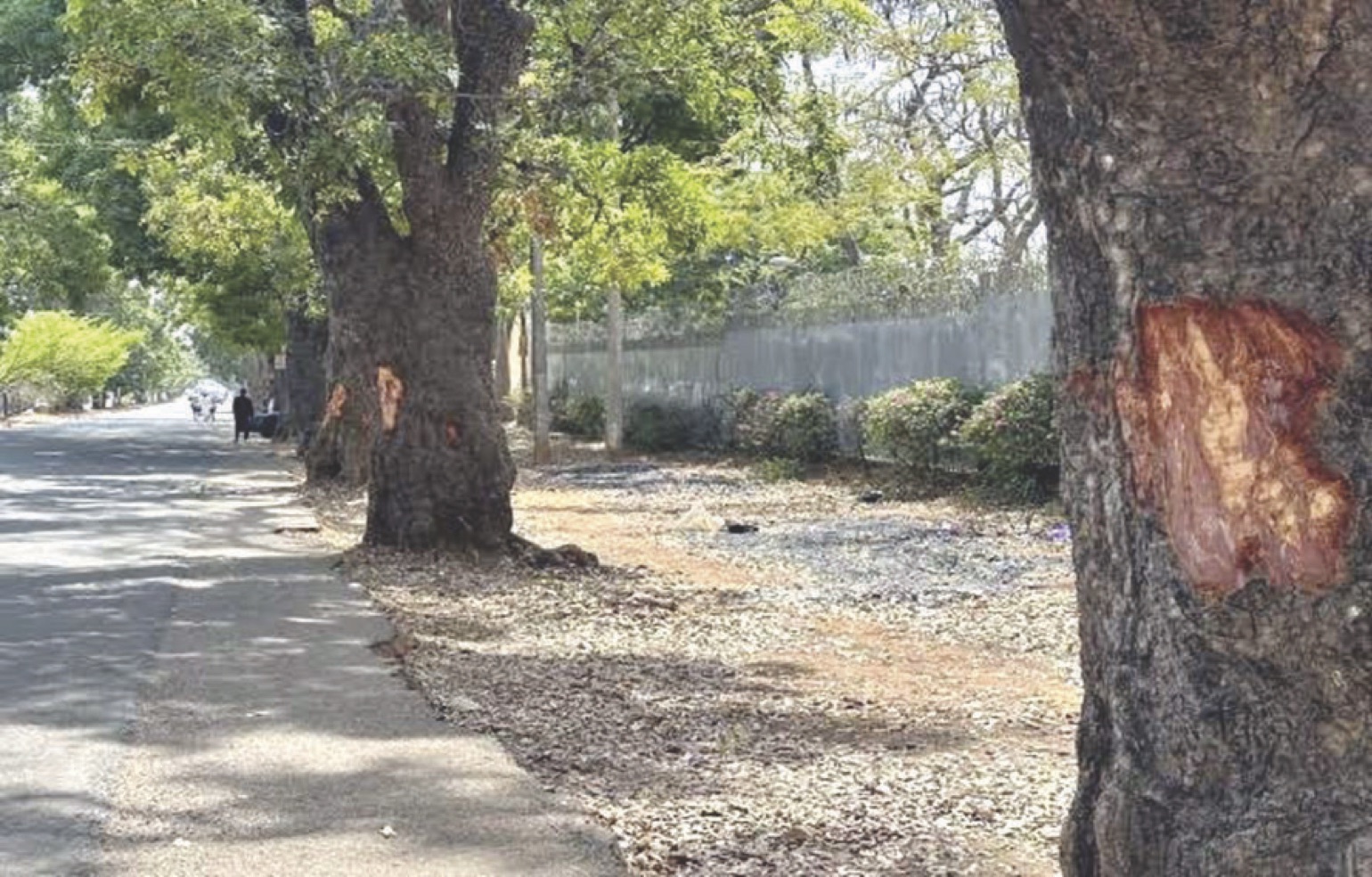
Every morning, commuters hurry past them. Lawmakers drive by. Birds still perch on their branches. Yet, up close, the mahogany trees lining Independence Way, near the Kaduna State House of Assembly, tell a troubling story, one written in scars within the city centre.

The barks of the mahogany trees are punctured, and large strips have been peeled away. Fresh wounds expose pale wood beneath what should be a thick, protective skin.
To Ibrahima Yakubu, an environmental crusader and long-time advocate against ecological degradation, these trees are not merely damaged, they are dying slowly due to human actions against them.

“These trees are historic,” Yakubu said, standing beneath one of the towering mahoganies. “They were here long before many of us were born. If this continues, future generations will only see them in photographs.”
Yakubu’s concern centres on an increasingly common practice: the punching and peeling of mahogany trees by local herbalists searching for medicinal substances. While the practice itself is not new, the scale and location of the damage is new.
According to Yakubu, insecurity across forested areas in Kaduna State has fundamentally changed how traditional medicine practitioners source their herbs.
“Because of banditry, kidnapping and fear of attacks, many herbalists can no longer go deep into the forests,” he explained. “So they have turned to roadside trees, even those in the city centre.”
A recent survey conducted by environmental volunteers revealed that nearly all the mahogany trees along Independence Way in Kaduna metropolis show signs of repeated extraction, raising fears that the trees may not survive the constant assault.
For Mallam Audu Aboki , a traditional herbalist, who has practised for over three decades, the accusation of environmental destruction feels incomplete without context.
“We did not choose this,” he said calmly. “Before, we went into the forest. That is where these trees belong. But today, who will risk his life there?”
Aboki explained that many forest reserves and bush paths once used by herbalists are now hotspots for criminal activity.
“People are kidnapped there. Some never return. Are we expected to die because we want medicine?” he asked.
Another herbalist, Mallam Sadiq Musa, echoed the same concern. He said the city’s trees have become the only option for survival.
“When a sick child is brought to me, I cannot tell the parents to wait until insecurity ends,” Musa said. “The forest is no longer safe. The trees in town are what we have.”
Both men insist that their intentions are not malicious. However, environmental experts warn that mahogany trees do not regenerate bark easily. Repeated peeling weakens them, exposes them to pests, and often leads to premature death.
Yakubu insists that the consequences go far beyond individual trees.
He said: “These mahoganies purify our air, reduce heat, protect road infrastructure and help fight climate change. Destroying them is like destroying a natural hospital.”
Other News
He also highlighted the ecological importance of the area around the Kaduna State House of Assembly, which he said serves as a temporary breeding and resting ground for migratory birds from different parts of the world.
“If the trees disappear, the birds will disappear. When that happens, we lose biodiversity we may never recover.”
“Before, this place felt cool and calm,” said Fatima Bello, a civil servant. “Now the trees look sick. It’s painful to watch.”
The situation presents a contradiction for Kaduna State, which has in recent times projected itself as environmentally-conscious.
The state government has reintroduced monthly sanitation exercises, expanded tree-planting campaigns and earned national recognition for its improved climate governance framework.
Officials have repeatedly stressed that environmental protection is critical to public health, flood control and sustainable development.
Hwever, there is currently no specific law protecting historic or roadside trees from exploitation.
Yakubu believes this is a dangerous gap. He said: “We need legislation. The Kaduna State House of Assembly must prohibit punching, peeling and cutting of these historic trees, especially in sensitive areas like Independence Way.”
He also called for public awareness campaigns, arguing that many residents are unaware that removing bark can eventually kill a tree.
Despite the calls for enforcement, Yakubu insists the solution should not criminalise herbalists alone.
“This is not about arresting people struggling to survive, it is about collaboration.”
He suggested government-supported herbal gardens, controlled harvesting zones, and alternative medicinal plant cultivation within safe areas; measures that could protect both livelihoods and the environment.
Even Mallam Aboki agreed that something must change. “If the government shows us another way, we will follow it. We respect nature. We only ask for safety and understanding.”
As traffic flows steadily along Independence Way, the wounded mahogany trees stand at a crossroads; symbols of a deeper crisis where insecurity, tradition, and environmental neglect collide.
For Yakubu, time is running out.
“These trees cannot speak for themselves. But if we keep ignoring them, their silence will be permanent.”
Whether Kaduna chooses protection over neglect may determine not only the fate of its historic mahoganies, but the kind of environmental legacy it leaves behind.