Follow Us on Google
• Traders wail, beg government to assist them directly
• We didn’t insure our shops, goods because we have no faith in insurance firms
By Henry Uche

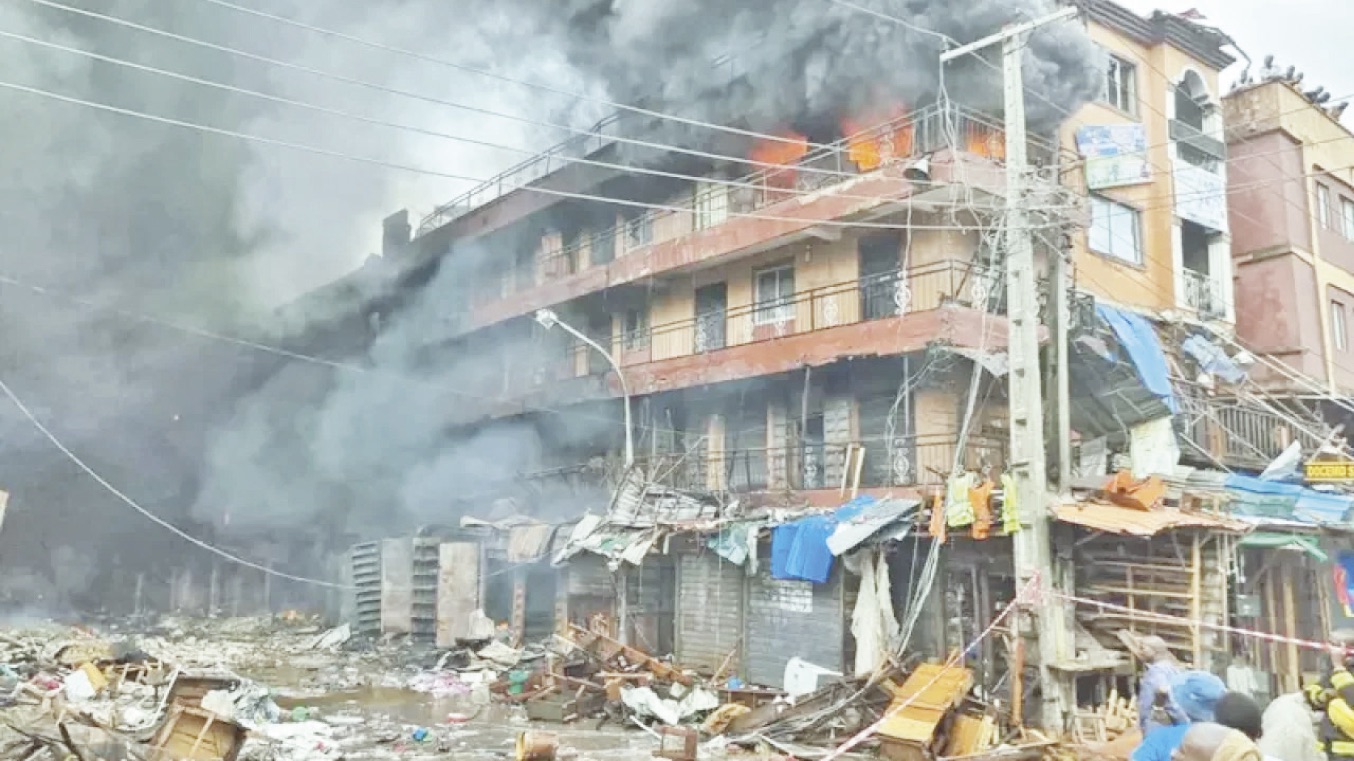
Victims of the inferno that razed several commercial buildings at the Dosunmu Market in Lagos Island last Tuesday, are heartbroken and counting their losses.
When Saturday Sun visited the scene of the fire incident, officials of Lagos State Fire Service, emergency management agency, and security personnel were on ground rendering services to salvage the situation.
In small groups, victims of the fire incident gathered lamenting and narrating their ordeal. They looked at what was left of their once thriving businesses with a deep sense of loss. One of the shop owners whose name could not be ascertained sat on the ground in tears wailing, as sympathizers gathered around her. She was said to have lost goods estimated at about N150 million.
Saturday Sun gathered that a three-storey building with 20 lock-up shops and three warehouses went up in flames at the market. No fewer than four structures collapsed while 14 buildings were significantly destroyed.
According to some traders, the fire was triggered by refuelling of a running power generating set by one of the traders, in one of the three-storey buildings, before it spread to adjoining buildings, causing a major havoc.
For some of the victims, their lifetime investment in the market went with the inferno. “I saved money to set up my business 30 years ago. The worth of my goods is about N87 million. Though I was able to evacuate some of my materials while the fire was raging, but a greater part was destroyed,” said Abiodun Azeez Alani, a trader who deals in decorative lightings and tailoring materials, at number 26, Dosunmu Street.
Also, Jonathan Umeh, who deals in textile materials, lost two shops to the inferno; bringing the business he started in 2004 to an abrupt end. From a small beginning, he grew the business to an estimated N100 million investment.
The story of Godwin Chukwudi Ubah, an importer of tailoring materials who has been in the business for about 25 years, is even more pathetic. He said he took a loan of N2 million from two Micro Finance Banks in November 2023. Six months down the line his shop and warehouse were destroyed by fire.
“I don’t know how to cope with my family. I’m confused. My labour for over 25 years just vanished in a twinkle of an eye. The fire started at Number 10 Dosunmu Street, while my shop is at Number 7, directly opposite my shop. I lost over N30 million worth of goods. I don’t know how to repay the loan I collected with this kind of terrible experience,” he lamented.
Lagos State governor, Mr Babajide Sanwo-Olu, during a visit to the site, ordered that the market be shut down for appropriate actions to be taken by the government. He also promised that the government will provide succour for the affected traders. But despite that promise, some of the traders appear not to have confidence in government promises.
The case of the traders is worsened by the fact that most of the businesses were not insured. The reasons range from their lack of confidence in insurance companies to unwillingness of insurance companies to insure their businesses due to environmental factors that pose a grave danger to the investments.
Preliminary investigation shows that the traders did not take precaution to safeguard their businesses. Umeh said that if every shop owner had a fire extinguisher, the situation wouldn’t have been as devastating. “I wish we all had fire extinguishers, the level of damage wouldn’t have been much. As for the state government, if they really want to help us, they should come to us directly rather than come through third parties so that the palliatives won’t be diverted.”
He revealed that an insurance company refused to insure some of the businesses against fire incidents because of the way the market was structured.
Similarly, Alani and Ubah did not insure their businesses against fire incidents. “We don’t believe in them. If you relate with insurance for a while, when such incidents happen, and you call them, they would start telling a different story. But if we see a reliable and trusted insurance company that would do what we agreed, then, why not,” Alani said.
Alani, who has nothing to fall back on except a small kiosk run by his wife, adjacent Balogun market, does not believe that the government would come to their rescue. He fears that “even if that happens, the people at the top of the market unions will hijack it. If they demolish any structure, the government and landlords should reconstruct them immediately; they shouldn’t keep us for an eternity before reconstructing the shops, and if the government truly wants to help us and ensure that any financial help gets to us, right in our hands they know what to do. We won’t teach them how to make the assistance transparent.”
In view of the fact that market fire outbreaks have become a regular occurrence, Ubah said: “I think I will pick insurance for my goods now because nobody knows tomorrow. But I believe the government can help us. To avoid diversion of aid from the government, every landlord knows their tenants, they can make it transparent if they want to help us” he stressed.