Follow Us on Google
By Steve Agbota
Players in the Nigerian maritime ecosystem are maintaining varied positions on the recently-launched national single window initiative.
While some clearing agents align with the concept that the project will streamline documentation and procedures for import, export and transit cargo, others disagree that the platform duplicates existing processes and contravenes provisions of the Nigeria Customs Service Act 2023.
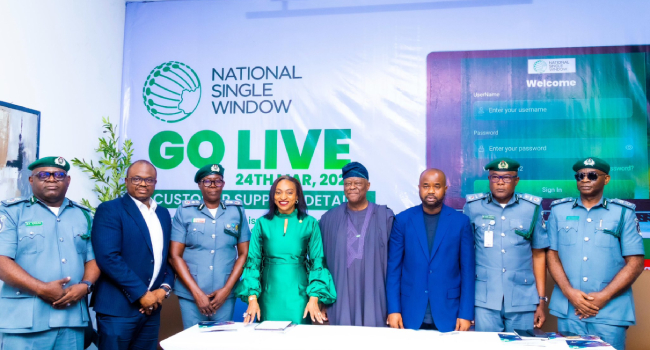
The system went live on Tuesday, when the Minister of Finance and Coordinating Minister of the Economy, Wale Edun and the Minister of Industry, Trade and Investment, Jumoke Oduwole officially unveiled the initiative in Lagos.
The ministers described the launch as a major milestone under the economic reform of the government.
Those frowning against the new platform insist it duplicates existing processes and contravenes the provisions of the Nigeria Customs Service Act 2023.
For the National Association of Government Approved Freight Forwarders (NAGAFF), the NSW project is not a duplication of functions but rather a harmonisation of trade processes anchored in law and international conventions.
Their position seems to counter that of the National Council Of Managing Directors Of Licensed Customers Agents (NCMDLCA) that is calling for the suspension of the programme.
A petition titled, “Duplication of Single Window application in Nigeria Customs Service Act No. 35 of 2023 and the Tax Administration Act No. 5 of 2025 as an impediment and obstacle to the clearance of goods from Nigerian ports,” signed by NCMDLCA’s National President, Lucky Amiwero and addressed to President Bola Tinubu, urged the federal government to suspend the implementation of the initiative.
The NCMDLCA maintained that the NSW was introduced with multiple charges that could increase the cost of clearing goods at Nigerian ports.
Amiwero said the initiative was already overburdened with charges imposed by various government agencies on importers and licensed customs agents, thereby making Nigerian ports among the most expensive in the world.
He argued that the NSW portal conflicts with existing legal frameworks guiding Customs and tax administration.
“The National Single Window portal has no relation with the Nigeria Tax Administration Act, which is meant strictly for tax matters.
Other News
“It usurps, duplicates and contravenes several provisions of the Nigeria Customs Service Act 35 of 2023. It also runs contrary to international best practices and domestic frameworks on trade facilitation,” the petition stated.
Before now, a maritime expert and Chief Consultant at Global Transport Policy, Dr. Segun Musa, described the NSW as a shell to house agencies, adding that Nigerians should not expect the project to transform cargo clearance.
He said that unless the agencies under the NSW are properly equipped with infrastructure, the initiative will fail to deliver meaningful change.
“Bringing agencies together under NSW is not the solution. Interactions may be faster, but without the necessary infrastructure, the effort will be frustrated. There has been a lot of noise that Single Window will change the dynamics; it cannot change anything.
“There is so much noise about the single window. Situation reports as of today are that it is just an ordinary shell. What will drive it is the components inside. “What are those components? They are the agencies that are warehoused. The shell will only warehouse the agencies to have first-hand information and interactions,” Musa said.
In his comments, the secretary general of NAGAFF, Godfrey Nwosu, said the Single Window initiative would not only facilitate trade but also attract foreign direct investment (FDI) into the country.
According to him, the platform is designed to simplify port processes and reduce cargo diversion to neighbouring countries.
“It is a tool to promote trade facilitation, attract foreign direct investment and reduce the diversion of cargo to neighbouring countries,” Nwosu said.
He described the Single Window project as a forward-looking reform designed to eliminate duplicative procedures across multiple government agencies operating at ports.
The association also cautioned against actions that could slow reforms aimed at improving maritime sector efficiency.
“The freight forwarding industry must move forward with reforms that promote efficiency, transparency and competitiveness. NAGAFF stands firmly in support of the NSW project and urges all stakeholders to embrace it for the greater good of Nigeria’s economy,” Nwosu said.
He further urged stakeholders to allow the first phase of the project to run its course before commenting on its effectiveness.
Nwosu added that the initiative would enhance transparency in port operations, lower the cost of doing business, improve Nigeria’s competitiveness in global trade, and align the country with international best practices under the World Trade Organisation (WTO) Trade Facilitation Agreement.