Follow Us on Google
•Hails Cardoso’s monetary policy framework
By Uche Usim
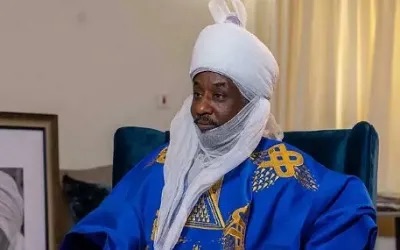
Former Central Bank of Nigeria (CBN) Governor and Emir of Kano, Sanusi Lamido Sanusi, on Tuesday, flayed Nigeria’s economic management strategy which delayed fuel subsidy removal, linking it to the lingering economic hardship pummelling vulnerable Nigerians.
Speaking at the Oxford Global Think Tank Leadership Conference in Abuja, he said fuel subsidy was economically cancerous and should be been scrapped more than a decade ago. Sanusi described the fuel subsidy not as a social welfare policy but as a “dangerous financial trap” that crippled government finances and plunged the nation into avoidable debt.
“What we called a subsidy was not really a subsidy. The government told 200 million Nigerians they would not pay more than a fixed amount per litre, no matter what happened to oil prices or exchange rates. When oil went from $40 to $140, the government paid the difference. When the naira depreciated from N155 to N300, the government paid the difference”, he explained.
He continued: “That was not a subsidy; it was the worst form of derivative, an open-ended hedge.”
Sanusi, who led the apex bank between 2009 and 2014, said the policy had effectively bankrupted the country.
“At some point, we were borrowing money not just to pay subsidies, but to service the interest on the loans taken to pay those subsidies. That was bankruptcy by policy,” he stated.
Other News
The former CBN governor recalled warning the government as early as 2012 that delaying the removal of fuel subsidies would lead to far worse inflationary pressures in the future. “If we had removed it then, inflation would have risen slightly from 11 to about 13 per cent and stabilised. Now, we are facing inflation above 30 per cent. This is the cost of delay,” he lamented.
Sanusi said Nigeria’s persistent fiscal instability stemmed from a misunderstanding of economic management, where short-term politics continually undermined sound financial policy. “Many Nigerians think the central bank or the Ministry of Finance can simply create prosperity. They cannot. “Their job is to provide stability and predictability, the foundation upon which private investment and economic growth can occur”, he stated.
Turning to the current CBN leadership, Sanusi praised Governor Olayemi Cardoso for what he described as a “return to professionalism and monetary discipline.”
“The central bank’s role is not to create growth or employment but to provide stability and an environment conducive to growth, and I believe the current leadership has made progress in that regard,” he said.
He applauded recent CBN reforms targeting exchange rate stability, inflation control, and renewed investor confidence, calling them essential to correcting Nigeria’s long-standing economic distortions.
Sanusi also urged closer collaboration between fiscal and monetary authorities, warning that policy inconsistency and weak accountability could undo ongoing reforms. “Without fiscal discipline and long-term planning, we risk repeating the same mistakes that brought us here,” he warned.
The Emir’s remarks highlighted a chilling reality, that Nigeria’s present economic pain, marked by surging inflation and currency weakness, is the inevitable outcome of years of political indecision and economic short-termism.