Follow Us on Google
From Fred Ezeh, Abuja
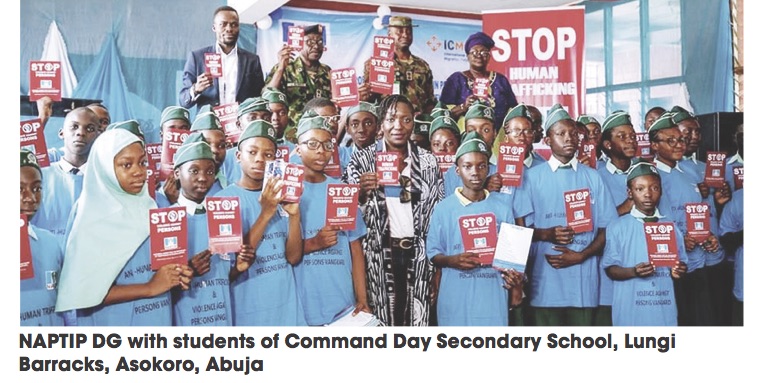
Few weeks ago, the National Agency for the Prohibition of Trafficking in Persons (NAPTIP) took the campaign against human trafficking to Command Day Secondary School, Lungi Barracks, Asokoro, Abuja, to herald the commencement of the nationwide “invasion” of military schools with messages against human trafficking.
At the meeting held in the main auditorium of the school, top management staff of NAPTIP, led by the director-general, Prof. Fatima Waziri-Azi, and the management of the school and military provided a cozy atmosphere for the students to freely speak, ask questions and get answers, and also speak on their experiences and fears.
Some of the questions that came from the students, according to NAPTIP, were funny, educative and expository. Nevertheless, NAPTIP officials were extremely happy to entertain the questions with clear and simple answers, and in some cases true-life stories were shared to buttress points.
Also, officials of NAPTIP from different departments, particularly public enlightenment, were conspicuous with pictorial and video materials, as well as presentations to expose the students to the dangers and new tricks of human traffickers.
In her address, Waziri-Azi shared many scary stories of young people that have fallen victim of human trafficking due to ignorance or quest for “quick and unclean” wealth.
She said that human trafficking used to be a discussion for mature minds, and was never mentioned in the midst of teenagers and children because they were never the target of the cartels involved in this crime against humanity, but things have changed drastically with increased Internet penetration.
She confirmed that human traffickers have invaded the digital space using different tricks and opportunities to, perhaps, woo their targets, most of whom tend to display some level of greed and desire for quick riches before the act.
The NAPTIP boss said the agency had entered into partnership with the military authorities in order to carry out massive sensitization of students as well as teachers in its schools across the country on the growing activities of human traffickers and other similar crimes like extortion, particularly in the digital space.
She confirmed that sensitization vanguards have been established in 80 out of 104 federal government colleges across the country to enable easy approach and connection with the students so they can freely learn and strengthen the campaign against human trafficking.
She further explained that the engagements with school authorities became necessary following increasing target of younger persons of school age by human traffickers, hence the need to acquaint the students with necessary knowledge, toolkits and changing tricks of the human traffickers, which often include abductions.
She encouraged the students to be vigilant, inquisitive in all offers and also disregard unverified job offers, scholarships, and several other “unrealistic” opportunities being marketed on different social media platforms, describing them as tricks by the human traffickers to lure their targets.
The NAPTIP boss highlighted the dangers of unlimited exposure to social media platforms, which the traffickers often leverage to recruit their victims with unrealistic promises.
She encouraged the students to always be smart and engage their discerning spirit when interacting with known and unknown persons on different social media platforms, and also report suspicious actions to NAPTIP for proper investigation and action.
She further explained: “I don’t mean that you shouldn’t engage in social media activities or aspire for opportunities abroad, but remember that there’s no free lunch anywhere. If the lunch is free, then you are the product. You have to be careful whenever you are online. Be cautious and have limit to the level of information or interaction you engage on in the social media.
“Many people, particularly young people of school age, have fallen victims because of ignorance or greed. That shouldn’t happen to you because you have access of quality and timely information that victims of human trafficking never had.
“Please note that victims of human trafficking are not always poor people as many people believe. People of good and strong financial background fall victim too due to ignorance. You must also know that close family members can initiate or facilitate your being trafficked. So, be careful and report any suspicious actions to your parents and NAPTIP if possible.”
NAPTIP’s director of public enlightenment, Mr. Josiah Emereole, in his presentations, used simple terms to define and explain human trafficking, and also exposed the students to the tricks being used by human traffickers to lure and recruit their victims, particularly online.
He urged the students to always be vigilant and alert regarding activities of suspicious persons online, and never hesitate to report any suspicious actions or interactions online or offline.
He narrated several stories with pictures of students of their age that have fallen victim of trafficking, thus encouraging the students to be careful and get acquainted with the sensitization activities of their school’s anti-human trafficking vanguard club for more information on the changing tricks of the human traffickers.
Head of region, International Centre for Migration Policy Development (ICMPD), West Africa, Dr. Mojisola Sodeinde, in her remarks, described the initiative in countering trafficking in human beings from the grassroots as laudable.
Sodeinde, who was represented by Adeniyi Bakare, said the initiative was particularly important for ICMPD because it addresses all of the key dimensions that anti-trafficking programme has been tirelessly working on during the last two decades.
Meanwhile, the Chief of Army Staff, Lt. Gen. Faruk Yahaya, who was represented by U.A. Mammadi, appreciated NAPTIP for the advocacy and sensitization, with assurance that the school will continue the sensitization so the students can be well informed and avoid anything that would expose them to human traffickers.
Members of the school anti-human trafficking club, however, used drama, music and other art work to pass messages against human trafficking, encouraging fellow students to be careful and report any suspicious actions to the club for more action.