Follow Us on Google
By Steve Agbota
The Nigeria Customs Service (NCS) has concluded plans to fully automate its overtime cargo clearance system in Zone A, a move aimed at curbing corruption, reducing port congestion, and ensuring greater transparency in cargo management.
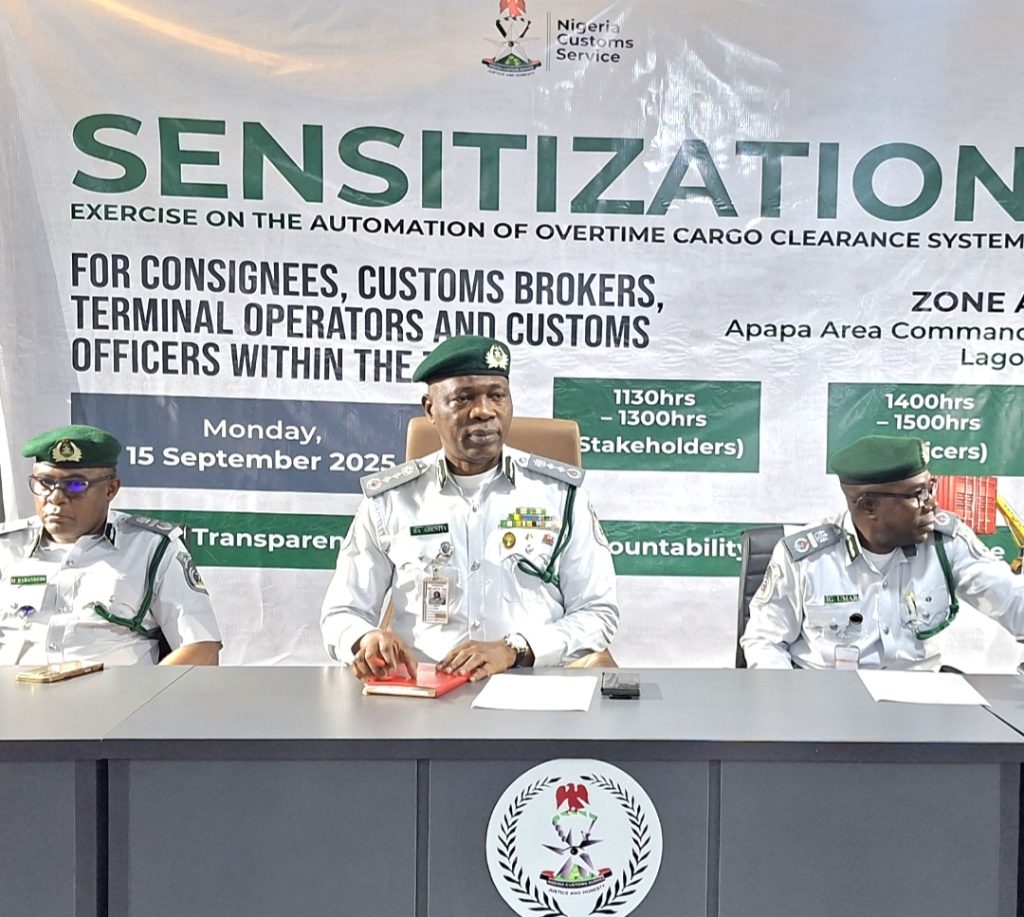
Speaking during a sensitisation exercise with stakeholders in Lagos on Monday, the Comptroller-General of Customs (CGC), Adewale Adeniyi, described the measure as a bold step to end decades of inefficiencies in managing overtime cargo, some of which have remained unresolved for as long as 15 years.
According to him, more than half of the complaints his office receives daily are linked to challenges in overtime cargo management, saying that the automation initiative is not a revenue drive but a trade facilitation tool.
“In 2024, our revenue profile rose to ₦6.3 trillion, yet less than one per cent came from the sale of overtime cargo. Our objective is not about revenue but about transparency, efficiency, and supporting economic growth,” he said.
He stressed that the Service is more interested in getting cargoes quickly to importers, manufacturers, and government agencies than keeping them in ports under overtime status.
He revealed that special desks have been established at Customs headquarters and across commands to prioritise critical government projects, organised private sector imports, and diplomatic consignments.
“These imports are vital to power, roads, health, and education projects. We would not want them to stay longer in our ports because that would affect national development,” he said.
Other News
Adeniyi further assured stakeholders that the new system has been designed to block loopholes and minimise human interference, thereby tackling corruption and shutting out criminal elements that attempt to exploit the process.
Also speaking at the sensitisation, the Assistant Comptroller-General in charge of Headquarters (ACG HQTRS), Idaho Umar, described the automation initiative as part of the Service’s transformation into a modern, globally aligned organisation.
He explained that the end-to-end digital clearance system will simplify procedures, enhance data integrity, reduce human interaction, and ultimately restore public confidence in the management of overtime cargo.
“The automation of overtime cargo clearance will achieve transparency of process, eliminate duplication, streamline documentation, and prevent indiscriminate disposal of goods. It will also ease congestion in ports, terminals, and warehouses,” the DCG said.
He added that the exercise reflects the Service’s commitment to innovation, collaboration, and continuous improvement in line with the Nigeria Customs Service Act of 2023.
Stakeholders at the session were assured that the platform will be continuously monitored and refined through consultations with terminal operators, shipping companies, customs brokers, and other industry players.
The Customs leadership emphasised that while revenue remains important, the overarching goal is to facilitate trade, reduce costs for importers, and make Nigeria’s ports more competitive.