Follow Us on Google
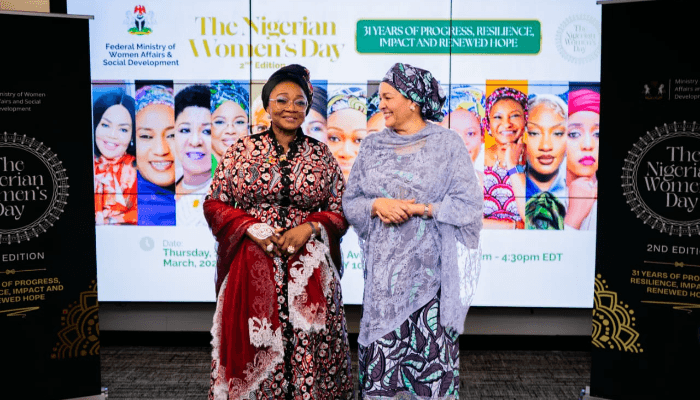
Nigeria took centre stage at the global conversation on gender equality as top international leaders gathered in New York for the second edition of Nigerian Women’s Day, held on the sidelines of the 70th Session of the United Nations Commission on the Status of Women (CSW70).
Convened by the Federal Ministry of Women Affairs and Social Development under the leadership of Minister Imaan Sulaiman‑Ibrahim, the event brought together policymakers, diplomats, civil society leaders and members of the Nigerian diaspora for a day of dialogue, cultural expression and policy engagement.
Among the high-profile participants was the Deputy Secretary-General of the United Nations, Amina J. Mohammed, alongside ministers, development partners, entrepreneurs and gender advocates.
The gathering, themed “31 Years of Progress, Resilience, Impact and Renewed Hope,” highlighted Nigeria’s efforts to advance gender equality globally while reinforcing the administration of Bola Ahmed Tinubu on women’s empowerment, family resilience and inclusive development.
Chair of the Board of Directors of Women Radio WFM 91.7, Toun Okewale Sonaiya, set the tone for the event with a welcome address that framed the day’s discussions around women’s leadership, innovation and cross-border collaboration.
Participants were also treated to a specially commissioned opening film that showcased stories of women’s leadership and impact across institutions and communities.
In her keynote remarks, Sulaiman-Ibrahim issued a strong call for practical action to accelerate women’s empowerment across Nigeria, drawing from the government’s Renewed Hope Social Impact Interventions 774 (RH-SII-774) framework.
She explained that the programme seeks to reach women in all 774 local government areas through targeted initiatives covering energy access, agriculture, digital inclusion, healthcare, protection services, creativity and innovation, leadership development, education, child development and family resilience.
Sulaiman-Ibrahim urged governments, development partners and civil society organisations to move beyond rhetoric and deliver concrete results.
“Transforming women’s lives at scale requires sustained investment, strong partnerships, and coordinated action,” she said.
“There is an urgent need for greater investment in women and girls, both domestically and globally. Women’s empowerment is not a social programme; it is an economic strategy, a security strategy, and a development imperative.”
Other News
A major highlight of the event was a fireside conversation between the minister and Mohammed, which explored how Nigeria’s national priorities align with the broader global agenda for gender equality.
Participants engaged both leaders on the key challenges and opportunities confronting women and girls across Africa and other parts of the world, with discussions ranging from economic empowerment to leadership participation and social protection.
The programme also featured three thematic panel sessions covering Global Leadership, Peace and Security for Social Impact, Women, Institutions and the Economy, and Positive Masculinity.
The panels examined the growing role of women in governance and global institutions, strategies for strengthening women’s economic participation, and the importance of engaging men as active partners in advancing gender justice.
Prominent speakers at the event included Minister of State for Labour and Productivity Nkeiruka Onyejeocha, Chairman of the National Population Commission Aminu Yusuf, and Executive Secretary of the National Human Rights Commission Tony Ojukwu.
Others were AIG Aisha Abubakar Baju, traditional royal figure Temitope Ogunwusi, and Country Director of ActionAid Nigeria Andrew Mamedu, among several government officials, development partners and diaspora leaders.
Beyond policy discussions, the event also showcased the intersection of culture, advocacy and creativity.
Internationally celebrated artist and human rights advocate Laolu Senbanjo delivered a presentation on how art can challenge stereotypes and spark social conversations, culminating in a live performance of his signature black-and-white body painting.
The cultural segment featured vibrant African dance and music performances that brought a colourful expression of the continent’s heritage to the heart of New York City.
Organisers said the event reflects Nigeria’s growing commitment to placing women and families at the centre of national development planning.
The second edition of Nigerian Women’s Day, they noted, reinforces the belief that sustainable economic growth and social stability depend on empowering women, strengthening families and investing in communities.