Follow Us on Google
Ohanaeze Ndigbo, others fume
From Fred Ezeh, Abuja
There was a national outrage a few days ago when a social media user raised the alarm in a video that his child notified him of the History textbook said to be newly approved for use in the school but it was later discovered that Igbo culture/history was completely missing both in table of content and in the entire pages of the book.
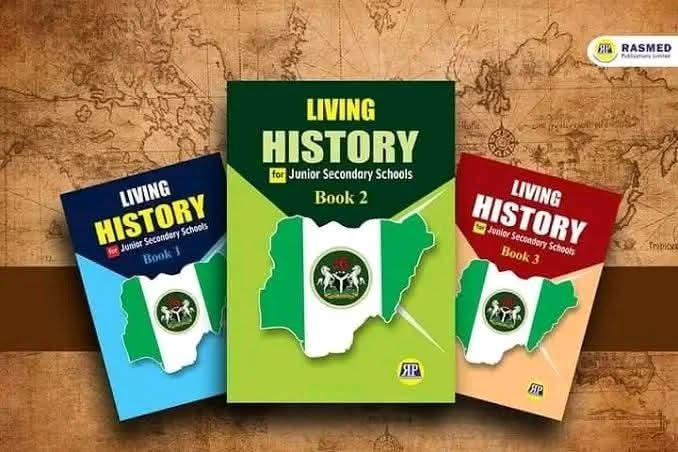
The development sparked widespread reactions with Nigerians questioning the rationale behind such development. They contended that a history book for schoolchildren should not shut any part of Nigeria out expecially a key ethnic group that is known to have contributed to the political and economic wellbeing of the country. Ohanaeze Ndigbo as well as other stakeholders expressed concern about the textbook which was reportedly approved by the Federal Ministry of Education for Junior Secondary School (JSS) students tilted “Living History for Junior Secondary School. It has no Igbo language content.

They demanded immediate withdrawal of the textbook from schools and in circulation, insisting that the exclusion of the Igbo content in the textbook was a deliberate act to keep the children/young learners away from the activities that defined their culture and root of the Igbo.
Ministry of Education’s response
The Federal Ministry of Education, in a statement, swiftly debunked the development and also neutralised the fears of the public, particularly the affected ethnic group. It stressed that the textbook was neither reviewed by the Nigerian Educational Research and Development Council (NERDC) nor approved by the ministry for use in secondary schools.
Minister of Education, Dr. Tunji Alausa, dismissed the fears, insisting that education can only thrive on truth, while unity thrives on tolerance and understanding.
He said: “My attention has been drawn to misleading reports and public discussions surrounding a History textbook titled ‘Living History,’ including claims alleging the exclusion of Igbo content and suggestions that the book has been approved for use in Nigerian schools.

“I wish to state clearly, firmly and unequivocally that ‘Living History’ is not an approved textbook in Nigerian schools and has not been recommended for use in any Nigerian school by the Federal Ministry of Education.
“For the avoidance of doubt, the textbook was never submitted to or approved by the NERDC. Hence, I encourage the public to support responsible discourse, reject divisive misinformation, and verify the approval status of educational materials through official channels before adoption or use. For verified information on approved textbooks, stakeholders should consult the NERDC.
Our findings
Daily Sun’s investigation revealed that the History textbook was probably published and marketed by an author that is unknown to the NERDC and the Federal Ministry of Education. Also, the textbook was never received, reviewed nor endorsed by the NERDC.
Meanwhile, a senior NERDC official who pleaded anonymity told Daily Sun that, since the incident was reported, the council had searched through its records and could not find the book in the list of approved History textbooks for junior secondary schools in Nigeria.
The official explained that, though education is on the Concurrent Legislative List (matters upon which both the National Assembly and State Houses of Assembly could make laws on), the issues of textbook for schools are handled by NERDC. “The council develops, reviews and recommend textbooks and some other instructional materials to schools. But in this case, it was not done. The book in question was not received nor recommended for use in schools by NERDC.
“However, we suspect that it could be some unknown authors/publisher that could have quickly fixed the textbook, and marketed it to some schools across different locations in the country taking advantage of our weak enforcement system. Sadly, we are handicapped in such a matter because the mandate of the NERDC does not include enforcement or periodic visit to the schools.
Other News
“Besides, we don’t have what it takes to visit schools to enforce quality assurance and compliance with the approved guidelines and usage of textbooks. Had it been the council was given such powers, it would have, in this case, immediately embarked on enforcement to schools to ascertain the true situation.”
Nevertheless, the NERDC official confirmed that the council often engages in periodic meetings with publishers that are known to the council for the purposes of quality assurance and assessment of their work.
“But in this case, perhaps, it may be some unknown individual that might have created the controversy to further cause division among Nigerians.”
The official, however, suggested that Federal Ministry of Education mandate the States Universal Basic Education Board (SUBEB)/Universal Basic Education Commission (UBEC) to investigate the matter and ensure that schools in their jurisdictions abide by the approvals of the Federal Ministry of Education as regards textbooks and other educational items.
“The NERDC needs such enforcement powers as given to the NAFDAC so it could periodically carry out operations across schools to ascertain their level of compliance to what was approved by the government in terms of textbooks and other instructional materials.”
Other reactions
An educationist, Sandra Weppo, stated that such a textbook for schoolchildren could further infuse the idea of ethnic hatred and division among children in their innocent early age, challenging the government to move-in quickly and mop up the textbook from wherever it could be found.
She added: “I read somewhere that the Minister of Education has denied knowledge of the textbook. He stated that the textbook was never approved for use in any Nigerian school.
“To this end, I suggest that the government trace the publishers and punish them for marketing unapproved textbook in schools. Similarly, the government should also sanction schools that are using the textbook.”
An Igbo community leader in Abuja, Onyeka Ibeh, said that such a History textbook is a danger to the fragile peace and unity in Nigeria.
He thus rejected the statement by the minister that the textbook was unapproved by the Federal Ministry of Education to use in Nigerian schools: “Igbos have obviously not been treated fairly in Nigeria despite the political and economical contributions of the people to the general growth and development of Nigeria. How can a History textbook be written and ‘approved’ for use in Nigerian schools with no Igbo language content?
“The Minister of Education may have claimed that the textbook was never approved by the NERDC but we don’t believe and trust that statement. He should follow up with action by withdrawing the textbooks and punishing the author.”
A parent, Ayuba Yohana, noted that the Nigerian history will be incomplete without the Igbo people. “I am from Kaduna State. The industrious spirit of the Igbo rubbed off on us. They were instrumental to the opening up of my community in Southern Kaduna.
“Many of them are in my community doing all kinds of economic activities, and along the line transferring the knowledge to our people. Some of them have married our ladies, and have lived with them for several years.”