Follow Us on Google
With Okorie Uguru [email protected]
Having spent a day at Twyfelfontein (Damaraland) in the Kunene Region, northwestern Namibia, it was time to head west to the Skeleton Coast and the Namib Desert, with the ultimate aim of ending up at the coastal city Swakupmond, in western Namibia.
Twyfelfontein is a vast Namibian wilderness with a large number of ancient rocks and dramatic, arid landscapes. It is also a UNESCO World Heritage site with 2,000 ancient petroglyph rocks estimated to be around 6,000 years old. It is a premier archaeological site showcasing hunter-gatherer and Khoi-San history. The region is extremely hot, making it difficult for plants to survive for long. Trees are scarce, all one sees is a continuous stretch of brownish-red hills. One expected the coastal region of Namibia in the west to be different. It is the next stop. It has about 500 kilometres of wild beachfront known as the Skeleton Coast.
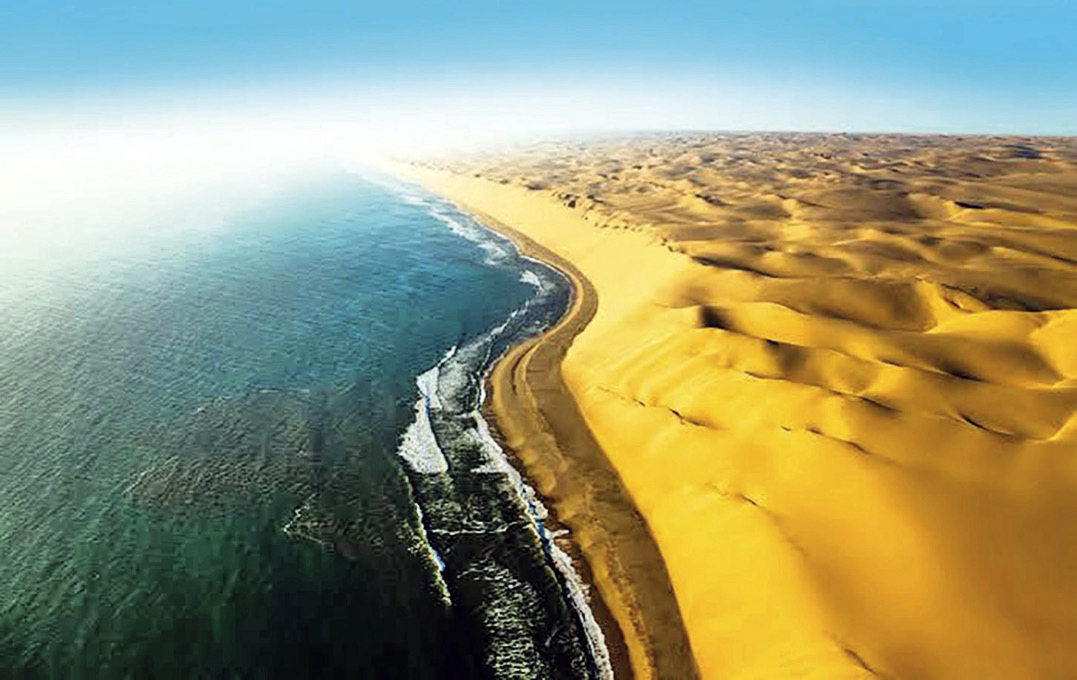
Namibia is an intriguing country with low population and vast landmass to explore. Driving from Twyfelfontein to the Skeleton Coast is an intriguing journey of sharp contrast, moving from rugged red mountains to barren coastal plains. The area is made more dramatic by the presence of the Namibian desert that kisses the ocean. However, in most part the long stretch of highway separates the coast from the desert. The area is alluring and equally dramatic. You hear the howl of the fierce desert wind, the crash of the ocean wind and the beauty of the beachfront.
It took almost four hours to drive from Twyfelfontein to the Skeleton Coast area.
The Skeleton Coast is a 40-kilometre wide and 500-kilometre m long coastal area in Namibia. It is a national park. The name is said to have come from the huge numbers of stranded whales that lost their life here and whose skeletons and bones could be seen all over the place. In the past, Ovahimba tribe who settled in the far north-eastern parts of Namibia used whale bones to build their huts. However, the whale’s skeletons are no longer there anymore, except pieces of bones scattered on the coast.
Also, many ships have been stranded at the Skeleton Coast due to the thick fog, the rough sea, and the unpredictable currents and stormy winds. The sailors who were able to make it to the land did not stand a chance of survival at this inhospitable coast and died of thirst. Many of these stranded ships are still on the coast.
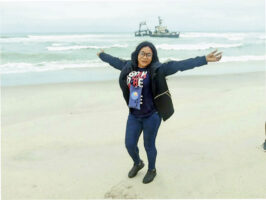
Most times, tourists visiting the Skeleton Coast park by the side of the road and walk around the vast emptiness of sand and water. Buildings around the coastal area are few. Walking round the wet beachfront, one could pick shells and white skeletal bones of animals.
From afar, one could see static ships on the Atlantic water bopping to the flow of the ocean current. Although some myths believe the coast was called Skeleton Coast because of the activities of pirates, there is no evidence to confirm that. According to history, the pirates considered the coast too dangerous and barren for their activity, and it had no trading ports to attack.
The two parts of Skeleton Coast Park
The Skeleton Coast National Park is divided into two – that is the southern and Northern parts. The southern part of the coast comprise mostly the recreation area and it is closer to the Ugab River, Swakopmund and the Walvis Bay and it is the only part of the Park that is accessible, whereas the Northern part of the Skeleton coast Park which covers the Torra Bay and the Kunene River near the Angolan border is not accessible and it is never open to tourists.
For tourists to access the northern part from Torra Bay up to the Kunene at the Angolan border, it has to be with a permit. This area can only be reached with a tour operator holding the concession and qualification. It is the most attractive area of the park. The tour operator guiding the tour had no concession to tour the northern part, so the group had to explore only the southern part of the coast.
South of the Skeleton Coast Park is where the National West Coast Tourist Recreation Area is located. Although it forms part of the Skeleton Coast Park, it is an individual coastal stretch of about 180-kilometre length from an area called the Ugab mouth south to Swakopmund and Walvis Bay. Namibia in 2010 integrated this area into its new Dorob National Park. It is freely accessible. Due to the abundance of fish this coastal stretch is a paradise for anglers who go there to fish.
Sand dunes kiss Atlantic Ocean
Opposite the Skeleton Coast is the Namib Desert, vast, dramatic and beautiful, with a spectacular desert landscape famous for its sand sea and coastal dunes.
The Namib Desert is the world’s oldest desert, and just among the few deserts that meet the sea. The desert, according to geologists, was formed from eroded sandstone in South Africa and Lesotho carried into the Atlantic by the Orange River and then pushed ashore by the fierce currents and wind.
The Namib Desert encompasses Namibia’s entire coastline, including sand seas, gravel plains and mountainous areas. At 55 million to 80 million years old, it is believed to be the oldest desert in the world
With dunes over 300m tall, it has the second largest dunes in the world after Badain Jaran Desert in China.
Outside the Namib Desert by the coast, there are two others. They are all preserved as national parks. They include: Namib-Nakluft National Park, which contains the main sand sea and Sperrgebiet National Park, which is largely off-limits to tourists.
Are there animals in the Namib Desert? There are animals like the Dune Lark, Namaqua Chameleon, Peringuey’s Adder, Palmatogecko, and specialized fog-basking beetles. These animals survive through specialized adaptations like digging in sand, collecting fog, or surviving on metabolic water. These animals survive through specialized adaptations like digging in sand, collecting fog, or surviving on metabolic water.
The Namib dunes offer top adrenaline-fuelled tourist sports, which includes quad biking, sandboarding, and 4×4 dune driving around the sand dunes. Other popular activities include skydiving, hot air ballooning, scenic flights, and fat biking across the desert landscapes.
One could also enjoy the thrill of skydiving. There are many companies that offer the services when booked at Swakupmond also.
While touring the Skeleton Coast in Namibia, there might not be human skeletons scattered on the coastal front, but there is so much fun for tourists to have a wonderful experience.