Follow Us on Google
From Godwin Tsa, Abuja
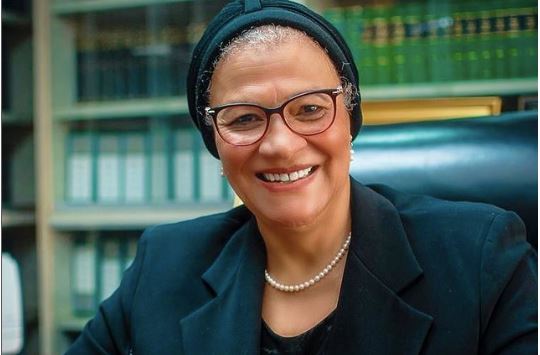
The Chief Justice of Nigeria (CJN), Justice Olukayode Ariwoola has extolled the virtues of Justice Amina Adamu Augie, who retired from the Supreme Court bench, describing her as an affable jurist who diligently and meticulously offered unquantifiable services to Nigeria and humanity in different capacities for several decades.
Speaking on Thursday at the valendictory court session in her honour, Justice Ariwoola said her amiable disposition and reticent outlook literally made her a “gentle tigress in the temple of justice”.
Justice Augie, officially retired from the bench of the Supreme Court on September 3, 2023, after attaining the mandatory retirement age of 70 years.
With her retirement, the bench of the Supreme Court now has only 11 justices.
According to the CJN, Justice Augie made herself a pliable legal personality that diligently sunk a pool of enduring legal knowledge and experience in all her judicial pronouncements.
She has variously exhibited rare qualities and tenacity of strength and character to the admiration of her colleagues and admirers, especially when it comes to the administration of justice.
“She has been a formidable ally, an admirable pillar of support and indeed, a jolly good fellow to all of us” Justice Ariwoola stated.
Speaking in similar eulogy was the Attorney General of the Federation and Minister of Justice (AGF), Lateef Fagbemi (SAN), who applauded her sound judgments which he said greatly enriched the country’s jurisprudence.
In his own speech, the President, Nigerian Bar Association (NBA), Yakubu Maikyau SAN, gave eloquent testimonies of the contributions of the retired jurist, describing her as a “rare gem” who largely succeeded in imprinting her name in gold in the annal of administration and adjudication of Justice in Nigeria.
Justice Amina’s retirement has further depleted the number of Justices of the apex court to an all time low.
Before now, the number of justices of the court had unprecedentedly rose to 20 in November 2020, after President Muhammadu Buhari approved the elevation of eight justices at a go.
Their appointment had sparked hope that the apex court would for the first time in history, attain the full complement of 22 justices as prescribed by Section 230 of the 1999 Constitution, as amended.
However, with the death of Justice Sylvester Ngwuta on March 7, 2021, about 23 days before to his retirement, and the retirement of Justice Rhodes-Vivour 14 days later, only 18 Justice were left on the apex court bench.
Before their replacements could be appointed, Justice Samuel Oseji died on September 2021, aged 67, less than a year after his appointment to the Supreme Court.
Likewise, while Justice Mary Odili, who became the second most senior jurist of the court, retired on May 12, 2022, Justice Ejembi Eko also bowed out of active judicial service on May 23, 2022.
However, in a shocking move, the then CJN, Justice Ibrahim Tanko Muhammad, voluntarily resigned his position in June, 2022, even as Justice Abdul Aboki retired on August 5, last year, thereby reducing the number of justices of the Supreme Court to 13.
Justice Chima Centus Nweze, who was the only Justice of the court from the South East region, died in Abuja, after a brief illness on July 29 this year.
While Justice Musa Dattijo Muhammad will retire by October 27, the CJN, Justice Ariwoola, will equally exit the bench on December 31.
Other remaining justices on the apex court bench, are; Kudirat Motomori Kekere-Ekun (to retire 2026), John Inyang Okoro (2029), Uwani Abba Aji (2026), Garba Lawal (2028) and Helen Morenikeji Ogunwumiju (2027).
As well as; Ibrahim Saulawa (2026), Adamu Jauro (2029), Tijjani Abubakar (2030) and Emmanuel Agim (2030).
By the combined provisions of paragraphs 13 (a) & 21 (a) of the 3rd Schedule Part 1, of the Constitution, the National Judicial Council, NJC, upon the advice of the Federal Judicial Service Commission, FJSC, has the statutory power to nominate and recommend the appointment of justices of the Supreme Court to President Bola Tinubu.
Section 234 of the Constitution mandates the Supreme Court to hear cases in a panel of 5 or 7 justices.