Follow Us on Google
By Philip Nwosu
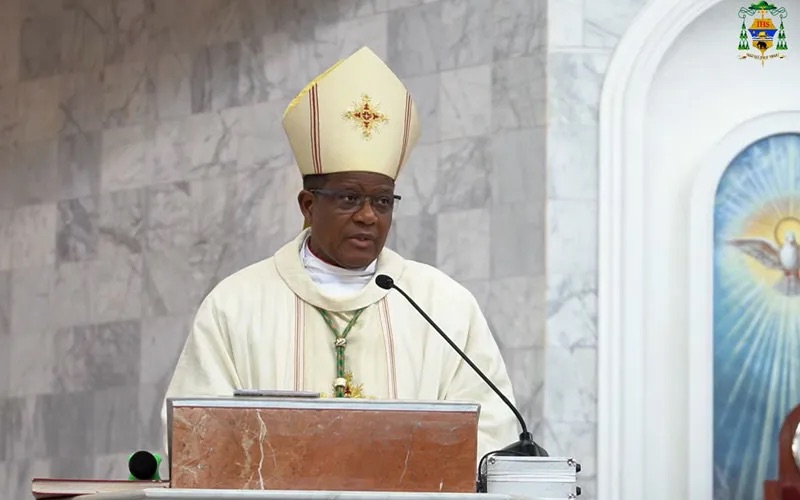
The Catholic Bishop of Nsukka Diocese, Most Reverend Godfrey Onah, has called for moral renewal across Nigeria, warning that the nation’s deteriorating condition stems not from its leaders alone, but from the moral failures of its citizens.
Delivering a lecture at a ceremony of the Catholic Brothers United in Lagos, the clergy likened Nigeria to a living organism, emphasizing that the health of any nation is a direct reflection of the integrity, conduct, and sense of responsibility of its people.
“A healthy nation is one whose citizens, institutions, and organs function in harmony, each contributing uniquely to the wellbeing of all,” he said. “When one part fails, like a wound on the finger or a diseased organ, the entire body is endangered,” he said.
The homily, rich in metaphor and scriptural allusion, drew parallels between the anatomy of a living body and the structure of a nation. Just as no part of the body survives on its own, the cleric argued, no citizen can thrive in isolation from the collective moral health of the country.
He condemned the widespread culture of blame-shifting in Nigeria, where citizens attribute the nation’s troubles solely to politicians. “No nation is better or worse than its citizens. Every nation is as sick or healthy as its people make it,” he declared
Citing scriptural references from Genesis, Psalms, and the Gospels, the cleric insisted that God entrusts citizens with the stewardship of their nation and environment. He criticized the hypocrisy of deeply religious Nigerians whose faith does not reflect in their daily moral conduct.
He told a story of a father who handed his child a torn map of Nigeria and was surprised when the child fixed it quickly. When asked how he did it, the child responded that there was a picture of a man on the back, and by fixing the man, he fixed the country.
Other News
“That’s the message,” the cleric said. “Fix the man and the nation is fixed.”
In a scathing comparison between Nigeria and other nations, the homiist recounted visits to Samoa, Côte d’Ivoire and Nigeria. While Samoa and Côte d’Ivoire displayed high levels of trust and integrity—even among the poor—the same could not be said of Nigeria, despite its outward religiosity. “In Samoa, even when the market was closed, people trusted strangers to handle money on behalf of others. In Nigeria, even in churches, you’re warned to lock your room tight.”
He lamented the culture of celebrating fraudsters, bandits and unscrupulous religious figures as successful and powerful. “How do we transfuse infected blood and expect the body not to be sick?” he asked.
While acknowledging the differences in responsibility among citizens, he asserted that every individual action counts. “A finger may not be the brain or the heart, but when infected, it can kill the whole body,” he said.
He urged the nation to take the teaching of moral values from an early age seriously, pointing out that in Nigerian schools, moral instruction is treated with far less seriousness than academic subjects. “We have religious knowledge exams but ignore moral instruction,” he said. “Students pass religion but fail morality.”
The cleric ended by reminding Christians of their prophetic duty—not merely to criticise governments but to shine moral light in all spheres of life.
“Our faith commands us to be light to the world, not just in word but in action,” he said. “If Nigeria is in darkness, then over 100 million Christian lights must ask themselves: why is the country still dark?”
He concluded with a warning and a hope: “Only God is perfect, but we are called to strive for that integrity. And if we sincerely pursue it, we may just help our nation rise again.”