Follow Us on Google
By Cosmas Omegoh
Christmas is here with the New Year celebrations trailing behind.
About this time every year, many more people are travelling to their various destinations to celebrate. More and more vehicles are on the roads conveying millions of people. That leaves the roads very busy, with its attendant congestion – and possibly accidents.
Now, the Federal Road Safety Corps (FRSC) wants everyone to travel safe and sound. The agency wishes that no one is involved in any mishap.
Against this backdrop, the Lagos Sector Commander, Mr Babatunde Farinloye, has been offering useful tips to help motorists survive the roads.
He says FRSC wishes that everyone undertakes a pleasurable journey, and arrives safely. He says to accomplish this, all and sundry must play a role to avoid accidents and distress, maintaining that “safety should be every body’s concern.” In an encounter with our correspondent, Farinloye emphasised that “speed thrills, but kills!” Excerpts.
How will you describe activities on the roads about this period?
The key characteristics of this period is an upsurge in traffic volume characterised by over speeding, over loading, impatience, sheer indiscipline, road rage, etc.
Some people fail to manage their journey ahead of time. They fail to manage their vehicles that are mechanically deficient.
We at FRSC know these things and how they can become major problems. So, we have decided to put together what we called “Operation Zero.”
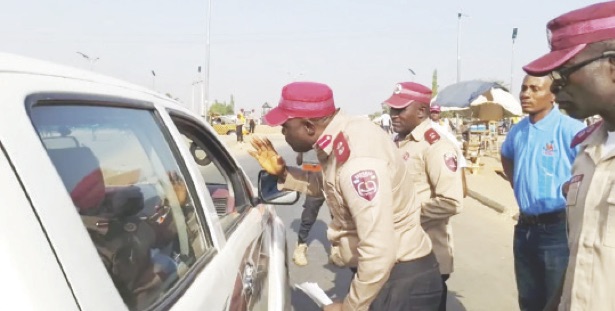
The theme of our campaign this year is “Speed thrills, but kills: Drive responsibly and avoid over-loading.” Our operations cover traffic control and de-congestion and public enlightenment. We had to start advocacy to worship centres like churches and mosques. We have been going to the parks and visiting opinion leaders, traditional and youth leaders. Now, we have to step up our enforcement drive, and promise prompt response to traffic accident victims. That alone has been intensified. We will also be doing what we call “Road Lining.” Our men will wear orange reflective jackets and stay in areas that are traffic congestion prone. We will also do mobile speed-control patrols; our men will be on the move and ensure that no vehicle goes above the recommended speed limit. This year we are going to deploy a large workforce we have in Lagos to ensure that we have an end-of-the-year patrol operation. We are going to deploy 1,400 marshals, and 2,400 special marshals; we want to bring down the rate of crashes to zero if possible and where we cannot do that, we want to ensure that if an accident happens, it does not claim lives, and there will be no serious injuries.
How would you advise people to prepare for their journeys this period?
Recently, we have been taking our advocacy to worship centres with a view to reaching out to road users. What we wanted to achieve by this is to help people plan their journeys.
In this period, people must learn to put their vehicles in order; they must plan their journeys ahead of time. Don’t manage any part of your vehicle. If you know that your tyres are not good, buy good tyres. If you know that you don’t have good fan belt, buy new ones or work on the ones you have. If your propellers are not good, work on them. If you know that any part of your vehicles is not good, work on it. The other aspect is that motorists must ensure that you are not in a hurry while travelling. They must know where they are going to. They must know when to wake up in the morning and hit the roads. They must have good knowledge of the roads and alternative ones they can use in case of anything. When you are moving, don’t be in a hurry especially when you encounter a hold up or traffic congestion. It is because of this that some people say ‘I want to make up for time lost.’ If you meet a hold up, make sure you give little time ahead of you so that you can stabilise, be able to go on the distance ahead. Don’t because of the lost time start going above the recommended speed limit. These are some of the things that must be borne in mind when people are planning their journeys.
Do motorists need to listen to their vehicles for any signs as they drive?
Of course, people ought to be listening to whatever their vehicles are telling them. We have dash board symbols. Those symbols there are not for decoration. They are indicators to show that one or two things are happening to the vehicle. They warn you about a defect in the vehicle. When an orange light pops up, for instance, it is indicating that your fuel is going down or the tank is almost empty. There are also indicators showing you that your brake pad is low, or your airbag is telling you something. If you take note of those indicators, you will realise that you attention is needed. If the temperature is going above the normal, you will know there is a challenge. We need to watch out for those indicators so that they can save us some distress while we are on a journey.
What are the major causes of accident on the roads?
The major causes of accident on the roads right are three: human, mechanical, and the environmental factors.
The human factor, in fact, constitutes about 80 per cent of the accident rates we have. Therefore, we have decided to work on the human error. We are working on the attitude and the behaviours of the drivers. Right from the driving school, we work on the drivers. We do some kind of monitoring of the training they are given at the driving school. We ensue that they understand the signs, traffic regulations and the laws of driving.
Candidates pass through driving schools now; of course, they must be graduated before they are presented to the VIO and to the FRSC for physical capture. It is no longer business as usual. As for the mechanical factor, we talk about the vehicle while in the environmental factor, we talk about the roads. The human factor is the most dominant of the three. That is why we mostly concentrate on the human factor. However, we are not leaving the other two factors empty. For the roads, we have made adequate research through our road safety audits. We have identified the failed portions of the roads that can cause accidents – we have identified portions where we can place road signs, road signals, road markings and other embellishments. And we have written to the appropriate authorities for remedial interventions and solutions. For the vehicles, we have been able to – through our road transport safety scheme, and free road safety checks on the vehicles – identified some of the problems and decided to also work on them so as to bring down the rate of accidents on the roads. Now, there is something we call Safety Loads for heavyduty vehicles doing haulage and transportation of heavy materials. We have been able to work on them. We have ignited that passion for safety. That is why we brought the safety load programme for this category of vehicles. Presently, all those containers vehicles that are moving around unlatched, there is penalty for them. We are still going to use mobile courts and other measures and agencies to ensure compliance at all costs. Again on the human factor, we are talking about clamping down on defaulters so that we can reduce the fatality index during this Christmas and New Year patrol period.
How will the saying ‘be your brother’s keeper’ apply on the roads this period?
Yes, once there is an accident on the road, motorist need to be their brother’s keeper. Always stop by to see how you can help.
Definitely, among the transport unions, when they see their members parked on the road, they always stop by to assist.
Among the fleet operators, we see them do that regularly. When they see their colleagues in distress they always stop by to assist. We also have volunteers that are not members of transport unions who assist. We have volunteers always everywhere; we have special marshals; we have community responders; we have security agencies in case of any distress.
Now, people need to employ a good deal of defensive driving technique. Defensive driving technique is supposed to be a part of the training every driver receives. Everybody must drive to stay alive. Road safety is a critical concern; it is also a shared responsibility. Everybody should be involved in safety on the roads. We have decided to mainstream road safety, and to create the passion and awareness among all categories of people in the society. Right at the primary school, we now have road safety a club; we have that even in secondary schools; we also have a road safety club among members of the NYSC; we have road marshals too. Across all levels of the society, we have road safety marshals. We have university professors end engineers who are special marshals.
Road safety is now beyond what we used to think of it in the past. Everybody is now road safety conscious. Everybody must be road safety conscious this season.