Follow Us on Google

By Adetutu Folasade-Koyi, who was in Hangzhou, China
The trip to the People’s Republic of China, to attend a seminar on Economy Construction and Green Sustainable Development for Developing Countries, sponsored by the country’s Ministry of Commerce, between June 6 and June 26, was not planned at all.

The seminar, more like a training session, was sponsored by the country’s Ministry of Commerce and organised by the Free Trade Development Board of Zhejiang Province, which held between June 6 and June 26,
Regardless, my colleague in the Abuja Bureau, Mr Paulinus Aidoghie, who had spent 22 months in Harbin, Heilongjiang Province of China; from September 2015 to July 2017, encouraged me to attend the seminar/training and experience a new vista. Paulinus urged me to go and see China with new eyes as I would be going to a new province.

From the moment the trip was confirmed, two Chinese embassy officials in Abuja, Messrs Zhang Hang and Zheng Shuchao, ensured the paperwork for the journey was done seamlessly.
I had been to China in 2014 and 2017 but this trip was the longest; three weeks, and I was wary of staying in a new, unfamiliar terrain. That fear was quickly dispelled after meeting 32 other trainees from 16 countries who related with me as if we had been classmates all our lives.

Hangzhou, Zhejiang Province
On Monday, June 5, after transiting from Bole International Airport (Addis Ababa) and the Capital International Airport (Beijing), I landed at the Xiaoshan International Airport in Hangzhou City, to a warm reception from Mr. Lu Tianhua and a programme volunteer, Charles. In the coming days, a graduate of the College, Tobias Jiang, would prove to be more than a volunteer for the programme as he was more like a handyman for the foreign trainees. I’d never seen a Chinese man so eager to put his guests at ease, going the extra mile to helping out with the odd translation here and there and even going the extra mile to make us comfortable; far away from home. Right from the airport, I was handed my itinerary for the next 21 days.

Even though it was quite late that Monday night, we arrived Zhejiang Tongji Vocational College of Science and Technology campus in Hangzhou. Everywhere was quiet. Even the lobby of the hotel within the campus was quiet. That was a first for me. Coming from Nigeria, I hadn’t expected a hotel lobby to be that quiet.
Knackered from travelling for over 17 hours, across continents, I was ushered into my room at about 1:40am. Tired and hungry, I made do with the snacks handed to me. I, then, settled to browsing the net, with the intention of catching up on news back home. The next time I opened my eyes, it was already morning and time to go for lectures. How did time go so fast?
The next day, June 6, Prof Zhu Zhengping, from the College, kick-started lectures on China’s economy and its interconnectedness with the development of Zhejiang’s economy. In case you do not know, Hangzhou is the city of the world famous Alibaba and hopes to have an operating income of 300 billion yuan by 2025.
China, she said, in just 12 years, increased her Gross Domestic Product to 121.02 trillion; as at 2022. With 1.4 billion people and more than 170 million talents, China, through its Belt and Road Initiative, has yielded 13.8 trillion Yuan, an increase of 19.4 percent, compared to the previous year.
With 31 provinces, expectedly some are rich while others are not so rich but, here’s the catch; the rich ones help those who are not so rich with the policy of one helping the other. Hangzhou’s history, which spans over 2,000 years, is intertwined with the country’s 5,000 years of unbroken civilisation, with the city’s natural beauty accentuated with the Yellow River which flows through the city. Hangzhou is now renowned for its technological infrastructure and achievements.
Prof. Zhengping disclosed that the Chinese government has taken modernity to rural areas by building houses and rent is low. Government, she added, also encourages businesses to set up in such places with tax incentives; albeit, the poor can borrow money with low interest rates. Interestingly, if your income is less than 60,000 yuan, your tax is zero.
It would also interest you to know that government encourages small companies by allowing them to borrow, at least 100,000 yuan and government would guarantee the loan. “You don’t need any collateral to access the loan,” said Prof. Zhengping.
At that point, my mind left the classroom and landed in Nigeria and wondered if such model could be applied in my home country; to lift millions out of poverty
From there, it was a flurry of lectures on how China, which is blessed with all the terrains in the world, has effectively deployed them to the benefit of her people. China, I was told, has more than 100 mountains, with 2,000 rivers covering more than 1,000 square kilometres. The main rivers are the Yellow River and the Yangtze River; with 34 world biospheres, 53 ethnic groups, yet, the country insists all are equal by actively pursuing a policy of ethnic equality and unity!
Home to more than 700 foreign-funded companies, China has attracted more than 214, 300 young talents in 2018 alone. China is also the headquarters of the world’s largest producer of passenger cars, according to Cao Xinrong, who gave us a lecture on the Chinese Water Culture and sustainable development.
Perhaps, China’s biggest success is in digital trade and green sustainable development.
The value of its digital economy has already exceeded 7 trillion yuan because government enacted policies to grow this new economy and its value-added addition to natural sources of its gross domestic products. China is, by far, the largest economy for Electric Vehicles (EVs). Concerned about climate change, the country’s transition from petrol and diesel vehicles to electric vehicles is a boost for its green economy.
So much so that, TESLA produced over 700, 000 units of Model Y and Model 3 Tesla in its Shang Hai factory; more than half of the company’s global output.
Of course, there are still diesel and petrol vehicles on the road. Electric cars abound. With the upward trend of oil prices, coupled with the rapid rise of car ownership and oil shortage, that put a serious dent in oil consumption. The only route was to go green, which gave birth to massive investment in electric vehicles.
Now, for a foreigner like me, how do you identify which car is electric or petrol powered? Simple. Electric cars have green number plates while those still using petrol have blue number plates. According to Cao, electric vehicles are “easy to maintain. With just 200 RMB (yuan), you can ride your car for a week, unlike the conventional cars where you will have to spend 400 RMB to fuel your car.”
The only thought in my mind at this point was that, thankfully, carbon emission is still low in Africa but in China, emissions standards are being tightened to reduce its impact on the economy and the citizens by moving more towards new, renewable energy. China, we were told, now relies mostly on diverse electrical energy—nuclear, thermal, hydrogen, etc. Cao told us that renewable sources are now the most relied upon energy in China.
It is easy to see how China has transformed from an agricultural economy to an industrialised country. Here, Hangzhou played a major part. On May 29, 2008, Hangzhou was awarded the title of E-Commerce capital of China by the China Electronic Commerce Association. It is noteworthy that 31.7 million households have fixed broadband internet access, out of 65 million, with 171, 000 5G base stations and 156 data centres. Just one city in China! Hangzhou didn’t get there overnight though. The province developed and implemented Work Plans, while the development of its digital economy started in 1994.
This is evident not only in its automobile industry, but also in its clothing industry. Clothing materials are healthy, delivered from the factory to the consumer; all sourced from nature.
That is where E-commerce comes in, with the mobile phone playing a huge part. E-Commerce is evolving in China and is now applied in a variety of sectors-tourism, education, among others. As we saw during our lectures, E-Commerce has changed their traditional transaction industry; all thanks to the smart phone, which is an integral part of the online digital platform across the country.
The success of E-Commerce gave birth to live streaming, with Hangzhou now touted as the ‘capital of E-Commerce.’
E-Commerce and Chinese agriculture
This form of commerce is not restricted to only the urban areas. The rural areas have benefitted immensely from this innovation. With E-Commerce, there’s been changes and transformations in villages such that there are now business villages affiliated with some top brands across the country.
A professor of E-Commerce, Chen Min Li, from Yiwu Industrial and Commercial College told us that the first internet E-Commerce village in China started in Yiwu. This encourages village inflows, attracting a lot of traffic to the rural areas, online and offline.
“In fact, heads of counties have been known to present and sell products of their areas via live streaming.” The Ministry of Commerce, it was gathered, is vital in promoting rural E-Commerce.
In 2022, online sales of agricultural products reached 531.38 billion yuan; an increase of 9.2 per cent. With E-Commerce , the farmers can sell their produce at a competitive rate as there’s symmetry of supply and demand information. For example, Swichang County, in Zhejiang Province, has more than 2,000 local online shops. Each county, therefore, has its own market day.
E-Commerce also empowers rural people to improve skills, which not only affects farmers’ production and lifestyle but also changes farmers’ concepts and reshapes rural life. E-Commerce also helps to change consumers’ preferences.
In Hangzhou, with its global clothing market, live streaming E-Commerce helps them sell their stock fast, thereby increasing the trader’s turnover. I also learnt that with live E-Commerce, the customer gets to negotiate a great discount.
Live streaming is no longer limited to just getting tips on how to apply makeup in China. They’ve evolved the services offered on that platform by offering and including shopping, tourism, financial management and take-outs (take-away in popular Nigerian parlance).
I soon discovered that, unlike Nigeria where we banter on social media, the Chinese are miles ahead by deploying social media as a tool for money-making. The rural areas have not been left behind, either. With live streaming of products and services, purchases are made online because they are interactive and entertaining.
The presentation promotes the product, resulting in high volume of purchases by appealing to the psychological need of the consumer.
Hopefully, Nigeria can learn from this by enacting a policy of states partnering with the local GSM companies to making live streaming affordable for users.
This is where Yowant is a success story for the local economy. An indigenous tech company in Hangzhou, Yowant set up shop in 2010, with live streaming as its core business. It is the first digital platform to live stream e-commerce across three digital platforms-TikTok, Taobao and KuaiShou.
In September 2022, the company reached 100 million people in just seven days!
The company has its Cloud Live Streaming network, a self-developed platform for live streaming and has a storage capacity of seven million items.
With its coterie of in-house live streamers, Yowant went public in 2018 and had its first live show in 2019. Guess what? One of the company’s live streamer has more than 36.7 million followers! They were trained by the company which made them grow from the average guy next door to a super star in digital trade.
Yowant’s live streamers do their live streaming on either of the company’s three platforms. With more than 25 partners, Yowant makes 15 billion yuan yearly. What does this do for the business? It raises the sales volume, attracts more customers and many more.
Live broadcast E-Commerce is estimated to exceed 4.9 trillion yuan this year, based on advanced communication technology. The country has actively encouraged online shopping, eliminating brick and mortar spaces in most cases. Hangzhou holds a special place in the heart of the country. It is the city of digital economy.
Chinese Green Economy
China’s journey to sustainable green development economy took all of 40 years. It wasn’t an overnight idea, I was told. Green economy is simply market-oriented. It’s is also called environmental protection economy and low carbon economy. Luan Xijie said that this economic form is different from the traditional, industrial economy.
Going green may cause unemployment in the short term, but green economy is, in a word, the economy of free contamination, ecology economy and environmental protection economy which encompasses human welfare.
To that end, China has a made a conscious effort on greenery. Chinese moderation depends on green development and on the common people. This simply means that if you destroy nature, the forest, you have committed a crime against the people.
China’s green economy is expected to increase by 16.3 trillion yuan in the next five years. This is because green economy has become one of the important engines of Chinese economic recovery, and an important driving force for promoting high quality economic development which developing countries would do well to key into.
Enjoy Town
Just a few kilometres from the College, Enjoy Town is a self-sustainable community with 1,500 residents. This community, which is in the suburbs, has its own bus station, commercial shops, movie theatre and shopping mall. Every week, residents get to watch three movies free of charge. I gathered that non-residents can also patronise the movie theatre. More than that, there’s the conventional and digital library for residents, with 18,000 books available for free. As with modern libraries, there’s free WiFi as well. We were told if you want to start a business, go to Enjoy Town and you get free office space; whether you live there or not.
Developed by private business, Enjoy Town also has government input; more like a public-private community. Government hired the company to render services for residents. It’s operated more like a future community where you have residential, business and entertainment facilities in one community. There’s provision of healthcare and aftercare facilities for residents.
Being far from town, the community takes care of the very sick and the elderly by providing for their medical needs on time.
Enjoy Town is entirely monitored by Closed Circuit Television. With the monitoring system, if here’s any security breach, there will be a beep on the monitor of the nearest security operative to deal with it.
There’s also feedback from the residents to government (which has 50 per cent shareholding) on how the facilities in Enjoy Town are being used and maintained by the facility managers.
Enjoy Town is the pilot community while new ones have sprung up and “are even better,” the facility manager who took us on a tour of the community said.
Shaoxing and Huangiju Museum of Yellow Wine
Away from the classroom, it was soon time to visit nearby Shaoxing-land of the iconic Yellow Wine.
Bridges, long and short, and small rivers, dot the Shaoxing landscape. With a population of about five million people and 2,500 years of history, Shaoxing can best be described as a county of rivers, bridges and, of course, Yellow Wine, a national treasure, drunk all over the country.
And who else to take us on a tour of the city and the museum than the homeboy himself, Sheng Yangpin, a director of training from the Free Trade Development Board of Zhejiang Province.
Being the first stop outside Hangzhou, we visited Shaoxing’s shopping mall, which had a collection of local shops trading in the finest materials that were sourced locally. The products on sale were strictly Chinese-made. From there, we stayed at the expansive and luxurious International Conference Centre. This is no ordinary International Conference Centre. It is a town all by itself, with a ski resort, which attracts locals and foreigners from far and near.
The next day, we visited the Huangjiu Museum, dedicated solely to the birth, evolution and cultural significance of the Yellow Wine.
Now, the Yellow Wine is not the same as the colour yellow. It has a brownish hue but it is wine, with some variants sweet, some sour. Yellow Wine is made from rice, wheat, yeast, and the water of Jianhu and some secret ingredients.
The history of the wine dates back to 1743 and is presently 280 years old. Actually, the history of the Yellow Wine, according to Yangpin, dates further back, to 2,000 years.
The folklore surrounding the Yellow Wine, as rendered by Yangpin, is that if you want to join the Yellow Wine club, you needed to have drunk five litres at a sitting!
In the olden days, it was sold in jars and a coupon is usually hidden in a jar; with a free gift from the brewery.
Shaoxing is a city of scholars. It is generally referred to as a place of ‘milk and honey.’
Three lakes run right through Shaoxing and they are all located downtown. The water and lakes make the city green and is typically used for transportation.
At the Huangjiu Museum, we were presented with nine varieties of the Yellow Wine, each with different alcohol content, to take care of various needs. As a visitor, however, you can only buy two bottles; something some of us weren’t happy with.
Yiwu International Trade Market
There’s a popular saying in this city: if you want to know the winner of a presidential election in the United States, don’t ask the politicians; just visit Yiwu! The market is divided into five districts (sections), with some offering wholesale and others retail. It is so big that you cannot walk the entirety of one district in a day!
Its capital goods market was opened on November 19, 2013, with total investment at 3 billion yuan on 35 hectares ,while the building area is 750, 000 square metres, with 1, 400 business entities. Yiwu’s origin can be explained in these words: inexplicable, out of thin air, touch a stone and turn it into gold. This market is far from cities and, as we were told, in the early days, traffic was hellish! But the locals worked so hard to turn Yiwu into what it is today. This market can best be described as the world’s largest supermarket. To move from the southern end to the northern end, you would have to walk four kilometres.
The market started in the late 1970’s, after the country’s cultural revolution and China opened up to the world. Yiwu was initially a street market before it evolved. In September of 1982, the first international market opened and three years later, its turnover exceeded 100 million yuan.
By the turn of the decade, in 1992, Yiwu international trade market became the domestic indoor wholesale market in the world! Over 15,000 overseas merchants, from over 100 countries and regions are stationed in Yiwu, with over 7,000 overseas enterprises setting up offices in the market.
With its sheer size, if you spend three minutes in each store and you spend eight hours in the market, per day, it would simply take you a year to go round this market!
Yiwu is 6.4 million square metres, with 75,000 stores, spanning 26 categories and 2.1 million varieties. Its overseas market is about 65 per cent, commodities sold to 233 countries and region and over 1.5 million containers per year going out of China.
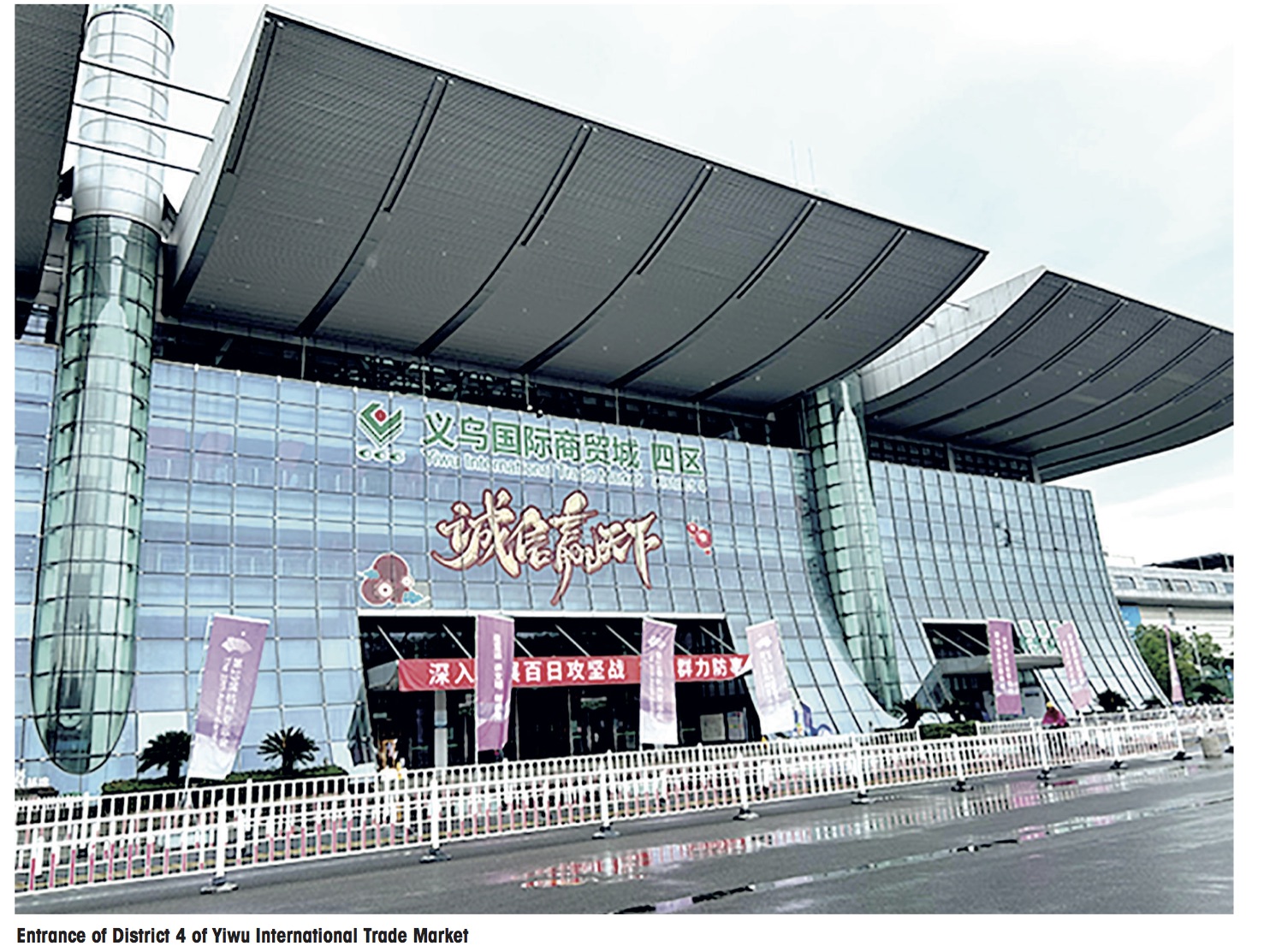
However, if you happen to visit Yiwu, your best bet to getting a good bargain is to visit District 4 (Level 5) because of its fashion market. It’s a good place for retail bargain and you’d be spoilt for choice. The fashion market, the most prosperous district, opened in April 2012 and spans a total area of over 420, 000 square metres! Although over 90 per cent of the good sold in Yiwu are made in China, good also come in from Japan, Korea and Germany. These are sold in District 5 and fall under the import commodities market.
Although there are no special days for trading, as the market is open every day, except for the Spring Festival when it is closed, you don’t need to be physically present to purchase anything at the market. Before I left the campus at Hangzhou, I had downloaded the market’s App and saved some items I needed. As an official of the market told us, during a briefing, “you don’t need to be physically present to make any purchase. As a newcomer and you want to engage in wholesale trading, it’s better to come to the market but, if you are a regular at the market, it’s better to buy online.”
If you’re interested in trading, you can contact the traders directly at chinagoods.com or simply download the Yiwugo App.
Yiwu is the place to start a small business. “The rule in China is this: the more, the cheaper it is,” said Fiamma, a local who left paid employment for business consulting in Yiwu.
Next, we moved to the China Commodity City Huangyu Commodity Garment Market. Although it’s a street market and cannot compete with Yiwu in size, I can bet you, you wouldn’t even be able to round all the stores in a day!
Shang Hai
If you visit China and you don’t go to Shang Hai, the city of skyscrapers, you’re missing a lot. Shang Hai has retained its status as the country’s financial muscle and money-spinner.
Almost everywhere you turn in Shang Hai, you’d be confronted with tall buildings, and you’ll really need to crane your neck to see the tip! Unlike 2017 when I first visited, this time around, Hilda, our tour guide, took us on a historical and cultural tour of the city. We started at night, with a visit to the Huangpu River. The walk along the river’s embankment was threatened by the intermittent rain, which was in its third day but we were undeterred. Our hosts had gladly supplied umbrellas and with warm clothing embracing us, we set out into the cold night.
Again, as I saw in 2017, Shang Hai is beautiful to behold at night, bumping into a stream of tourists at every turn. For me, the beauty of the Chinese tourism industry is that the locals are enough! Standing ramrod straight, against the background of the 114 Huangpu River, is the iconic Oriental Pearl Tower. Built in 1994, it is an iconic landmark in Shang Hai and you’ve just got to take a picture against that background, as if to prove to cynics you were actually there!
The next day, we were actually inside the tower where the elevator took us to 263 metres, to the Transparent Observatory, where you get to see Shang Hai in all its glory; the city spread out for all to behold. Again, Chinese tourists outnumbered the foreign visitors
Here, your must have a heart of steel to step on the transparent glass. Looking right down through the transparent glass is the street and right in front of you are roofs of skyscrapers you never thought you’d see. If you’re afraid of heights, please don’t stand on the transparent glass at the Observatory.
Leaving Hangzhou
If there’s something that stuck with me throughout the programme, it was China’s mantra for success; common prosperity for all. And this finds expression through its Belt and Silk Road initiative, linking the world for a common prosperity.
Soon, it was time to leave Hangzhou and I wondered; how do you tell the story of a people with 5,000 years of uninterrupted civilisation without omitting some crucial details? How do you tell the story of a people, who shut out the world, underwent a cultural revolution and when they were ready, opened up to the world and has opted to share its prosperity with the world? Well, it’s quite simple, really. I choose to tell my story, my experience in one of China’s most successful cities, Hangzhou, in Zhejiang Province. Others would tell theirs; someday.
When it was time to leave China, at the airport, again, Tobias and other volunteers, led by the ever-smiling and funny Mr. Lu, went to a great deal to make the process as easy and smooth as they could.
Done with the check-in formalities, Tobias enveloped me in a bear hug and I instantly choked up. On his part, Mr. Lu opted for the formal handshake. That was enough for me. It was time to say goodbye to China but not the new friends in my life.