Follow Us on Google

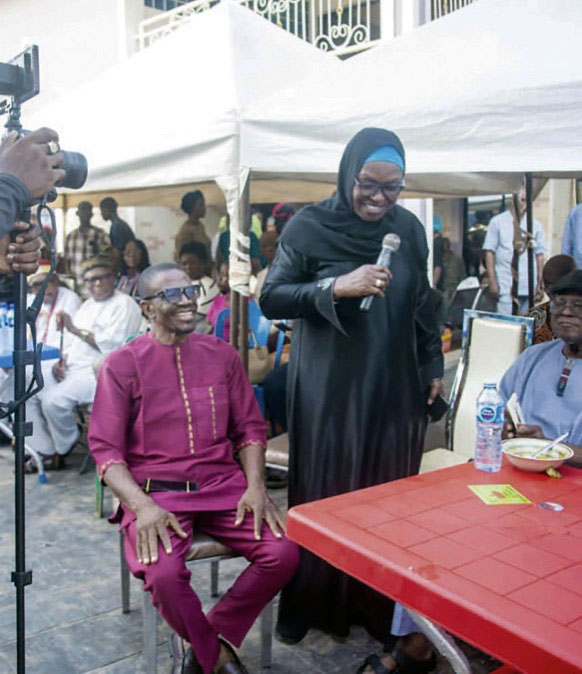
His Majesty, Eze Chidubem Iweka III, the Igwe of Obosi Kingdom in Anambra State, is an artiste whose interests cut across difference spheres of arts: literature, movie making and music production. In the literary world, he is known as a novelist, playwright, and poet. He was the former Chairman of the Association of Nigerian Authors, Anambra State chapter. To his credit are three published works: The Ancient Curse, So Bright a Darkness and August Inmates (longlisted for 2019 the NLNG Literature Prize). Henry Akubuiro wangled a chat with him recently at Best Western Meloch Hotel, Ifite Awka, Anambra State, during a recent literary outing, on his reading habit and writings. Find out, also, how he was denied a national literary prize he won.
Let’s go back to your formative years as a reader. Can you tell us the first works of fiction you read?
The one I remember vividly was Chike and the River by Chinua Achebe in early secondary school, but, before Chike and the River, there were other books like Ivanhoe, Robbin Hood and Midnight Tales I read in primary school in the 1960s. Some of these books were simplified classics. As you can see, I started reading quite early, in primary school, novellas, more or less.
How was it like reading those foreign books and being exposed to cultures and societies you had never experienced?
It was very fascinating, just like fairy tales. I remember Rapunzel, a German fairy tale written by Friedrich Schulz and adapted by the Grimm Brothers. (Singing nostalgically) Rapunzel, Rapunzel, let down your hair…. It’s about a girl who got trapped in a castle. She had very long hair. She would throw her hair through the window and her lover would climb up with her hair as a rope. There was something very surreal about reading those stories.
What are the best books you have ever read?
It depends on the genre, whether you are talking about fiction or nonfiction. For fiction, I have enjoyed the books of Robert Ludloom, because I love espionage. I also like Agatha Christie. When we were kids, we loved James Hadley Chase. As a young secondary schoolboy, I thought that James Hadley Chase was the best writer ever. I didn’t really enjoy his love stories, for I thought they were on the slow side for me, but I enjoyed the thrillers. Hardly Chase and Ludloom probably made the best impression on me. I enjoyed the suspense, the thrills, being thrillers, and the intrigues. Later on, Chinua Achebe became a favourite. I also enjoyed reading the Cameroonian writer, Ferdinand Oyono.
Who is your best hero in a work of fiction?
My best hero then was actually Robbin Hood, because he took from the rich and gave to the poor (laughs), and I thought that was cool, because he found himself in a society that had the abject poor, so poor that they had to patch their shoes; some were banished and lived in the forest. Robbin Hood really didn’t rob individuals; he took from the government –the government has always been a bit on the oppressive side, generally, in history –and distribute to the poor who had no access to the common treasury
If you visit a bookshop or a bookstand, what are the things that move you to buy a book?
I will read the blurb and the comments at the back cover and then flip through a few pages to see the command of English by the author, because that is what is going to thrill you and keep you on your toes. A writer can write about something that is literarily lackluster, not really an interesting subject, but the way the writer handles it will make you continue to turn the pages. I can use myself as an example – I am not blowing my horn – one of the recent poems I wrote “My Primary Pen” on how I discovered my primary school pen in a drawer: “In my secondary school days, I discovered my primary school pen in a drawer/ and there it laid in a cluttered drawer/ battered and scraped and forgotten/ beaten up with a cap missing…”
I wrote about three long stanzas on that primary pen. I have given it to some friends to read, and they have found it quite interesting. So I think it is the style of the writer, the content, the command of English and packaging that combine to make a good book. Like Professor Ngozi Chuma-Udeh’s new book, Forlorn Fate, the packaging is nice; it is enticing; it makes you want to know what’s inside. But, at the end of the day, packaging counts for nothing if the content is not attractive.
What’s the last books you read?
The three last books I read were from fellow authors who asked me to vet their works. One of the books is published and two others are yet to be published.
Do you have a book you are reading now?
No, because I am writing three books of mine at the same time. One is a poetry volume called Reflections of Hope. Another is fiction called The Third Coming. I have taken Ogbanje to a white family in America, and it is manifesting there (laughs). I am also writing a book that I have written for roughly five years –it is my first experience of racism in America where I lived for many years, which prompted my joining the Pan-African People’s Revolutionary Party, in 1975. From there, I followed this factor of racism. I recently presented a lecture at Renaissance University, Enugu State, on “Racism in the Global Village: Solutions”. That’s why I am not reading much, because I am writing three books at the moment. Otherwise, I am an avid reader.
Today, many Nigerians no longer read. Are there compelling reasons everybody should read?
Well, we should read, because all the secrets of life, education, different aspects of life, all tenets of progress, the ups and downs of life, both negative and positive, are all hidden in books. So, if you want to know, you have to read. They are all hidden in books. I don’t blame the people who say, if you want to hide something from a Nigerian, put it in a book –not all Nigerians, though, because people are still reading. The hard copies are no longer selling so fast because of the internet, e-books and audio productions. However, we, especially of the old school, are finding it hard to make that transition from the hardcopy to the e-book.
So, if you are asked to make a choice between hardcopy and e-book today, which is your preference?
The e-book, the internet and all that give you faster access to print materials, lock you on to the very endless highway of diverse scripts. But they come with disadvantages, too. The e-book takes a toll on your eyes, because there are people who spend maybe 12 hours daily on their laptops, iPads, and phones to read. Sometimes I wake up in the middle of the night to write, and, when I open my laptop, the glare of that light shocks my eyes, and I know that is damage being done. I use both laptop and iPad. Sometimes I will tone the light down a lot so that it won’t abuse my eyes much. Apart from that aspect, I think the e-book is much better.
You are a very busy traditional leader who attends to customary functions regularly. What time of the day do you read?
These days, we get so much information on WhatsApp, Twitters and Facebook, so you can’t help but read. I mostly read at night, because that’s when I have time, after midnight, when everybody is asleep.
Some people who haven’t read your books might be wondering: does he actually write these books himself? Tell us about your books…
The Ancient Curse (2007) is a novel about spiritual fraud. We have a man whose deity from a past life he reincarnated came for him to start worshipping it. The fact that, these days, Christianity is the more fashionable thing, when you say you are a Christian, people will accept you more than if you are a traditionalist. So he decided to worship the deity to save the life of his daughter, his only child, because the deity had already claimed his father, mother, and brothers to force him to serve it. Thus, he did it, but in the line of Christianity. He named the deity Jesus and locked it up in a room, and was using the power of that deity to perform miracles in the name of Jesus but not Jesus Christ.
Eventually, the deity turned against him for he couldn’t offer his daughter, the only child. It is a lesson actually, because, these days, there is so much spiritual fraud going on in Nigeria. That book is still relevant and will be relevant for a very long time, because what I wrote in that book is still happening, in fact, getting worse. People are using all these deities to perform all forms of rituals and miracles, and they pretend to be pastors.
My second novel, So Bright a Darkness, has so many layers; but, basically, it is an ancient town that refused civilisation. It rejected civilisation completely, but, eventually, the government had to build an express road through the town, and the people had to fight it. An American, a white man, who settled in the town, was also opposed to that express road, so they fought it the best they could. Also, some aliens who settled in that town protected them and provided them with all the medicine and amenities they needed that were alternatives to what was obtainable in the western world. Actually, the plot is very complicated.
Interestingly, your third book, August Inmates, was longlisted for the 2018 NLNG Literature Prize…
Yes, August Inmates is a story of corruption. In the plot, about six inmates, all corrupt government officials, were put in a room with a journalist who had been criticising them, together with a corrupt arms dealer who supplied arms to different Third World countries, to both opposing forces, and he was applying to organised crime rings, too, so he was also a very corrupt person. The only upright person among them was the journalist who knew all of them. So the regime that had planned a coup de tat, intentionally, placed the journalist with these corrupt officials, and they wired the entire room with hidden cameras and microphones, and watched their interactions. In the course of their stay in that detention room, out of frustration and quarrel, they were able to expose themselves thoroughly, while the coup plotters who incarcerated them recorded everything. In the end, they were executed and the journalist was offered to run for president. It was believed he would sanitise the country.
Does reading help you as a writer?
Of course, reading exposes you; it expands your knowledge; you can’t be an island as a writer. You have to read other writers. Don’t copy them but be exposed by them. Gain more exposure and knowledge by reading fellow writers but develop your own style.
What move you to begin a particular book?
It is the urge. It is like an itch on your backside. Reflectively, you want to scratch that point that is itching you. That’s how writing is to me. It is like, at any given time, there is a story that wants to escape from inside me, and there is no way it can escape except I put it down on paper or electronic device. It is not as if I want to just write; I write because there are stories in me that want to be released from their prison
So many Nigerian writers complain they don’t break even from their works. What keeps you going?
I will give you an example. The art form is not expressed because you want to make money out of it. If it is all about money, then will you fail before your event starts? I have been writing since my early secondary school days, and never got any national acclaim until my novel, The Ancient Curse, was nominated for the Ken Saro-Wiwa Prose Prize in 2008, and it won the prize. But when I went to Minna for the ANA Convention that year to collect the prize, I was denied the award, for they were looking at the year of the reprint, and found out that the book had elapsed by one year prior to the submission for the award. So the judges took my prize and shared it to the other two runners-up. It was such a shock. But I was glad my book actually won the prize, but I could take it home because of the aforementioned reason.
Many years after, another book of mine, August Inmates, was longlisted for the Nigeria Prize for Literature, a remarkable feat. So, if I was writing for money or fame, I wouldn’t have gotten there. About fifteen years ago, I was shooting a movie in Enugu and I needed a group of dancers to perform a particular scene, and there were some students of ESUT who had a dance troupe called EPAC (Enugu Performing Art Company). But when I got there, I found out that the girls among them had resigned, but somebody was telling me how good those girls were. I told myself I was going to find them, and I did. When I met one of the female dancers called Obiageli, who, incidentally came from my place, she told me, “Any time we have a show, the boys in our group will take all the money and leave behind for us peanuts.”
I, then, asked her to bring all her friends. When they came, I told them I created my first music band in 1972, and it was in the airwaves, and we never did it for my money. We used to play free of charge until we got recognition, and we started getting paid. The art is not something you do because of money; you do the arts because you love what you do. You keep doing it until you sharpen your skills, and people will now offer you money, and, after a while, you start naming your prize. The famous Celestine Ukwu discovered us and gave us instruments. He said you guys are fantastic. We were all teenagers. That was how we started charging for shows and getting paid. If he had emphasised on money from the beginning, we wouldn’t have made it. Many young people drop out because they didn’t see the money, but that is not how it is supposed to be.
What’s your assessment of reading culture in Nigeria?
In my town, we were complaining that the library had shut up, so I called my people in America, and they sent two lorry loads of books, hard copies, which I used in refurbishing the Obosi Library at the Town Hall. I put in computers with a staff, and placed her on monthly pay. Then I advertised for young people to come and use the library. After a while, I handed over the payment of salaries to the Obosi Town Union. One day, the librarian came to me, and I asked how the turnout had been. I was shocked when she told me that, during her first year, only about five readers used the library. That tells you that people, now, sit at the comfort of their homes and access whatever would have taken them to the library. Perhaps the only people using the library are people whose houses are somehow rowdy who need peace of mind.
What’s the future of the book in Nigeria?
No matter what happens, the hardcopy will never disappear, because it is not always that you will have access to the internet. For instance, the newspaper would have fizzled out completely. Also, most people would have thought that the wristwatches would have fizzled out. Certain habits die hard. We are too used to certain things. Newspapers are still there because people are reading them. Sometimes, I read the newspaper on my iPad, but I still enjoy opening the broadsheet.