Follow Us on Google
RHI hits 27,345 in FCT as Tinubu, beneficiaries tell stories of survival, growth and hope
By Juliana Taiwo-Obalonye
When the Renewed Hope Initiative (RHI) marked three years of impact in the Federal Capital Territory, the celebration was not just about policy, programmes or statistics. It was about people — children, women, elderly residents, persons with disabilities and vulnerable families whose lives have been touched in different ways by an intervention the First Lady, Oluremi Tinubu, says should be judged by the number of lives transformed.
That message was at the heart of the Abuja event, where beneficiaries, government officials, traditional leaders and partners gathered under the theme, “Our Stories, Her Impact.” For many in the hall, the occasion was a reminder that social intervention is most meaningful when it reaches people at their weakest point and gives them room to breathe again.
“The success of the Renewed Hope Initiative is measured by lives transformed,” the First Lady said, framing the anniversary as a celebration of human impact rather than ceremony. “The testimonies from the Federal Capital Territory represent a fraction of the work we have done across the nation.”
The FCT report presented at the event showed that more than 27,000 people have benefited from RHI interventions across the six area councils in three years. The programme reached 3,307 children, 4,427 people through economic empowerment, 4,866 beneficiaries in food security and agriculture, 970 persons with disabilities, 4,423 people through protection and systems strengthening, and 550 elderly residents.
Behind those numbers are familiar Abuja realities: women trying to keep small businesses alive in hard times, farmers struggling to recover from rising costs, parents fighting to keep children in school, persons with disabilities seeking inclusion, and elderly citizens hoping not to be forgotten. The programme’s coordinator said the structure was designed to respond to those different needs.
“Our work focused on enabling households to improve food production, supporting income-generating activities, protecting children and vulnerable adults, and strengthening local systems to continue services beyond our direct interventions,” said Dr.AdedayoBenjamins-Laniyi, who presented the FCT impact report.
Benjamins-Laniyi said the initiative was built around five strategic pillars and more than 15 major interventions. She explained that economic empowerment support came through vocational training, microgrants and market linkages, while food and agriculture interventions included input distribution, training in improved farming techniques and post-harvest support.
For many women in the FCT, that support has meant the difference between closing a business and keeping it afloat. For some, it has meant the ability to buy supplies, pay school fees or expand a trade. For others, especially those in vulnerable households, it has been a first step toward rebuilding confidence after loss, illness or economic strain.
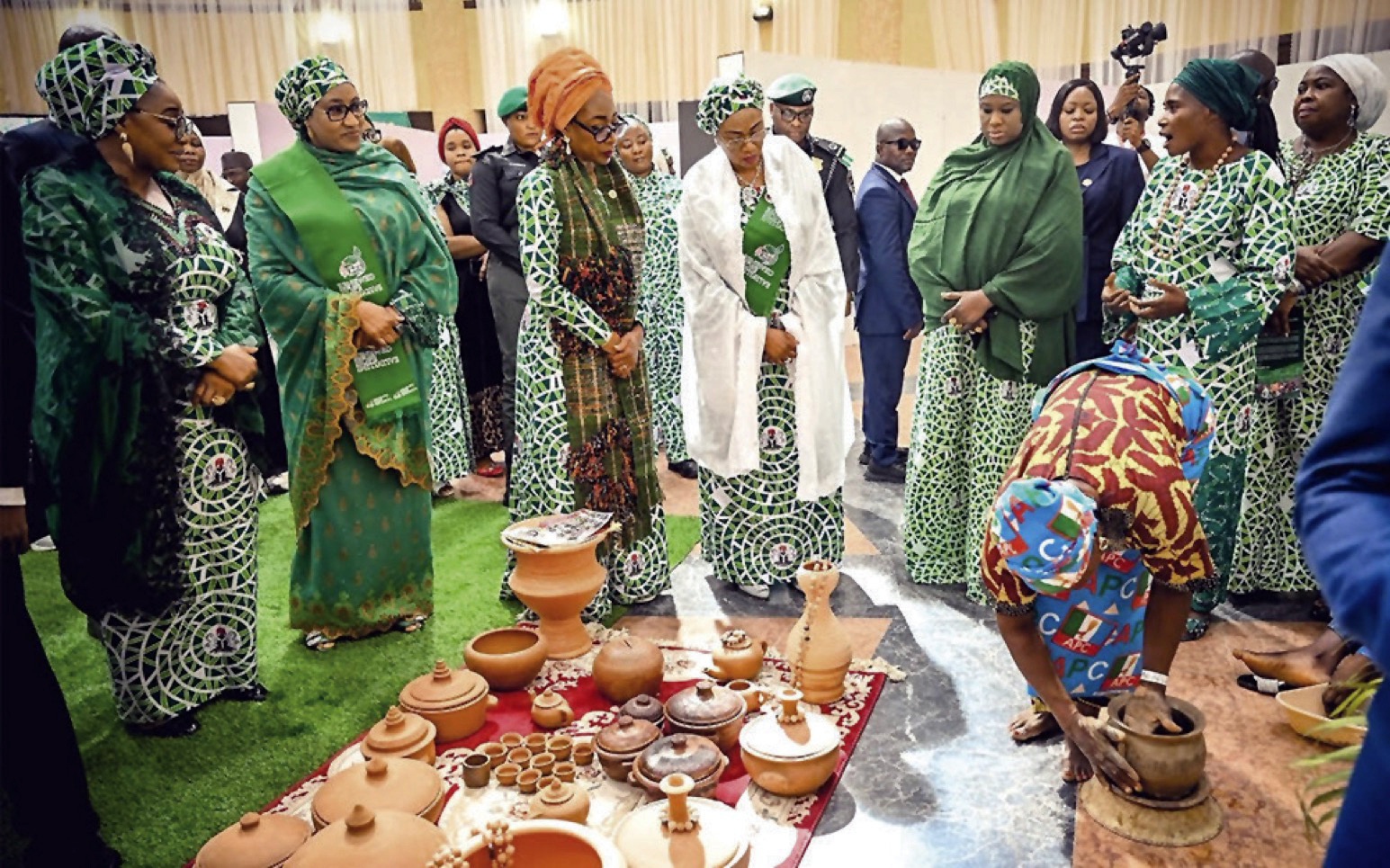
One of those beneficiaries is 50-year-old Martha Denu, a seamstress and shoemaker, whose testimony captured the human face of the programme. She said RHI gave her a sewing machine, then supported her with shoemaking tools and a big sewing machine that changed the direction of her life.
She said: “My name is Martha Denu. I’m a beneficiary. First they gave me a sewing machine and then they sponsored me to learn shoe making. Then they bought a filing machine for me and a big generator. So now I’m making my shoes that I’m selling for as much as N40,000. Before now I was directionless, even food to eat was a problem. I am a mother of one and didn’t have anything to do because I didn’t go to school beyond Primary Six. But today that doesn’t matter. I had no helper before, but today I have been helped.”
For Martha, the support was not just a handout. It became a livelihood. She said the business has improved her income and restored her sense of purpose. The change, she suggested, was not only financial but personal: from dependence to dignity, from helplessness to usefulness.
The most striking part of her testimony was that the programme did not just help her survive; it helped her teach others. Martha said she now trains women in the trade, passing on the skills she received. The support, she said, has also helped her become a role model in her own small circle. She no longer sees herself as someone left behind by circumstance, but as someone building a future one stitch and one pair of shoes at a time.
The First Lady said the RHI was created to complement the Renewed Hope Agenda of President Bola Ahmed Tinubu through people-centred interventions that improve livelihoods, empower vulnerable groups and create opportunities for families. She recalled that the initiative began in 2023 and moved quickly into communities in need.
“The journey of the Renewed Hope Initiative began on 7th July, 2023 with its inaugural meeting at the State House. Thereafter, we hit the ground running by reaching out to communities in need,” she said. She recalled that the first intervention came on July 13, 2023, when RHI supported victims of the flood disaster at Trademoore Estate, Lugbe, Abuja.
The First Lady also said the FCT model owes much to the cooperation of the Minister of the Federal Capital Territory, NyesomWike, and the Minister of State, Mariya Mahmud, who she said helped create a structure that could carry the initiative’s work effectively in the territory. She recalled that Wike had asked her to nominate a woman to coordinate the affairs of RHI in the FCT.
“He said he wanted to come and pay the courtesy visit and with his magnanimity, he said he wanted me to nominate a woman who will be able to coordinate the affairs of the RHI in the city because they’ve never had that before,” Mrs. Tinubu recalled.
She said she immediately thought of Dr.Benjamins-Laniyi, whom she described as someone who had shown up consistently for women’s programmes and disability-related initiatives. Benjamins-Laniyi, in Mrs. Tinubu’s telling, became the right person at the right time. “When Barrister Wike entered that office that day, I didn’t have any candidate other than Dr.Dayo,” the First Lady said. She later praised her for innovation and for turning the FCT structure into something active and visible.
Other News
“She has really turned around one talent that we give to her. I sat here watching the innovation, all the innovative programs that you brought to the table,” Tinubu said.
One of those innovations was the Dream Girls initiative, which the First Lady highlighted with pride. She said it showed that empowerment must go beyond cash and goods to include aspiration, discipline and preparation. “Dreaming is what keeps any human being going. If you sit and don’t have a dream, a vision of what you want to become, it becomes very tough for you,” she said.
That message resonated with the younger audience, especially girls whose future often depends not only on resources but on the belief that they can become more. The First Lady also stressed etiquette and protocol as essential life skills. “You have to learn a lot of things about etiquette and protocol because you don’t know when you will be called upon to do something,” she said.
The Minister of Women Affairs and Social Development, Hajiya Imaan Suleiman-Ibrahim, said the initiative had made women and children central to development in a practical way. She described the First Lady’s leadership as one that had turned policy into action. “Your Excellency, everyone today in this room is inspired, and everyone today in this room is grateful. You did not just direct it. You showed us how to do it, Your Excellency. We are overwhelmed with gratitude,” she said.
She said the RHI approach was not just about handing out items, but about creating economic pathways. “When you said for us to go and put money in women’s hands, Your Excellency, through the Renewed Hope agenda, we were not just giving women gas cookers, but we are creating opportunities for them to be gas entrepreneurs so that they can be able to choose how they write their own success stories along the value chain,” she said.
She added: “We are not just giving women grants to go and farm. We are giving them the opportunity along the whole agro value chain so that they can also become agro-entrepreneurs.”
According to her, the programme has also strengthened the role of traditional institutions, making them part of the delivery chain for health, education and economic empowerment. “Traditional rulers and their wives are no longer spectators. We are now implementators,” she said. “Our policies are now recognised as delivery points for health, education and economic programmes.”
She said women had benefited from skills support, agricultural assistance and small business grants, while girls were being supported through education, mental health and anti-violence advocacy. She said: “In FCT communities, we are seeing fewer cases of child marriage and more girls complete secondary school. This is prevention in action. The beauty of RHI is that it respects culture while advancing progress.”
The Minister of State for FCT, Mariya Mahmud, said the initiative had inspired women across the territory and had turned assistance into opportunity.
She said: “You didn’t just direct it. You showed us how to do it, Your Excellency. Thank you, Your Excellency, for leading with a heart of gold.” She said the real value of the programme was in creating value chains that women could own and grow. “We’re not just giving women grants to go and farm. We’re giving them the opportunity and what people call agro-value chains so that they can also become agro-entrepreneurs,” she said.
The President of the Defence and Police Officers’ Wives Association, Mrs. Mernan Femi-Oluyede, said the anniversary was also an acknowledgement of dignity restored for security families and other vulnerable households.
According to her, “the true measure of any intervention lies not in the numbers recorded, but in the lives transformed. Behind every empowerment programme, educational support initiative, healthcare intervention, and welfare package is a story of renewed dignity, restored confidence, and strengthened hope.”
She said DEPOWA had seen the effects of the initiative among veterans, widows, persons with disabilities, women, students and vulnerable households. “These interventions have given voice to the hopes and aspirations of countless families. A widow rebuilding her life, a young student pursuing educational dreams, a family regaining stability, or a veteran finding renewed purpose — these are the stories we celebrate today,” she said.
The wife of the Ona of Abaji, HajiaHawa Ibrahim Baba, who serves as the President of the 17 wives of FCT Traditional Rulers’ Association, commended President Tinubu and the First Lady for changing lives positively.
”Three years ago, the first lady started the RHI with a promise to leave no women nor girl-child behind, we testify that in our communities, that promise is a reality.
”RHI brought governance and traditional decisions to the same table, our palaces is more recognised as delivery points for health, education, economic progress and more.
”Traditional rulers and their wives are no longer spectators, we are now implementers and empowered women,” she said.
That was the real picture in Abuja: not just 27,345 beneficiaries on paper, but 27,345 reasons to believe that intervention still matters when it is rooted in compassion and consistency.
Tinubu captured that expectation in one line that framed the spirit of the day: “To all the beneficiaries that RHI has impacted, I celebrate you. Your courage, determination, and success stories are inspiring and encouraging. As you have been helped and assisted in one form or the other, do the same for a neighbour that we cannot see, no matter how small.”
In a city where many people live close to need but far from help, that charge carries its own weight. It is a call to turn support received into support given — to make kindness contagious, and to let the impact of RHI stretch beyond programme halls into homes, streets, markets and communities across the FCT.