Follow Us on Google
From Uche Usim, Abuja
All eyes are on the Central Bank of Nigeria (CBN) for socour as the Nigerian economy succumbs to local and global volatilities.
Huge sovereign debt, stubborn inflation, widening poverty, low productivity, war in Ukraine, weak export, corruption and insecurity are the dark clouds hanging over country and blighting the economy.
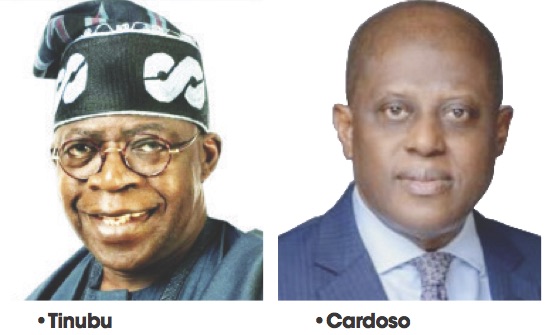
But President Bola Tinubu sees a silver lining. He said the economy has the potential to grow to $1 trillion by 2026 and to $3 trillion in 10 years.
While some analysts infer that Tinubu’s vision is a pipe dream and a titillating political gimmick, the CBN Governor, Dr Yemi Cardoso, is running with it.
At the 58th Annual Bankers Dinner in Lagos last weekend, Cardoso said strategic reforms were underway to revive the economy and ultimately achieve the projected growth.
He said the CBN was currently undergoing internal realignments to achieve regulatory fortification needed to perform its oversight functions more effectively.
He said the CBN has approved the adoption of an explicit inflation-targeting framework to enhance the effectiveness of the monetary policy.
“The details and requirements for this framework are currently being finalized alongside the fiscal authorities”, he said.
According to him, the apex bank, in the past, burnt its fingers by straying from its core mandate of price stability and groping into unfamiliar terrains.
Cardoso said the greatest gaffe was embarking on uncoordinated intervention programmes which gulped over N10 trillion with minimal impact on the economy.
He added that the interventions were unorthodox deployment of monetary policy tools without clarity between fiscal and monetary policies.
He identified those areas of intervention the CBN went into with limited expertise to include; agriculture, aviation, power, youth development among others, which distracted it from achieving its core objectives.
He said the bank would junk such a template since it did not yield the desired results.
“Instead of direct interventions, we will collaborate with stakeholders and formulate policies that create an enabling environment for sustained economic growth and development. Our catalytic role will support increased investment and private sector participation in the economy, improve access to finance for MSMEs, and enhance financial services for the underbanked. This includes promoting specialized institutions and financial products to support emerging sectors, developing regulatory frameworks to unlock dormant capital in land and property holdings, facilitating accelerated access to consumer credit, and expanding financial inclusion to reach the masses.
“We will work with experts to develop derisking instruments that encourage private sector investment in key industry verticals such as housing, textiles and clothing, food supply chain, healthcare, and educational supplies, which have high potential for local inputs and value retention. The CBN will leverage its convening power to engage multilateral and international stakeholders in government and private sector initiatives,” he explained.
To reset the monetary policy space, Cardoso said deposit money banks in Nigeria must raise their capital base to build the financial capacity to service the demands of a $1 trillion economy.
He said: “Attaining this target necessitates sustainable and inclusive economic growth at a significantly higher pace than current levels. It is crucial to evaluate the sufficiency of the banking industry to serve the envisioned larger economy”.
He added that the hurdles before the CBN was not just about the stability of the financial system, as current assessment of the performance of the banking system has shown the CBN has already established stability; but more of mobilising sufficient capital relative to the financial system’s needs in servicing a $1 trillion economy in the near future.
He said it was in an effort to surmount the challenge that jacking up banks’ capital base has become inevitable.
It is not clear yet what the new minimum capital threshold would be from the existing N25 billion stipulated by then Chukwuma Soludo’s management of the CBN.
On the overheated foreign exchange market, the CBN governor assured that the bank will introduce a set of foreign exchange rules to address the naira crash and achieve exchange rate stability.
“Clear, transparent, and harmonized rules governing market operations are essential to ensure the proper functioning of domestic and foreign currency markets. “New foreign exchange guidelines and legislation will be developed, and extensive consultations will be conducted with banks and FX market operators before implementing new requirements.
“New foreign exchange guidelines and legislation will be developed, and extensive consultations will be conducted with banks and FX market operators before implementing new requirements,” he explained.
Cardoso said that in reaching that decision, the CBN would prioritise price stability to safeguard the livelihoods of Nigerians and insulate them from further suffering.
“Under my leadership, we will tackle institutional deficiencies, restore corporate governance, strengthen regulations, and implement prudent policies. We assure investors and the business community that the economy will experience significant stability in the short-to-medium term as we recalibrate our policy toolkits and implement far-reaching measures”.
He tackled the Godwin Emefiele-led management of the CBN for adopting policies that created a negative perception challenge for the apex bank, particularly as a result of failure on corporate governance, diminishing independence and deviation of the bank’s core mandate, inefficient management of the foreign exchange, and reckless venturing into development financing.
The CBN governor expressed confidence that by adopting appropriate corrective measures and strategies, macroeconomic stability could be restored and the fundamental flaws redressed.
He added that the removal of subsidy on Premium Motor Spirit, the floating of the exchange rate of the Naira and other policies adopted by the government were envisaged to positively impact the economy in the medium term.
These measures, he noted, were expected to boost investors’ confidence, attract fresh capital into the economy, stimulate domestic investment and ultimately improve the country’s external reserves, while contributing to the stability of the domestic economy.
Noting the challenges posed by the local and global economic environment, Cardoso said the country’s financial sector has remained resilient, with key positive indicators of financial soundness above average regulatory benchmarks.
On the 43 items recently unbanned by the CBN, Cardoso said their ban resulted in increased demand for foreign exchange in the parallel market, leading to the depreciation of the exchange rate in that segment of the Nigerian Foreign Exchange Market. (NFEM) and widening the premium between the parallel and official market.
“Studies have shown that during the period when the 43 items were restricted, there was a 51.0% increase in trade evasion by importers accessing the foreign exchange market, resulting in a revenue drop of approximately $1.4 billion, or $275 million annually, between 2015 and 2019.
“Additionally, revenue from tariffs on goods decreased from a high of approximately US$920 million in 2011 to about US$250 million in 2017. In 2019, the actual tariff on goods stood at US$320 million, but counterfactual evidence suggests that as much as US$680 million could have been earned in the same year. “Furthermore, evidence has shown that foreign exchange restrictions had an adverse impact on Nigerian households and contributed to inflationary pressures. The reduction in trade restrictions and levies on rice,sugar, and wheat by 50.0% had only a minimal impact on welfare, with a 0.8% improvement, and a mere 0.4% reduction in extreme poverty.
“Moreover, the benefits of trade gains for the general population were negligible, as the average industry in Nigeria pays 13.7% more for its inputs”.
The President of the CBN, Ken Opara, in his remarks, shared the economic and financial market development perspectives in the current year as well as insights into the outlook for the coming year.
Opara commended the CBN governor for some of policy initiatives since assumption of office aimed at repositioning and stabilising the economy, including focusing on the core mandate of the CBN on pricing and exchange rate stability, unification of the exchange of the naira, and initiation of steps to boost liquidity in the foreign exchange market and achieving real positive change in the economy.
The Director General, Centre for the Promotion of Private Enterprise (CPPE), Dr Muda Yusuf, told Daily Sun that the most urgent task of the CBN is restoring confidence in the foreign exchange market, which it has begun doing by gradually clearing the forex backlog.
Other areas he wants the CBN to focus on are; deepening the financial system; efficiency of the financial system; capital requirements for banks; ways and means financing of fiscal deficit; naira redesign policy; concentration risk in banking sector; stakeholder engagement; corporate governance and tenure and cost of funds in the banking system.