Follow Us on Google
By Rita Okoye
When 27-year-old Precious Esong Sone left Cameroon to further his studies in the United States, he carried a simple dream: to make a remarkable difference in healthcare. 3 years later, he has done more than that, he has changed how experts and patients alike think about the emotional toll of living with chronic diseases such as diabetes.
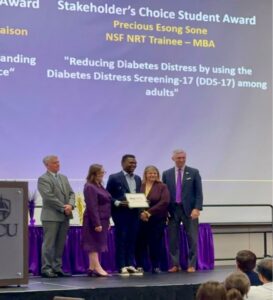
In April 2025, Sone won the Stakeholder’s Choice Award at East Carolina University’s Research and Creative Achievement Week (RCAW), a recognition determined jointly by academic reviewers, research professionals, community experts and members of the public. His project was hailed as innovative, practical, globally significant and deeply human.
The Problem Nobody Talks About
Globally, Type 2 diabetes is climbing at alarming rates. According to the CDC, 38 million Americans live with the condition, many struggling with what experts call diabetes distress a sense of frustration, fear, and emotional fatigue that can derail even the most disciplined patients.
“It’s not just the medication or diet,” Sone explains. “It’s more about the daily emotional battle. Patients feel overwhelmed, and that distress itself makes the disease worse.” Studies show that up to 45% of adults with Type 2 diabetes experience this psychological strain. Yet in many clinics, it goes undiagnosed, leaving patients unsupported.
From California to Carolina
Sone’s breakthrough journey began in California in the summer of 2024. There, he collaborated with Cameroonian-American physician Dr. Joyce Ekole to pilot the Minnesota Department of Health’s Diabetes Self-Management Education (DSME) Toolkit. What made Sone’s contribution novel was his decision to integrate DSME with the Diabetes Distress Screening-17 (DDS-17) into a single, digital and phone-based intervention. No prior framework had ever combined these validated instruments into one operational care pathway particularly in Sub-Saharan Africa.
The toolkit provides structured, weekly guidance on medication adherence, glucose monitoring, exercise, and stress management. Coupled with the Diabetes Distress Screening-17 (DDS-17), it allows clinicians to track not just blood sugar levels but also emotional well-being. Over eight weeks, patients joined structured education sessions and completed distress assessments before and after the program. The results were eye-opening: distress scores dropped sharply, patients gained self-confidence, and adherence to medication and exercise routines improved. In the fall of 2024, Sone attempted to carry the project eastward to North Carolina, enrolling adult patients, adapting it for local patients while retaining its mobile-first design.
Recognition and Impact
The work struck a chord at ECU’s 2025 RCAW. Hundreds of projects competed, but Sone’s stood out for its blend of science and empathy. When the Stakeholder’s Choice Award was announced, his name drew applause from the Chancelor, Dean of Graduate School, Faculty Staffs and Community Experts.
“Precious’s project is a pioneering model, not just innovative but also replicable across diverse health systems, meeting people where they are and offering tools they can use immediately,”” said Dr. Grace Gavigan, CCEDS NRT Program Coordinator. “It demonstrates global significance, offering a scalable tool for healthcare providers worldwide.” Sone’s poster presentation, featuring charts of distress scores and patient testimonies, became one of the most visited during the event.
A Global Dimension
Beyond Greenville, the implications are vast. In sub-Saharan Africa, where resources are limited and diabetes cases keep rising, Sone’s model offers a low-cost, scalable intervention. By using phone-based education and simple screening tools, clinics could replicate the approach in rural and underserved areas. Already, clinics and some universities in Cameroon and Nigeria have expressed interest in piloting the framework, seeing it as a practical solution to local challenges. Stakeholders in both countries have engaged with Sone to explore feasibility studies, showing its potential for broader adoption.
“This is research that doesn’t just stay in journals or in classroom,” Dr. Ekole remarked. “It can change lives in resource-limited and urban areas in Cameroon and sub-Saharan Africa as much as in the United States such as North Carolina where about 12.4% of the adult population are diagnosed with diabetes.”
The U.S. Connection
In the United States where Sone now studies and works faces a significant diabetes burden, with 11% of adults diagnosed. His intervention directly addresses these underserved populations by tackling the psychological side of the disease, a gap often overlooked in traditional treatment. Because the model is low-cost, mobile-based, and adaptable, it is particularly suited for rural and lower-income U.S. communities. Its scalability ensures it could be deployed nationally, amplifying its major significance in the broader field of U.S. public health.
The Road Ahead
For Sone, the recognition is a milestone, not the finish line. As an MBA student with a concentration in Healthcare Management and a fellow in the CCEDS NRT program, he is preparing to expand the project into larger trials while publishing findings for global audiences. His long-term vision is clear: to champion healthcare models that treat not only the body but also the mind. “We must stop separating the clinical from the human,” he says firmly. “Healing must be holistic.”
Pride in the Diaspora
Back home, news of his achievement has sparked pride among his peers and several Cameroonian communities. In diaspora forums and WhatsApp groups, photos of him standing by his award-winning poster have been shared widely. To many, Sone represents the promise of a new generation of African researchers and healthcare leaders leading innovations abroad while keeping an eye on the needs of their communities.
As one admirer put it: “This is what it means to be African and global at the same time.”
For now, Sone continues his work quietly in Greenville, but his story is already inspiring conversations far beyond the walls of academia. His message is simple, yet profound: “Diabetes is not just about numbers. It’s about people.”