Follow Us on Google

On the very first day of this week, precisely five days ago, something of deep significance to global peace and cohesion happened in the city of Lagos.
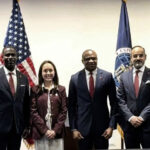
It was the day ambassadors representing different countries, most of them in Europe and Asia, gathered physically and virtually to honour General Tukur Yusufu Buratai with the award of “The Bearer of Security Torch.”
It was a day Nigeria was honoured, as it was the first such award presented on the global stage. The significance of such an honour is not lost on the many personalities from all walks of life who made out time to attend the event, coming at a time when Nigeria is taking all kinds of punches at the global arena on account of one mishap or the other.
But why would those ambassadors, operating under the aegis of the renowned World Institute of Peace, feel a former warrior deserves an honour to do with peace, when the job from which he retired less than two years ago has more to do with war and its attendant killing of the peoples’ enemy?
Well, perhaps the answer could be found in Machiavelli’s submission that, in war, the best form of peace is often found. Even when he held sway as the Number One Soldier in Nigeria, Buratai had made genuine moves aimed at improving what was clearly a frosty relationship between the civil populace and the Nigerian Army that he headed.
How did he do that? It was by his establishment of a whole directorate saddled with improving that relationship and deepening it in the overall interest of the Nigerian nation.
But then critics will ask: what happened then, that this same man’s tenure as Army Chief ended up becoming somewhat controversial?
When he was appointed the Chief of Army Staff by President Muhammadu Buhari in July 2015, the one thing that did not cross the mind of then Major-General Tukur Yusufu Buratai was his tenure of office becoming somewhat controversial.
Those who knew him way back then said the man was down to earth and humble, and that he was a man of few words who will rather allow his action, or his achievements, to speak for him. He was also never on record to have craved publicity inspite of all the major things he had achieved for Nigeria in the course of his well-decorated career.
With all these attributes, Buratai must have thought that his tenure was going to be a quiet one that will be full of positive action without the accompanying fanfare. But he was mistaken.
Though he was heavily apolitical, Buratai did not know that soon after his appointment, politicians who had an axe to grind with the then new president were going to seek to politicize his tenure, reading his actions in the subjective context of politics, even when the military he led was a professional body that has since 1999 been insulating itself from politics. Buratai was contented with attaining the exalted rank of an army general, and had never lobbied for a post or promotion.
But the stakes were very high politically. A political party that had been ruling for almost two decades on a stretch had just been uprooted through an election, and some of its members were determined to discredit anything good the government that took over from them was doing. Sadly for Buratai, these people did not care to make a distinction between politics and national security. And they played a key role in making him perhaps the main issue in Nigeria almost throughout his five year tenure as Army Chief.
Tukur Buratai was appointed to command the Nigerian Army at a critical time in the history of the country, at a time Boko Haram was threatening to take over many parts of northern Nigeria, including, to some extent, the Federal Capital Territory (FCT).
By 2015 when Muhammadu Buhari became president of the Nigerian federation and appointed General Tukur Yusufu Buratai as Army Chief, Boko Haram was governing a sizeable chunk of Nigerian territorial space, said to be the size of Belgium. The security situation in the country was very dicey, and for sure the nation needed truly tested hands to manage the situation and prevent it from taking a turn for the worse.
The president called for the curriculum vitae of all the senior generals serving at the time, and wasted no time in picking Tukur Yusufu Buratai as the Chief of Army Staff. It was one appointment that was hailed nationally, as the man chosen was fully deserving, having made a name in fearlessness and diligent delivery of set goals.
Buratai did not disappoint, even if some are likely to argue to the contrary, of course, since no human being, from the time of the prophets of God till now, has ever been seen as perfect.
By December 2015, he had led from the front and ensured the initiative was seized from the Boko Haram insurgents. Barely five months into that appointment, attacks on soft and hard targets had reduced by 75 percent,
By June 2016, there was no attacks outside the northeast, unlike before when attacks were regular occurrences in Jos, Kano, Kaduna, Sokoto, Suleja, Abuja amongst others. By July 2017 the incessant suicide bomb attacks had reduced by 90 percent.
The years 2017 and 2018 saw the virtual defeat of the terrorists. What brought about the intermittent setbacks were mainly inter-service competition (not conflict), which sadly exists till today; lack of establishment of civil authorities in the recovered local government areas, low deployment of the Nigerian police in the northeast, uncoordinated government efforts and of course the resilience of the terrorists in regrouping, recruitment and re-arming.
The evolution of new tactics, techniques and procedures in the counterinsurgency operations are major achievements.
The Super Camp Maneuver Concept of Operation, the Mobule Strike Teams, the production of the EXUGWU MRAP, the Motorcycle Battalion, the revival and operationalisation of the Special Forces Command, etc are all initiatives borne out of the challenges of the counterinsurgency operations of that era.
Inspite of these landmark achievements, if you ask General Tukur Buratai what were his major achievements as Army Chief, chances are he will mention extensive training of army personnel and human capacity building, which are the defining factors in true military professionalism. Courses were regularly conducted. Officers and soldiers were exposed in large numbers to foreign courses. The Nigerian Army will never be the same in terms of the quality of its officers and soldiers. They can compete and excel in all international military engagements.
The Nigerian Army Resource Centre is one institution that transformed the Army landscape in terms of human capacity building. It has since became a major source of pride for the Army and the country as a whole. Then came the Nigerian Army University located in Biu, as one of the foremost legacies of Buratai and indeed the Buhari Administration.
The five years stewardship of General Buratai as Army Chief saw to many exercises being established. Exercise is the best form of military professional training. The introduction of realistic training exercises were among the visionary legacies of General Buratai The exercises conducted during that time included HARBIN KUNAMA, CRICODILE SMILE, AYAM AKPATUMA, PYTHON DANCE-and SAHEL SANITY, all of which were both visionary and strategic. With the conduct of the exercises two major objectives were achieved.
One was training of the Nigerian Army officers and soldiers in Tactics, Techniques and Procedures in internal security operations. Secondly, it also contributed to national security improvement where security challenges across the geopolitical zones of the country were addressed decisively.
During the tenure of General Tukur Buratai, the IPOB, IMN and MEND amongst others were checkmated. This is in addition to several counter-insurgency operations. Bandits, kidnappers and violent separatists were also decisively dealt with and operating at best in the fringes.
Other achievements recorded during that period included medical evacuation abroad, upgrade of all Army Level 4 hospitals, general improvement of educational standard, increase in troops morale (though a few cases were politicized), massive barracks renovations, massive infrastructural development, massive lift capabilities, improved procurement for the Army, as well as standardisation of Army uniforms.
New institutions were also established, including the Nigerian Army Cyber Warfare Command, Women Corps, Land Forces Simulation Centre, ST Foods, Nigerian Army Farms and Ranches and others that are too numerous to mention here.
Another justification for the award on General Buratai by the World Institute for Peace is that though toughness has been his defining feature right from childhood, General Buratai managed to balance it with diplomacy even when he was in active service.
Under his stewardship, the Human Rights Desk was established, and incidences of military brutality were reduced to barest minimum. Many civilians attested to the fact that they always forgot the man was the Army Chief when in his presence. He exuded simplicity and humility at their very best.
Little wonder therefore, that as Nigeria’s Ambassador to the Republic of Benin, General Tukur Buratai has been breaking new grounds in diplomacy, reducing cross border crimes from his duty post that used to be regarded as take-off point where contrabands are packaged for delivery to Nigeria.
Buratai entrenched a closer interaction and deeper cooperation between Nigeria and Benin Republic, its next door neighbour.
It is to the credit of this officer and gentleman that he has continued to render excellent service to Nigeria. He has refused to get deterred by criticisms, and uses it rather as a fuel to achieve more for this great country.
The Tukur Buratai Research Centre (TBRC) that he established late last year is poised to become one of the best institutions that will make pursuit of excellence as its mantra, in this part of the globe. It is an institution that will serve Nigeria optimally and save our academics and researchers the burden of having to always travel abroad whenever they want to engage in research for development.
Posterity will record Buratai’s major achievement as perhaps ensuring the stability and sustainable of democracy in Nigeria. He not only gallantly fought the nation’s enemies, he also ensured ambitious military officers never got the chance to torpedo our democracy, in the false name of fixing our fault lines.
From the foregoing therefore, it could be seen that General Buratai’s legacies have more to do with building an educated, enlightened, egalitarian and peaceful society that will not have to fight a war in playing its role at the national, sub-national and international stage.
Did the World Institute for Peace do its homework well by bestowing to this illustrious Nigerian the first such award that has global recognition, and which will improve Nigeria’s ranking among the comity of nations of respect? Surely the answer is in the affirmative.
BRASS TACKS challenges General Buratai to continue to justify this major recognition by doing more in the service of humanity not only in Nigeria, but globally as well.