Follow Us on Google
• Declares Northeast safe for work
From Fred Ezeh, Abuja
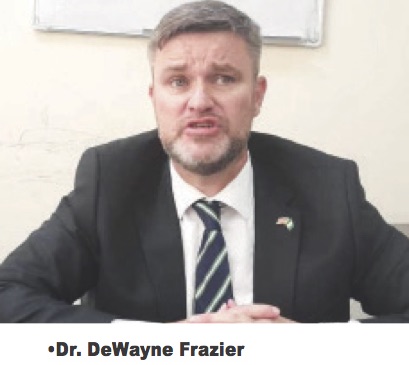
Dr DeWayne Frazier was recently appointed the new president of American University of Nigeria (AUN), having served in several other African countries where he had gathered experience.
In an interview with Sunday Sun, he shared his experience so far in the school, and his dreams of making the university a global one.
He said that under him, the university would train quality nurses and doctors for Northeast.
How has it been since you arrived in Nigeria?
It has been a great time for me since I arrived in Nigeria few months ago. I am not surprised with the reception that I have received so far travelling around Adamawa State, which has a bad reputation in the Western media. Quite a few entities around the world have declared the place unsafe, hence I was urged not to come. But when I arrived, it was the same feeling I get whenever I am in Chicago, New York and other places.
How safe do you feel working in the Northeast region of Nigeria that seems to be volatile?
I feel really safe, but I think like anywhere in the world, you have to be intelligent and careful. I don’t move anyhow neither do I move without adequate guidance and advice. I don’t go in the middle of the night walking around by myself. I don’t go by myself to the market. I try to be smart in all my engagements. Kidnapping still happens especially when they think that someone can afford ransom. So, what I do is to be smart, be vigilant, be aware of my surroundings. I have drivers that take care of me.
Are the people hospitable?
I can tell you for free that Nigerians, particularly Adamawa people, are super nice. They have treated me like one of their own. They care about my safety and wellbeing, and I am grateful for that. I have a better security protocol person under the direction of a US Marine. The US Marine guard ambassadors, politicians, all kinds of top persons in the US. I feel very comfortable and safe in Nigeria. I just have to be careful and follow the protocols that we have, but I’ve never felt unsafe since I arrived in Nigeria.
Have you lived in any part of Africa before coming to Nigeria?
Yes. Africa is like a second home for me. I have three adopted children that are from Eastern Congo, and so Africa has played an important part in my life, and the children had been home for 13 years. It’s been a blessing so far. I found the reception great and I will say again, Nigerians, certainly, can make any food spicy. I mean, I didn’t know that you can get white rice and it would be spicy. Some of these dishes are so authentic, you won’t find them anywhere else in the world and I won’t lie Nigeria has the best Jollof rice I’ve ever had in my life and I’ve had Jollof rice from a lot of places.
What plans do you have to increase the competitiveness of AUN among its contemporaries?
My predecessors have done a lot in the past years for the school, and that could be seen in academic performance of the students. We are not a Nigerian and American University only, we want to be an international global university. A force to be reckon with in global university education system. So, I am actually working with institutions like Times Higher Education, which is the British outfit that does rankings. I am discussing with them about, maybe to host a conference in the future in Nigeria. This will bring African colleges and universities together. I am also going to meet with a couple of the largest research institutions in America, particularly University of Louisville in Kentucky, which has one of the best engineering schools in the world. We would link up with them and their Pan African Studies department.
What level of support is coming from the state government?
Adamawa State government and the governor, Umaru Fintiri, have been supporting us in different ways, and we are optimistic of doing more in different ways. The school has brought businesses and revenue to the state. We will soon start a study on long term chronic illness in Northeast region, and we will apply for larger grants when we find what is the most prevalent, like diabetes, heart disease, and other ailments. We have also been connecting with a lot of Churches and Mosques, and groups in America that can be of assistance. I have already got some groups that want to work with us. So, what I want to do is to get as many international groups and a lot of them will be Americans because we are an American University working alongside Nigerians, because if I get them to visit one time, they would fall in love with the country because the people are so hospitable.
Any plan for medical school?
The dream of having a medical school is on. We want to have a medical school that will help in the production of professional health workers that would, at least, carter for the people of Adamawa State and other parts of the Northeast, and beyond. Just in that region alone, we could produce and employ every single medical doctor that we graduate. That will help to reduce the manpower shortage being experienced in the health care system particularly in the northern Nigeria.
It was recently reported that AUN will also commence some new courses like public health. Tell us more about it?
You are right, and it’s a thing of joy for us. We are on a final work on accreditation process which will be completed very shortly. I have had excellent relationship with NUC since I came. We have paid all the dues, turned in every needed document as required. We expect that within a short time we will get that approval, but I don’t want to foreshadow and say the NUC has already approved it. They have approved quite a few of our other programmes, but I have no doubt of this one. We have invested several resources into the programme. For instance, we have some great people that helped us to start some of the diploma programme. We are going to do the full bachelors programme which is the most needed. But what’s going to make it vastly different is a couple of things. We are working with University of Northern Iowa and we would add some of the American style curriculum to it. So, not only will they take a lot of the general education courses, but they would also have programme where they have to do work in little clinics, either on campus or out in the communities. So, the nurses are going to get so much real world experience, which is required at least at the global level. I don’t know the Nigerian model much yet, but I am learning about it. We intend to produce more nurses and other professional health workers for the Northeast and other parts of the country and beyond.
Do you have any plan for resource exchanges between AUN and others in courses like ICT, engineering?
Each academic programme has to be a little bit different because of how available they are even in the US. One of the most difficult programmes to start in America is engineering because it’s very costly. It’s costly here too, but in America, most small private schools do not run engineering programmes. So, that’s why I am working on a collaboration with a big institution like the University of Louisville, where they would guarantee admissions for our students into their bachelor’s degree; to do their master’s degree in one of the top engineering schools in the world. The other thing is zoom lectures with Americans teaching on a specific topic of their research interest and vice versa. We would do the same with engineering and other courses. Such moves bring in more international students, they can come and study with us for two or three years and then try to go after their studies. So, I get excited about it because we’re going to have more international students. I don’t want my Nigerian students being on campus and being that you know 90 per cent of the students, I want to see a quarter of the students being from around the world, because then Nigerians will grow in their thoughts of being global citizens and they’ll understand what it means to operate in a global economy better.
How do you source lecturers for some of your new courses?
It’s difficult some times, but I do a lot of begging, a lot of praying especially to people who have had education in western schools. A lot of Nigerians that we have are people that come from US and others, and so they have either had the course or they have got close enough academic discipline that we can say here’s an example of the course, here’s an example ixnd it hurts like to even know how things happened. But the first group we educated was not with the ministry. We actually got an individual to fund the first 15 or 20 girls that we trained, and they were girls that escaped that night just before they were taken captive by the Boko Haram, but it’s been a blessing. So, I think we have got a good future with the Federal Ministry of Women Affairs on that.