Follow Us on Google
By Timi Nipre
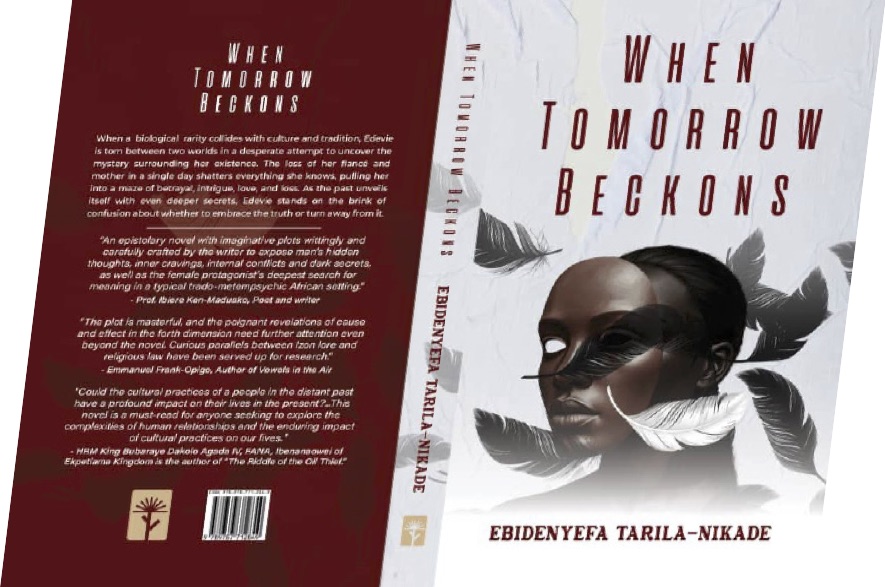
When Tomorrow Beckons is a deeply emotional and socially conscious novel that examines the intersection of personal dreams, cultural expectations, and the indomitable spirit of a woman determined to reclaim her life, despite her tragic life encounters. Ebidenyefa Tarila-Nikade, known for her advocacy on women’s and children’s wellbeing, delivers a narrative that resonates with truth, courage, and an urgent call for societal/cultural reform.
At the heart of the novel is Edevie, who dreams of a fulfilling life and a loving home. When she prepares for her marriage to Ofonime, a man she believes to be the love of her life. She envisions a future filled with sweet love, companionship, mutual respect, beautiful children and shared dreams. However, what begins as a romantic union quickly deteriorates into a harrowing experience of pain, loss, emotional trauma, betrayal and cultural entrapment.
The novel is divided into three distinct segments —”Yesterday,” “Today,” and “Tomorrow” —which serve as metaphors for Edevie’s journey. “Yesterday” explores her youthful innocence and hope. “Today” exposes the harsh realities of her life- the death of the one man she had dreamt of building her future with and her entanglement with her supposed ‘bestie’- Emeka, who even though is married to another woman, cannot stand the sight of seeing Edevie in the arms of another man. “Tomorrow” offers a glimmer of hope and the promise of redemption, underscoring the power of resilience and self-liberation, after fulfilling the ‘eretusa’ rite.
Tarila-Nikade uses Edevie’s personal story to shine a light on several urgent issues facing women in Nigerian patriarchal society in the disguise of tradition.
One, gender inequality. Edevie’s struggles reflect the deep-rooted patriarchal values that expect women to endure hardship in silence to maintain the family structure, as the tradition faults the violation of the supposed sacred institution of marriage, but applauds men for the very same crime.
Emotional Abuse: the narrative doesn’t shy away from the brutal realities of emotional abuse, offering a stark, unfiltered look at how such selfish prowess is often normalized or dismissed by the society.
Stigma Around HIV and other classified health related issues:
Edevie’s tragic case wouldn’t have intensified if her husband-to-be Ofonime, had not come to the abrupt realization of his status during their marriage counseling session with the church marriage committee without any form of emotional preparation for the news, whilst they were still in jeopardy with the confusion of their genotype results- AS and AS. Perhaps she wouldn’t have lost her mother just yet. Tarila-Nikade challenges this stigma, advocating for women’s right to safety, dignity, and choice.
The Christian Faith and Self-Righteousness: The novel also touches on the discriminatory judgments of the society on another, when we all know that there’s actually no one without blemish. with Edevie facing pressure and blame for her pre-marital escapades with Ofonime, and her later entanglement with Emeka, which eventually leads to only more pain and betrayal.
Myth: The novel opens us up to the possibility of the reality of our existence as tied to a supernatural force beyonds us; in this case, the myth of reincarnation as seen in the concluding chapters of the book. All of Edevie’s pain and sufferings is eventually tied to the reincarnation story of Tariere, who had committed the sacrilege of adultery, which led to the death of her husband without the rite of ‘eretusa’ been done to appease the gods and avert the wrath of the gods that often led to calamity in the family. In order for her to end the evil cycle, she must go pay for the compensation that Tariere had failed to pay or else the cycle would continue upon her early death as it had been in her previous lifetimes.
Character Development: Edevie is a remarkably well-drawn character—multifaceted, intelligent but emotionally complex. Readers witness her transformation from a naive young woman in love and preparing to be married to the love of her life as seen in her letter to her friend Sele, to a vulnerable and weak woman, who becomes prey to a manipulative and unremorseful ‘bestie/childhood crush’ who further complicates her life in the disguise of her guardian angel and later to someone who learns from the ruins of her life, to prioritize her own voice, worth, and future. This growth is neither sudden nor simplistic. It is hard-won and realistic, making Edevie an unforgettable protagonist whose journey speaks for many silenced voices.
Emeka, as the antagonist, is disturbingly loyal at first, a calculated portrayal of how manipulators often present themselves. His descent into the selfish patriarchal entitlement mentality is gradual but chilling, allowing readers to experience Edevie’s shock and disillusionment firsthand as events unfold his true intentions.
Secondary characters, such as Edevie’s mother, father, aunties, colleagues, church members, to be in-laws, and friend Sele, also contribute to the novel’s emotional depth—some acting as enablers of betrayal, greed, moral judges, entitlement mentality in the disguise of help as seen with her aunt, while others as rare sources of love and support as seen with her parents and colleague Hauwa.
Dr. Ebidenyefa Tarila-Nikade writes with lyrical clarity and emotional precision. Her prose is both accessible and very rich in the english vocabulary as well as the traditional language of the ijaws especially, and often laced with Igbo idioms and cultural references as well, that root the story in a specific Nigerian context while maintaining its universal relevance. The dialogue is natural, the pacing well-balanced, intriguing… and the transitions between past and present smooth and evocative.
The author does not rely on melodrama to make her point. Instead, she carefully builds emotional tension through nuanced scenes and introspective monologues and dialogues in this letter to her friend Sele. The result is a story that feels lived-in, authentic, and quietly powerful.
When Tomorrow Beckons is more than a novel —it is a social mirror, a call to action, and a testament to the strength of women who choose to stand tall even when the world around them tries to keep them kneeling. Ebidenyefa Tarila Nikade has crafted a story that is both heartbreaking and hopeful, one that speaks directly to women struggling in silence, and to the society that too often fails to hear them.
This is a book that should be read in classrooms, book clubs, and advocacy groups. It challenges harmful cultural norms while offering a path forward, where tomorrow indeed beckons —and where women can finally answer that call on their own terms.