Follow Us on Google
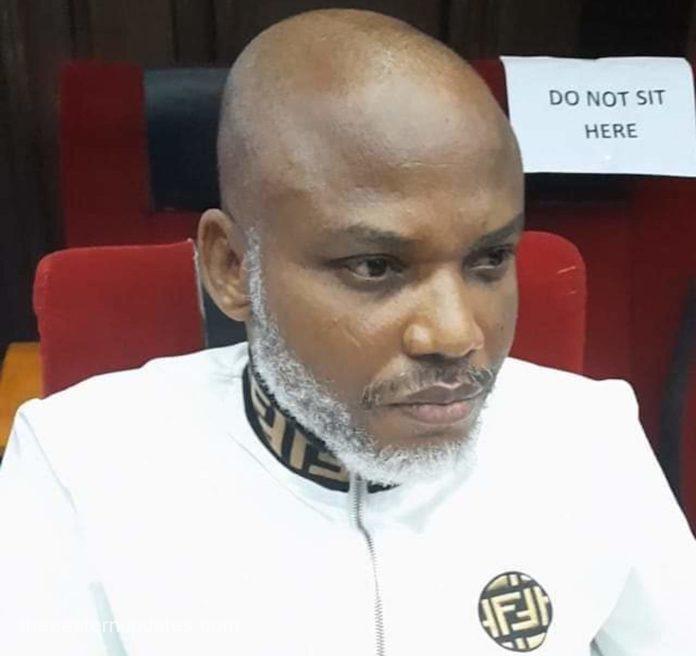
After 10 years of tortuous trial, Justice James Omotosho of the Federal High Court in Abuja sentenced the leader of the Indigenous People of Biafra (IPOB), Nnamdi Kanu, to life imprisonment. The judge had convicted him of all the seven terrorism-related charges which the Department of State Services (DSS) prosecuted him for.
For two of the charges, Kanu got a combined 25 years in jail without option of fine. It will run concurrently. Omotosho said the law allowed the court to sentence him to death for the terrorism offences, but that “death sentence globally is being frowned upon by the international community.” He ordered that the defendant be kept in a protective custody in any part of the country, but not in Kuje prison, Abuja. He also ordered that the radio transmitter be forfeited to the Federal Government. Kanu was later moved to a correctional facility in Sokoto.
Kanu first faced charges in 2015. He secured bail in 2017, but later fled the country. He was re-arrested in Kenya in 2021 and has been in custody since then. The recent judgment failed to look at the bigger issues that led to his agitation. No doubt, the judgment has attracted mixed reactions. While some applauded the ruling, others slammed it for failing to address other issues raised by the defendant.
Many believe that his incarceration may worsen the fragile security in the South-East where the people observe compulsory sit-at-home order every Monday. The weekly holiday has ruined the South-East economy. Notable Nigerians including political bigwigs from the South-East have called for calm, stressing that they would seek political solution to resolve the matter. Some, however, read selective justice in Kanu’s matter. While some of the main terrorists in the North-East are being rehabilitated and begged to stop terrorism, Kanu, a freedom fighter, was given a life sentence. This is contradictory. Only political solution will resolve the matter and the restiveness in the South-East.
Beyond the conviction of Kanu, the government should address issues that gave rise to his separatist agitation. They should not be glossed over or swept under the carpet. The marginalization of the South-East is real and must be fully addressed. Additional state and more local governments to the zone will engender equity in the country as only the South-East region has five states while others have at least six. More than 50 years after the end of the Nigeria/Biafra war, there is urgent need for reconciliation, healing and closure.
The Yakubu Gowon administration came up with three Rs: Reconciliation, Rehabilitation and Reconstruction immediately after the war. Nevertheless, that did not make any meaningful impact. Since after the war, the South-East has been schemed out of the political equation in Nigeria. No one from that zone has been found worthy to be the President of Nigeria. Democracy demands inclusiveness, and any feeling of marginalization in any part of the country should be addressed and resolved.
Other News
In terms of infrastructure development, the region is also marginalized. Many of the federal roads in the zone are dilapidated. The federal presence in many other areas of development is too low. The region suffers discriminatory policies in admission into federal unity colleges. It is also shut out in major political appointments. This is against the Federal Character principle as enshrined in Section 14(3) of the 1999 Constitution (as amended).
Agitation against this type of arrangement led to the formation of IPOB and similar groups. To suppress this agitation, the Federal Government, in 2017, sent troops to the region. In Operation Python Dance, as it was then called, soldiers ended up arresting, torturing and in some cases, killing many youths of the region, some of whom were innocent of the allegations against them.
Jailing Kanu without addressing the root causes of what led to the agitation will not solve the problem. There must be conscious effort to truly end the civil war and rehabilitate the region. The establishment of the South-East Development Commission (SEDC) is a good step, but the commission must be empowered to do what it was set up to do.
There has to be a second look at discriminatory admission policies in public schools. Granted that quota system in place is to grant access to education to educationally disadvantaged states, there should be a standard benchmark for all candidates. It is highly provocative to deny admission to a child who scores as high as 130 out of 300, but give admission to another child who scores as low as 20 marks.
This boils down to restructuring or constitutional reforms which a good number of Nigerians have called for. If there is devolution of powers from the centre down to the regions, as it was in the First Republic, it will go a long way in enthroning equity in the system. Each region will develop at its pace and make returns to the centre. It will minimize the agitations for self-determination. The Bola Tinubu administration should bequeath this legacy to Nigeria.