Follow Us on Google
In the world of hard news in journalism, truth is told, but feeling is always left out. The news writer must not inject his own opinion into the news because he must uphold the principle of objectivity
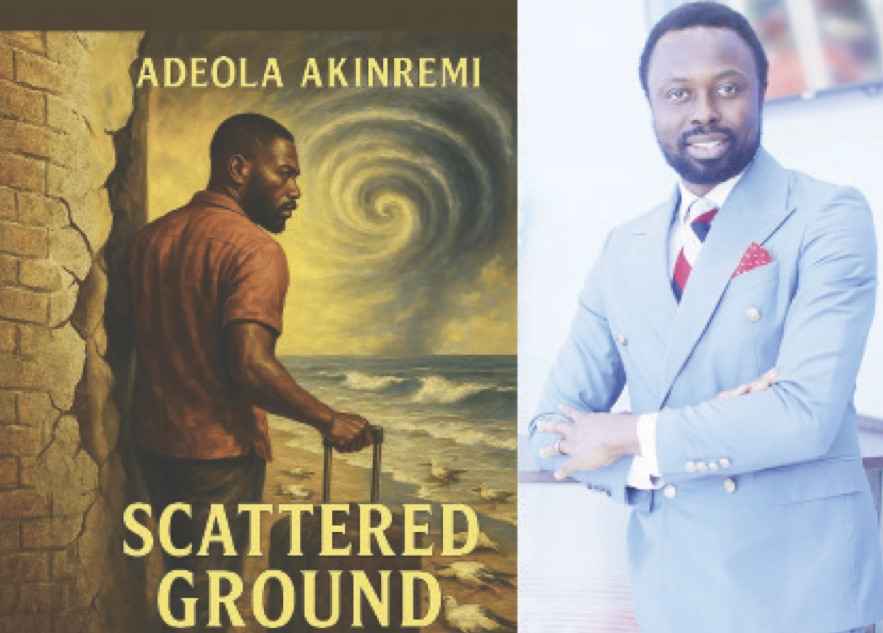
For years, one of Nigeria’s fearless journalists, Adeola Akinremi, stood at the centre of some of the nation’s most explosive stories, including terror, politics, corruption, and human suffering. He filed reports that shook power and stirred global attention.
He is a United States-based public policy expert, who is widely regarded as one of the most decorated journalists of his generation.
Some of his stories have been referenced and cited by the Associated Press, The New York Times, The Guardian UK, The Washington Post, and the Los Angeles Times. Currently, he is on study leave from THISDAY.
But behind those powerful headlines lay something deeper, heavier, and that he could never publish.
Now, in a dramatic and emotional turn, the award-winning journalist has finally broken his silence. He did not do this with another investigation, but with poetry.
His debut collection, ‘Scattered Ground’, has been observed that it is not just a book, but a raw and unfiltered outpouring of everything he left unsaid.
“Scattered Ground is everything I could not say in a news story or policy environment. The grief behind the dateline, the hope beneath the headline, the human soul that statistics can never capture,” Akinremi, former Features Editor of THISDAY, and World Bank Group consultant, declared.
As features editor with THISDAY, he built his name on fearless reporting. He was known for stories that cut through propaganda and exposed uncomfortable truths.
Akinremi has been honoured with the Nigeria Media Merit Award (NMMA) for Newspaper Reporter of the Year (2014), the Nigeria Media Merit Award for Features Writer of the Year (2006), and the Diamond Award for Media Excellence, which are three of the most prestigious recognitions in African journalism.
But in 2015, that courage came at a cost. After publishing a report from Adamawa State on the suffering of internally displaced persons during the Boko Haram insurgency, Akinremi became a marked man.
The terror group issued a public death threat against him. But what was his offence? He was said to have been accused of speaking too boldly, writing too truthfully, and refusing to soften the horror.
The situation became so serious that the Committee to Protect Journalists had to intervene. The committee called on Nigerian authorities to ensure his safety.
For many, that would have been the end. He could probably have stepped back in order to stay safe. But not Akinremi. He kept writing stories that perhaps shook the presidency.
In 2016, Akinremi delivered one of the most shocking political exposes in recent Nigerian history. He uncovered a plagiarism scandal, involving former President Muhammadu Buhari. He revealed parts of a major speech that had been lifted from a speech delivered in 2008 by former United States President, Barack Obama.
The story exploded, and spread across global media. It sparked outrage, and forced a rare and embarrassing apology from the presidency. Though the world reacted to the story, only Akinremi understood the weight of chasing it.
The silence behind the story is where the Scattered Ground begins. It was noted that journalism, no matter how powerful, has limits. It captures events, but not always emotions. It reports suffering, but cannot fully hold grief. It counts victims, but cannot measure pain.
Two among the questions that probably remained unanswered when Akinremi was in an active journalism include what happens to the silence after an interview ends? And what happens to the images that refuse to leave your mind?
For years, Akinremi carried those questions. Now, he has answered them with poetry. With Scattered Ground, Akinremi strips away the rules of journalism and steps into a space where nothing has to be trimmed, edited, or balanced. The world of poetry is where the truth is not just told, but it is felt.
The poems dive into the emotional core of the issues he has spent years reporting, including war, displacement, climate crisis, failed leadership, and identity.
But this time, there are no headlines, no word limits, and no restrictions. It is just about raw honesty.
In Scattered Ground, climate change is not seen as a debate, but devastation. Akinremi writes about communities losing everything, such as farmlands turning to dust, rising seas swallowing homes, families forced to flee not because of war, but because nature itself has turned against them.
These are not distant stories. They are real encounters from his years of reporting and policy work across continents. In the poetry, they hit differently. The Scattered Ground makes people understand the crisis and also feel it.
Akinremi also turns his lens on power; the same power he once scrutinised as a journalist. But in poetry, his voice changes. It becomes quieter, sadder, and more reflective.
He writes about governments that fail their citizens, institutions that silence dissent, and systems that deepen inequality. He also looks into the anger in the land, which, according to him, is controlled, measured, and almost mournful.
He reasons that beneath every criticism lies disappointment, with a belief that things could have been better.
One of the strongest themes in Scattered Ground is displacement. Akinremi clarifies that it is not just physical displacement, but emotional and psychological. He explores what it means to leave home, and what it means to stay behind.
Some of the lines say: For those who leave, home becomes a memory. For those who stay, home begins to disappear.
The situation is considered to be a powerful and haunting reflection of the world where millions are constantly on the move, searching for safety, opportunity, or simply survival.
Akinremi’s poetic voice does not exist in isolation. He draws inspiration from literary giants, who are a select and remarkable global tradition of newspaper editors, who have chosen poetry as a second language, a tradition that cuts across continents and centuries from Britain to America , France and Nigeria.
In Britain, the journalist and critic Clive James, long associated with The Observer and The Daily Telegraph, published several poetry collections, including the celebrated Sentenced to Life (2015), written while dying of leukaemia, which became a Sunday Times bestseller and was hailed as proof that a prose man of letters can, in the end, speak most purely in verse.
In America, Harriet Monroe, who founded the groundbreaking magazine Poetry in 1912 while working as arts critic for the Chicago Tribune, published multiple poetry collections, including You and I (1914), helping to usher in the Modernist era. Rita Dove, a former Poetry Editor of The New York Times Magazine and U.S. Poet Laureate, has published ten books of poetry, demonstrating that the editorial chair and the poet’s desk need not be separated.
In France, Philippe Sollers, founder and editor of the literary journal Tel Quel and later L’Infini produced poetry-infused prose works including the radical Paradis (1981), a landmark in the French avant-garde tradition that blurs the line between journalism, criticism, and lyric form.
And in Nigeria itself, J.P. Clark-Bekederemo, who worked as Features Editor of the Lagos Daily Express, became the nation’s pre-eminent poet and playwright, proving that the African press has always been incubating poets as well as reporters. Akinremi follows proudly in that lineage.
Also, the Weekend Editor of The Sun Newspapers, Tope Adeboboye, has chosen poetry as his second language. Apart from his novel, entitled: ‘Sunny Side of Midnight’ he has to his credit, ‘Songs of My Rebirth’, which is a poetry collection
But Akinremi’s story is uniquely Nigerian. It is rooted in the chaos, resilience, and contradictions of a nation constantly in motion.
“Journalism gave me the world as it is. Public Policy is the way I intervene with government decisions with consequences on human lives. Poetry gives me the world as it must be felt. Scattered Ground is everything I could not say in a news story or policy environment, the grief behind the dateline, the hope beneath the headline, the human soul that statistics can never capture,” he stated.
The Scattered Ground, according to Akinremi, is not just a poetry collection, it is a release, a reckoning, a confrontation with everything left unsaid, the emotional archive of a journalist who has seen too much to remain silent.
In a media world obsessed with speed, clicks, and breaking news, Adeola Akinremi has chosen a different path. He has slowed down, reflected, and spoken from the deepest place possible.
He believes that sometimes, the headline is not enough, the story continues long after the paper is printed, and the only way to tell the full truth is through poetry.
Akinremi, with Scattered Ground, has gone beyond just reporting the world. He is feeling it, and he wants all and sundry to also feel it too.