Follow Us on Google
From Scholastica Hir, Makurdi
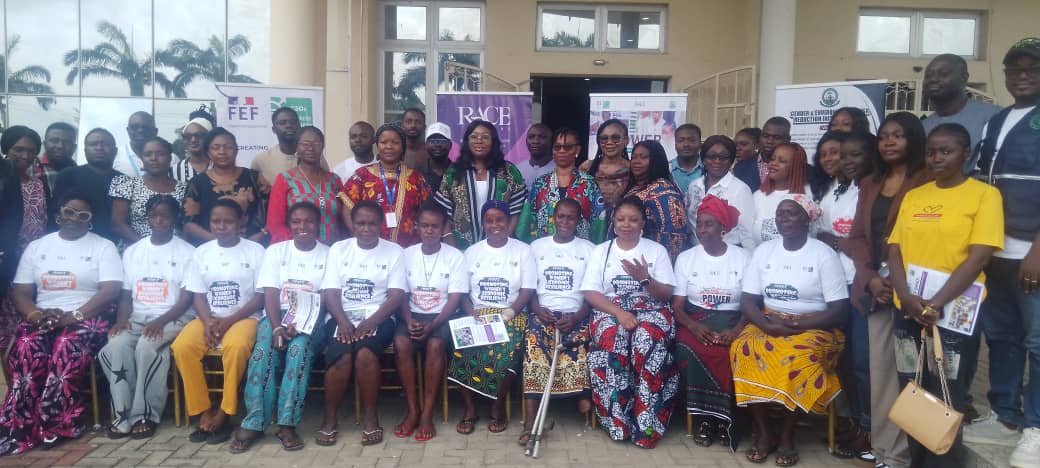
Over 50 women from Internally Displaced Persons (IDP) camps and host communities in Benue State have benefited from skills acquisition training designed to empower women in conflict-affected communities.
The scheme, which is under the “Promoting Women’s Economic Empowerment/Resilient Project (POWER),” meaning “Tahav” in Tiv language, is implemented by the Centre for Redefining Alternative Civic Engagement for Africa (RACE Centre), in collaboration with the Gender and Environmental Risk Reduction Initiative (GERI), and supported by the French Embassy in Nigeria.
The essence is to build economic resilience of Gender-Based Violence (GBV) survivors and other vulnerable women in IDP camps and host communities in the state.
Speaking during a Women Empowerment Dialogue meeting for Conflict-Affected Communities in Makurdi, the Executive Director of RACE Centre, Evelyn Ugbe, said 50 women have already been trained in various skills, including tailoring, hairdressing, bag and soap making, and baking, among others.
She said the theme of the event, “Building resilience & advancing economic opportunities for women in conflict-affected communities”, reinforces commitment to sustainable empowerment and resilience among women who have been disproportionately impacted by conflict and displacement.
“Our mission today is simple: to explore innovative, sustainable strategies and best practices that can empower women economically, contribute to implementing the State IDP policy and State Durable Solutions action plan, and create a platform for networking among stakeholders.
“We strongly believe this event will not be another talkshop but will lead to actionable recommendations for a sustainable, comprehensive livelihood support system for women in IDP communities.”
Ugbe, who described the women as “their Sheroes”, tasked stakeholders to ensure sustained financial assistance for women in IDP camps, saying the funds are vital to enhance their economic resilience and facilitate their journey towards self-sufficiency and dignity.
She disclosed that a needs assessment of 100 women in Daudu II IDP camp and host communities in Guma LGA revealed that while 48% lack formal education, 77% face financial exclusion, and 94% demand vocational training.
She urged the government to integrate women IDPs into economic empowerment initiatives, provide safe spaces and mental support, facilitate access to markets for their products, and create linkages to pave the way for business opportunities.
Other News
Speaking, the Executive Secretary of GERI, Mrs Elizabeth Jeiyol, applauded the Sheroes for showing commitment to their training and the French Embassy for facilitating their project of empowering women in conflict-affected Benue communities.
The Special Adviser to Governor Hyacinth Alia on Women Affairs and Benue State Coordinator of the Renewed Hope Initiative/RHI, Hon. Scholastica Ben-Sor, noted that an empowered woman is an empowered society girded with stability and development.
According to her, society benefits greatly from women’s empowerment, especially in peacebuilding, fostering social cohesion, community resilience, and well-being, among others.
Mrs Ben-Sor said achieving women’s economic empowerment requires political will and collaborative efforts from governments, civil society, NGOs, and the private sector to create transformative solutions that empower women and girls, leaving no one behind.
She urged all stakeholders to not only build women up but give them economic power in every sense, which is the pathway to the safety and development of children, especially the girl child.
The Director General, Bureau for International Cooperation and Development (BICD), Dr Leo-Angelo Viashima, who was represented by the Acting Director/Head, Human Resources and Administration, Beauty Adaaku, said as the coordinating body for humanitarian partners and development agencies in the state, BICD recognises that sustainable recovery and lasting peace cannot be achieved without the full and equal participation of women.
Viashima said, “Their leadership, economic inclusion, and social empowerment are not only essential for rebuilding communities but are also fundamental to achieving long-term development goals.”
He assured that the state government, working with partners, would strengthen resilience by expanding economic opportunities, fostering access to resources, and creating safe, inclusive spaces where women can thrive as entrepreneurs, workers, leaders, and change-makers.
Some of the women, Martina Atom, Terwase Precious, and Grace Ogbe, said their lives have taken a new turn since they met with RACE Centre and GERI and started the training. They appreciated the organisations and the French Embassy for their intervention, expressing hope that the state government would own the programme and sustain it until they can find their feet.