Follow Us on Google
From Adanna Nnamani, Abuja
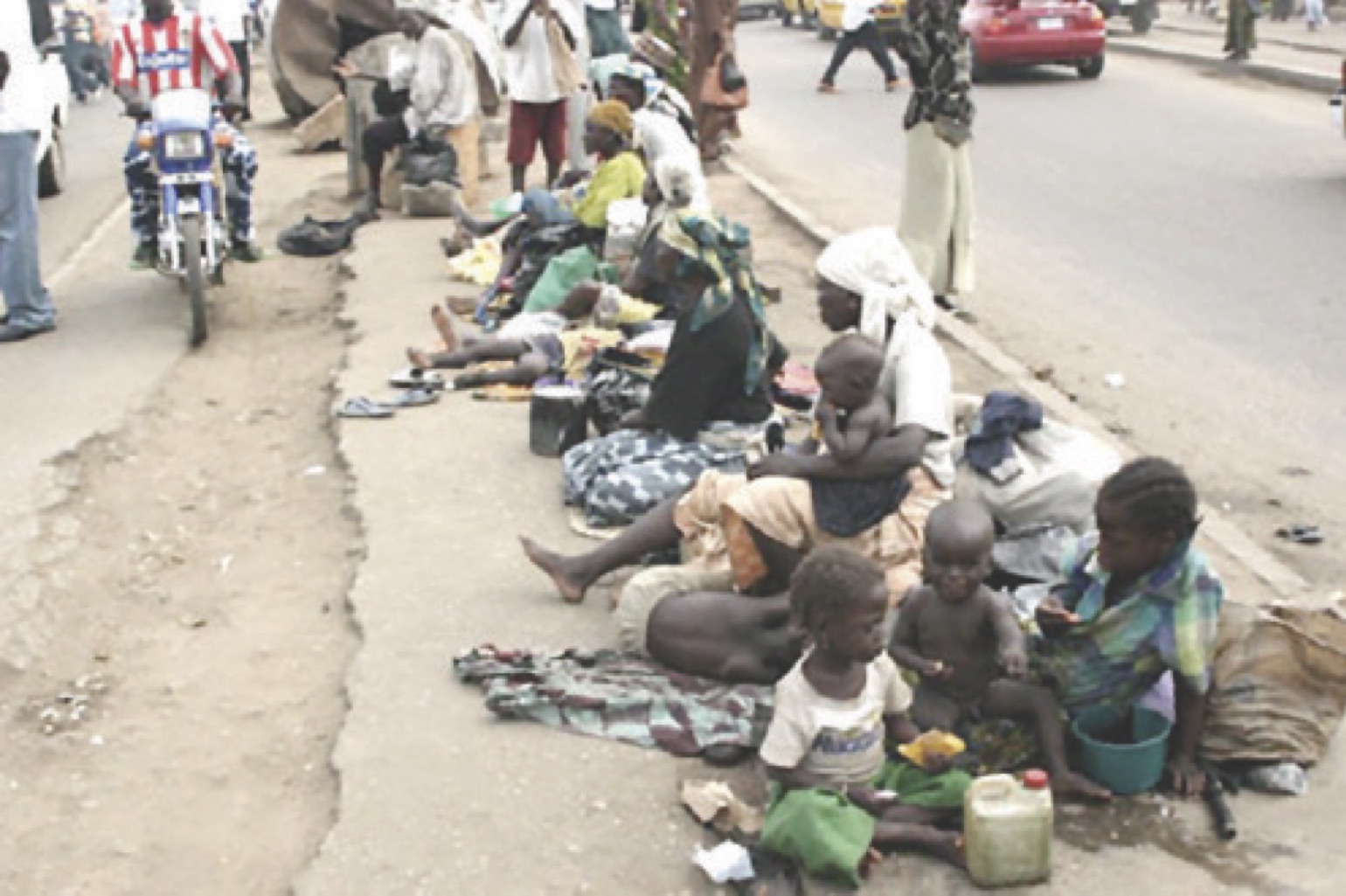
What was once associated with street corners, outstretched hands and disability in Nigeria, is quickly evolving into a widespread trend and culture.
Today, begging is no longer restricted to the visibly needy, sick or physically challenged, it is becoming a norm, creeping into everyday interactions, as individuals across different professions subtly and even brazenly solicit extra cash.


One question you hear almost everywhere, whether it is in the supermarkets, fuel stations, restaurants, or at the airports, is, “Madam, anything for me?” Or “Oga, something for the weekend?”
From uniformed personnel to service workers, many more people are now relying on tips, favours and outright pleas as a steady side income, raising questions about professionalism, dignity and culture.
Just recently, the conversation around Nigerians and the growing trend of begging sparked online after a Ghanaian ride-hailing driver went viral for his remarks. In a video clip circulating on X (formerly Twitter), the driver told a tourist that Nigerians are quick to ask for money, describing it as a common habit.
In his words, “if you go to Nigeria eeh, the whole people are beggars. They will beg you for money. That is to tell you how much they beg.”
The comment divided social media users. While some criticized him for generalizing an entire nation, arguing that not all Nigerians behave this way, others shared their experiences.
Recounting one of her numerous experiences, Gift Nosa, a public relations consultant based in Lagos, told Daily Sun: “Just the other afternoon, I had stepped out of a supermarket in Ikeja, Lagos trying to reach my car while balancing grocery bags and feeling tired, when a security guard approached me with a polite smile. Just as I was wondering if he was coming for a security check, he stretched out his hand and said, ‘something for the weekend, ma.’”
Nosa said what is more concerning is how normalized the practice has become, noting that in the past, tipping was seen as a gesture of appreciation, typically voluntary and occasional, but today it feels compulsory.
She said it has now become so bad that she is often compelled to carry extra cash or avoid some public spaces because of such behaviours.
According to her, “Before now, Nigerians were known for resilience. Even when things were hard, people found ways to survive without begging. But now it is everywhere
“You see it at the airport, hospitals, malls, even fuel stations. Staff will attend to you and then ask for ‘something for the weekend.’ It’s becoming a norm.
“Most times in shopping malls, staff will quickly help you carry things even when you clearly do not need it or give you special attention so you will feel pressured to give them something. You end up feeling like a bad person if you do not. Anywhere you go now, someone will ask you for money. It is getting too much.”
For her, it is becoming more common because it is actually pays off. “If they were not making money from it, they would stop. But, clearly, people are giving them money, so it has become like a side hustle.”
For Chima Obidimma, a businessman based in Port Harcourt, Rivers State, the rise in begging is mainly due to economic hardship, low wages and unemployment. He opined that many workers are forced into the habit because their earnings are no longer sufficient to meet basic needs.
He also blamed the trend on weak workplace ethics and poor enforcement of professional boundaries, which allow such behaviour to thrive. He said that there is a shift in mindset among some young people, where the desire for quick financial success discourages patience and hard work.
Obidimma noted that while begging may not be ideal, it is becoming an inevitable coping mechanism in a struggling economy. He argued that, unless there is a significant improvement in economic conditions and job opportunities, the trend is unlikely to disappear: “I think it is mainly because salaries are not enough to meet people’s needs. Even those who are working cannot survive on what they earn, so they resort to begging.
“Some companies do not set clear boundaries. Staff feel it is okay to ask customers for money, and it becomes part of the culture.
“A lot of young people are not working, and if you are not earning you will look for alternatives. Some people do not want to start small. They want quick money, and when that doesn’t happen, they turn to begging.
“I do not think there is anything that can be done to completely stop it. Nigeria is one of the poorest countries in the world so people will always beg to survive. As long as the economy is bad, begging will continue. If the economy gets better and more jobs are created, that is when you will see a real reduction.”
Similarly, Afam Okwuone, a media consultant, argued that the current wave of begging shows how difficult life has become for many Nigerians. According to him, people who ordinarily would not beg are now pushed into it by necessity, adding that the pattern is becoming more targeted and opportunistic, with individuals approaching those they perceive as financially comfortable, especially in public places like supermarkets, banks and fuel stations.
Although Okwuone admitted that some people beg out of habit, he, however, insisted that the broader issue is structural, driven by job losses, low income and rising living costs. For him, the situation is unlikely to improve unless there is a significant turnaround in the economy.
His words: “It is based on the fact that the economy is tough. A lot of people are now begging because they do not have any other means to survive. Before, it was not this bad. But now, everywhere you go, supermarkets, fuel stations, even banks, people are asking for money. When they see that you bought a lot of things or filled your tank, they believe you can spare something. Some people are just natural beggars, but many are doing it now because things are very difficult.
“There are no jobs, and even when people are earning, the money does not cover much. The only way this can be reduced is if the economy gets better and more opportunities are created. I do not see it stopping anytime soon because the hardship is still there,” he stated.
A civil servant, Happiness Wililams, cited low income, laziness and lack of contentment as possible reasons for the increasing behaviour in the country.
According to her, “I have not really had an experience about it, but I think some of them beg because their salary is low and cannot sustain them till the next pay so they decide to beg to support themselves
“While some beg because they feel begging is the fastest way of money without stressing yourself, others that are working in an establishments that pay them well and still beg is because they are not contented with what they are being paid and they need more.”
On his part, a labour rights activist, Fidelis Ashaku, said the rise in begging is not just as a result of moral failings of individuals but a symptom of deeper structural and economic problems.
For him, the behaviour reflects systemic issues, including low wages, high unemployment, weak labour protection and the widening gap between elite and ordinary citizens.
He said: “Yes I have noticed this trend too, and honestly, it is something we cannot just dismiss as ‘bad behaviour’ or ‘lack of dignity.’ What we are witnessing is a social signal, a visible symptom of deeper structural issues.
“From my own experience, it has become almost unavoidable. You walk into a mall, and before you even settle in, someone is subtly (or directly) asking for ‘something.’ At airports, security personnel who are meant to embody professionalism now hint for tips. Even in everyday spaces, the line between service and solicitation is getting blurred.
“As an activist, I do not see this as a moral failure of individuals. I see it as a failure of systems. When a society consistently produces conditions where people cannot meet their basic needs through dignified means, informal survival tactics begin to emerge.
“What many call ‘begging’ is, in reality, economic desperation wearing different uniforms, sometimes literally. A security guard asking for money is not just an individual acting out; he is a worker whose wages likely cannot sustain him in an economy marked by inflation, unemployment and weak labour protections.
Ashaku raised concerns about the wider social consequences, noting that while survival tactics are understandable, the normalization of asking for tips or informal payments risks eroding professionalism, weakening institutions, and reinforcing inequality.
He suggested that the focus should shift from blaming individuals to addressing the societal and economic conditions that force people into these behaviours.
For those on the receiving end of criticism, the explanation is simply survival. A security guard at a shopping plaza in Abuja, who spoke on condition of anonymity, said his monthly earnings barely cover transportation and food.
“Madam, things are hard. What we collect is not enough. Sometimes, it is the small things people give that help us survive,” he said.
Meanwhile, a journalist and sociologist from the Obafemi Awolowo University, Idowu Isamotu, framed the increase in begging as a long-standing societal phenomenon that has recently taken on a corporate dimension.
According to him, begging has existed in human societies for centuries, but today it is more visible in professional and formal spaces such as malls, airports, and offices. He attributes the trend to a combination of economic pressure, systemic failures, and changing societal norms.
Isamotu emphasised that economic hardship is a major factor as stagnant salaries, rising costs of food, housing, and transportation push many workers to seek alternative ways to survive. For some, he said the practice is driven by personal ambition or greed.
He also noted that the normalization of tipping and solicitation in formal spaces has blurred the lines between service and “soft begging,” warning that over time, this can undermine professionalism and institutional integrity, as workers prioritize personal gain over duties.
He said: “Begging has been existing from the time immemorial. The only difference now, I mean in recent times, is that corporate begging is now gaining momentum, especially in cities like Lagos, Abuja, Port Harcourt and Kano, among others.
“Tipping” is already a social norm in our society except we want to live in denial which will not do us any good.
Just go to courts, banks, airports, correctional facilities, and others. It is already part of the system to say “Thank you” when leaving if you want to be reckoned with next time you visit the places for help.
“I will say it had been existing for a long time but it became emboldened in the recent time following unfavourable government policies to the poor.
“Virtually all the professions are affected already with this development because, like I said, it is already a social norm. Nobody cares about professionalism again because everyone is becoming more compromised in his or her dealings.
“In the long run, there will be a deepening collapse of the systems because right things will never be done by these categories of people. We have seen a situation where some files are hidden by some clerical staff in some offices just because they were not tipped by the party seeking something in that office.”
Pakistan and Nigeria are often cited as having some of the highest numbers of beggars globally, with estimates placing the figures running into several millions. High rates of poverty, unemployment, and social inequality in developing nations contribute to these trends.