Follow Us on Google
•Price of tomatoes jumps from N7,500 to N18,000 in Kaduna market
From Sola Ojo, Kaduna

For several years in the past, February used to be tomato season in Bakin Dogo Market. There, buyers made choices and paid a token for a whole basket or other smaller measures while the seller begged to sell.
But this February is different as sellers and buyers are confused about the skyrocketing prices of tomatoes in the same market.
According to Wikipedia, the tomato is an edible berry of the plant Solanum lycopersicum, commonly known as the tomato plant. The species originated in western South America, Mexico and Central America. The Nahuatl word tomatl gave rise to the Spanish word tomate, from which the English word tomato derives.
Raw tomatoes are rich in vitamin C, which brightens skin and fights inflammation, while cooking tomatoes releases more antioxidants such as lycopene, which may protect against cancer. Tomatoes offer various benefits and contribute to heart, cognitive (brain) and prostate health, Verywellhealth says.
Even when many individuals and households don’t know the health benefits of this juicy edible berry, they want it for stew thickening, salads and other staple foods either for private or commercial purposes.
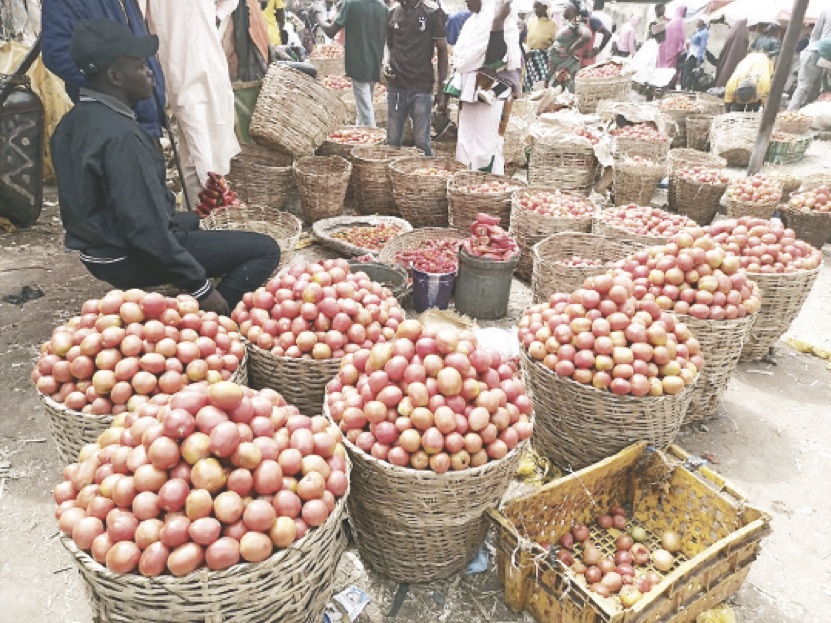
When Daily Sun visited Bakin Dogo, the largest foodstuff market in Kaduna cosmopolitan city, located in Kaduna North local government area of the state, there were several baskets of different species of fresh tomatoes on display with a few buyers in sight.
A caterer identified herself simply as Madam Joyce, who came to buy tomatoes and other soup ingredients at the market from Karji in Chikun local government area of the state, said she was shocked at the prices of tomatoes compared to her budget, based on what she bought three weeks earlier.
“I drew my list based on the estimates of three weeks ago. Then we were still complaining that it was high. But today, we were shocked at the prices.
“We have been checking all over the place and it appeared they have all agreed on how much to sell. This is why you see me sitting down here.
“In this same market three weeks ago, I bought a basket of tomatoes for N7,000. Today, Wednesday, February 7, 2024, they are selling it for N19,000.
“From the look of things now, the price is not likely going to come down as it used to be by this time. Though I planned to buy a basket, as it is, I can only buy half a basket,” she said.
For Mrs. Grace Familugba and many other Nigerian ladies, she could not imagine her kitchen without tomatoes – fresh or preserved.
Grace used to come to the market this time to buy baskets of tomatoes and preserve them for her domestic use until the following season. Unfortunately, her budget this time could not give her the usual target.
She said: “Everything has gone up beyond imagination. In Nigeria today, we can no longer add prices to our market list. There are different prices for morning, afternoon and evening.
“I’m tired. I’m just weak because of the prices of things. The amount we used to sustain the family for two to three weeks can now last for just a few days. Things are not just adding up. We are just tired and short of words.
“The only thing is to learn how to preserve the tomatoes since tomatoes are a very important part of our daily meals. This is what I’ve been doing for years.”
A tomato seller and member of Tomatoes Sellers Peace and Unity Association, Mogadishu Layout, Bakin Dogo, Kaduna, Umar Sagir, blamed subsidy removal for the tomato price woes.
“The only problem is the removal of fuel subsidy. This has continued to hurt our purchasing power. For example, before the removal of fuel subsidy, we used to buy tomatoes in the bush at the rate of N4,000 or N6,000, depending on the species.
“These prices include transportation from the point of purchase to this market. Now we buy between N11,000 and N12,000, pay N2,000 transport per basket, and don’t forget that some of them will perish during loading and offloading.
“So, patronage has been low because not everybody can afford it. This is supposed to be the cheapest season. But it is not so because fuel determines the costs from planting to harvesting and marketing.
“The only solution is for the government to bring back the fuel subsidy. That may sound funny and unrealistic but that is the only solution because things are already getting out of hand,” he said.
On his part, the secretary, Tomato Sellers Association, Kaduna State Chapter, Dalhat Adam, who has been selling tomatoes for more than 30 years at Bakin Dogo market, Kaduna, said the business was moving well.
“The business is moving fine. We have derica, UTC, serial, and other types of tomatoes for sale. We are supposed to be in the season of tomatoes by now. Unfortunately, that season may not come this year due to emerging factors, especially the esubsidy removal.
“By this time last year (February 2023), we were selling a basket of tomatoes between N6,000 and N8,000, depending on the type and sizes. This time around, we are selling up to N18,000.
“We get the bulk of tomatoes we sell in this market currently from Kadawa in Kano State, which is the largest place we source our tomatoes from. In a day, we see the supply of up to 60 trailers moving around the country. In this particular market, we offload at least three trailers per day,” he said.
Explaining that the tomato business is unpredictable, he said: “You can gain and lose within days. Unlike other businesses that may take months and years to record losses but in the tomato business, you can lose all your investment within three days and back to square zero. It is not what anyone can come and join. We still have a lot of losses.
“Don’t also forget that most times, people buy tomatoes with baskets for easy transportation and we get these baskets from as far as Onitsha in Anambra State at N700 each.
“Again, we have to go to tomato farms with these baskets. This is because it is cheaper at N700. When you want to buy it on the farm, you will pay as high as N1,200 per one. And you know in this type of business, N500 is a lot of money.”
On the possibility of setting up a tomato processing plant within the market to address wastage, he said: “For now, we don’t have any tomato processing company in this market despite the volume of tomatoes we have. Most of our customers are those who buy and resell in other small markets and communities.
“However, two weeks ago, a Lagos-based company approached us to provide a cooling warehouse where we can keep our tomatoes to reduce losses. According to them, the warehouse will be like a cooler where we can keep unsold tomatoes. We are still discussing the fundamentals of this proposed partnership.”
A tomato farmer, Bello Mustapha, blames insecurity and the high cost of farm inputs for the high cost of tomatoes in the market.
He said: “The spate of insecurity and high cost of farm inputs, including seedling and fertilizer, among others are majorly responsible for what you see in this market. We can no longer have access to our distant farmlands because of bandits.
“Again, those who can go to farm, especially in Kano State also battle the high cost of farm inputs. They can only sell based on what they spend. The harmattan season is what is helping some of us because the tomatoes are not ripening fast.
“So, if there is improved security and more farmers can have access to their farmlands, the better for us because some people will plant naturally without looking for improved variety which will at least serve their domestic purposes,” he said.
Photos as they appeared:
1) Joyce (smiling expression)
2) Grace (second lady)
3) Sagir
4) Dalhat
5) A seller waiting for the buyer(s)