Follow Us on Google
By Henry Akubuiro
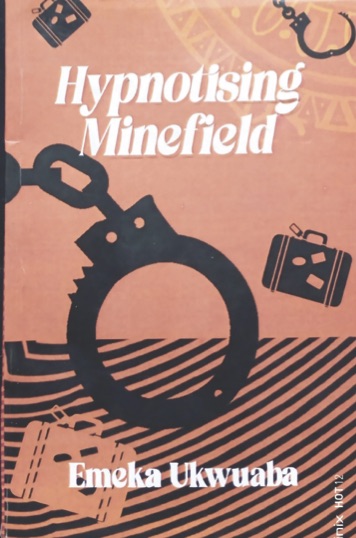
Title: Hypnotising Minefield
Author:Emeka Ukwuaba
Publisher: Sevhage Publishers, Abuja
Pagination: 355
Year: 2025
Emeka Ukwuaba’s titillating novel, Hypnotising Minefield begins medias res, right in the thick of things, with the Sword of Damocles hanging over an ambitious young man, Bright Kabula. A new military junta has just ousted the democratically elected government of the fictional African nation of Nagiva, ushering draconian laws. Bright Kabula, who had been facing trial before the military’s political incursion for possessing five kilograms of cocaine, suddenly finds himself in the throes of death, the junta having prescribed death by firing squad for drug peddlers under the new Special Tribunals (Miscellaneous Offences) Decree.
Hypnotising Minefield is the fourth work by Emeka Ukwuaba following the publication of the historical novel, Unending Jackboot Rhythm; the poetry volume, Vile Tentacles; and the novel, Benign Pain. Ukwuaba’s writings pay witness to postcolonial African conditions. They underpin the implications of arrested development occasioned by bad leadership and the criminalisation of governance. In Hypnotising Minefield, the fresh water ecologist, Ukwuaba, doesn’t limn a gentler world; it is a novel populated by desperadoes, who, pushed to the wall to survive a harsh economic system, embrace the criminal enterprise as an open sesame. Though a crime fiction, Hypnotising Minefield teems with overt social echoes. In the symbiotic relationship between the state and the citizen, the novel discovers a yawning gap, one which privileges parasitism over mutualism; hence, the recourse to desperate measures to survive by the disenchanted citizens of Nagiva.
With Hypnotising Minefield, the author has gifted the literary world with precious binoculars to see through the labyrinthine alleys of drug trafficking, the furrowed face of corruption and the nebulous geography of pretence, where political messiahs morph into puppeteers, who excite us in one breath and disappoint us the next moment on realising that the puppet is bereft of life and can’t sustain the euphoria for too long. The novel decries military adventurism in politics by depicting the strangulation of civil society by the coupists.
Laments the author; “The junta immediately suspended the constitution by decree and quickly passed others that severely restricted citizens’ freedoms of speech, association, and enterprise. A stunned population, already grappling with mass incarceration of all former political leaders, was further alarmed when a new decree was enacted that changed the punishment for drug trafficking from carrying prison terms to death by firing squad.” (p.2). Though set in a fictitious country, the novel corresponds with what obtains in some military regimes in African countries, including Nigeria in the 1980s and 90s. The more the reader turns the pages of Hypnotised Minefield, his propensity to feel some deja vu.
The opening pages of Hypnotising Minefield isn’t for the fainthearted, what with the death of Bright Kabula by firing squad and the emotional turmoil in his family before and thereafter. Drug offences that attracted six months under democracy now attract capital punishment. Gonza jokes that the new oppressive decree has become a “False Accusation Against Public Officers Decree.’ All the major trade unions in the country are deliberately targeted as a means of checkmating dissidents by the Supreme Military Council. Journalists who criticised the judgment against Bright are also hounded by the military dictatorship.
When you think it’s all over for Bright, the author pulls a fast one with a love story. Unknown to most people, Merimba, Bright’s girlfriend, was pregnant for him before his execution. When her parents get wind of that, they labour to sanction her to keep the pregnancy. Somehow, commonsense prevails, and Bright Jr. is born to continue his lineage. African society treasures the continuation of a lineage to avoid a dead man’s name being “erased”. Ukwuaba subscribes to this notion by sanctioning the Merimba miracle child. It also speaks volumes of Merimba’s undiluted love for the deceased by keeping her own side of the bargain, even the hangman has since done his worst on her partner to announce the end of the relationship.
The second military coup in Nagiva within a short time is a demonstration that the military is not better than the civilian regime they are demonising. The ousted military regimes in this work of fiction are blamed for economic mismanagement, human rights abuses, repression, abandoned infrastructure projects, sweeping ban on importation, etcetera.
The novel uses the lives of the drug baron, Trudor; the hustlers, Malema and Namungenyi, to illustrate the high network of drug peddlers and their never-die attitude. While in prison, Trudo manipulates the entire government agencies. Ukwuaba doesn’t tell us about drug peddlers alone; he also shows about the workings of the system. Take for instance, the preparations of Malema and Namungenyi to ferry drugs across continents. Wrapped capsules of cocaine are packaged specially to avoid leakage. A regime of antibiotics, laxatives and anti-flatulent tablets are provided for them. Their gag reflexes and gut lining are also trained. It is a risky adventure but the possibility of transforming their lives motivate them to embark on the risk.
You might be wondering what happened to Merimba. An old-timer, Uhuru, who has returned from abroad, reconnects with Merimba and marries her. One would have thought Merimba would have lived with Bright Jr. alone without marrying another man and earn her flowers and the crown of Miss Dependable. Some other notable developments in the novel include Jaykay, Bright’s younger brother’s relocation to Europe after signing a football contract and his realisation that it is not a clean sport after all, as managers sanction performance enhancing drugs for their players; Malema and his professional syndicate’s fleecing of a white lady, Marlene, through love scam and her eventual suicide; Kizzito, Merimba’s twin brother’s sentencing to death by firing squad in Indonesia for drug peddling and the former’s agonising days thinking of a second tragedy of a loved one; and the intervention of the Nigerian president to save ten nationals in Indonesia, including Kizzito, which keep the reader on edge.
If I could recommend a crime fiction that wows and interrogates society at the same time, Hypnotising Minefield is that fiction you couldn’t trade for fizzy champagne.