Follow Us on Google
From Romanus Ugwu, Abuja
The signs that implosion is likely to happen in the All Progressives Congress (APC) are gradually becoming ominous. There are signs of terrifying uncertainties over the future of the ruling party ahead of the 2027 presidential election.
From 2025 till date, the influx into the ruling party has been shocking and unprecedented – the 2023 vice presidential candidate of the main opposition party, Senator Ifeanyi Okowa, at least seven incumbent state governors and still counting, many former governors, serving and former high-level political office holders at local and federal levels, the defections have become loudly unimaginable.
But the opposition coalition party, the African Democratic Congress (ADC), which has continued to receive majorly what some described as disgruntled politicians, appears eager to dislodge the APC.
The APC, however, believes Nigerians will still return it to power, insisting that the gale of defections indicates the party is popular with majority of Nigerians. Celebrated mostly with fanfare and in carnival forms, the defectors that usually adduce various reasons for abandoning their political platforms to identify with the ruling party always claim to have found a new home under the canopy of the APC.
But, beyond their claims of finding a new home, subsequent developments have made it obvious that most of the defectors were particularly instigated by the desperation to remain relevant politically.
What has become of particular concern to many political watchers is that what should be celebrated as joy is gradually turning into an albatross on the neck of the ruling party, judging by the looming fears of defections resulting in the possible implosion of the party.
And regardless of how the stakeholders tried to emasculate the realities with the razzmatazz they deployed to welcome the defectors, especially the state governors, Daily Sun can report that there have been manifestations of signs of widening cracks after every entrance into the ruling party.
The veracity has manifested in many forms, particularly through the obvious or covert cold war among the major stakeholders of the ruling party at the state chapters.
If they were not struggling to confirm the real ownership and exhibiting desperation to assert authority over the control of the party structure at the state levels, or more intensely over who should be accorded the authentic party leader between the new joiners and the founding loyal members and chieftains of the party at various states.
Unfortunately, the national leadership, the presidency, and other major stakeholders, allegedly orchestrating and inducing the defections for selfish political reasons, presumably for the 2027 presidential election, seem to be worried about the delicate volcanic nature of the situation and its potential threat to erupt either in the immediate or nearest future. And that once it happens, it is capable of inflicting incalculable damage on the party.
On a mild scale, the threats of implosion in the APC, in the perception of many pundits, have already started manifesting in many forms across the states. From Enugu State, where the rift allegedly consumed a serving federal Minister, Uche Nnaji, to Bayelsa, where it has instigated and fuelled the prosecution of former Minister of State for Petroleum and the governorship candidate of the ruling party in the 2023 off-cycle governorship election, Timipre Silver, there have been records of casualties across board.
Also in Delta State, the anxieties of possible implosion initially manifested with signs of fury through the cold war and cantankerous relationships between the defected governor, Sheriff Oborevwori, and the colony of his political structure, fiercely engaging the founders and financiers of the party in the state in a battle royale.
However, the anxieties later evaporated when factional leaders like the former deputy Senate President, Ovie Omo-Agege, seemed to be totally cowed, disarmed, and whipped into line, reducing the fierce battle among the gladiators.
The situation in Plateau State appears perilous, where there were endless exchange of verbal war and face-off between the loyalists of the party’s national chairman, Prof Nantawe Goshwe Yilwatda, and the state governor, Caleb Manasseh Mutfwang, before they could gradually sheath their swords after finding an amicable, peaceful ground.
In Osun State, it took the party leaders’ dexterity, sentimental networking, and intense horse-trading to frustrate the persistent attempts from the governor, Ademola Adeleke, to dump the troubled Peoples Democratic Party (PDP) and join the APC. Once the door was shut at him, he looked the way, which resulted in his eventually opting for the Accord Party (AP).
A bigger thick cloud of uncertainties in the ruling party also permeated into other states like Benue, where the governor, Rev. Fr. Hyacinth Alia, fiercely engaged the Secretary to the Government of the Federation (SGF), Senator George Akume, in a long-drawn battle, over who ought to be the leader of the party in the state.
The troublesome situation was the same in Cross-River before it culminated into sacking of hitherto proactive state chairman, Barr. Alphonsus Ogar Eba. But there has been, invariably, a relatively peaceful atmosphere in Akwa-Ibom, where stakeholders may have adopted, in principle, an unwritten peace agreement as a guide to correlate harmoniously.
Curiously, in almost all the states under the platform of the ruling party, there seems to be relentless efforts by the stakeholders to paper over the cracks of brewing uncertainties over the actions of the gladiators posing imminent and ominous danger to the future viability of the party ahead of the crucial 2027 general elections.
And if the signs of the impending implosion were very mild in those states, they are becoming scary and visibly loud in Rivers to the point of completely recalibrating the political landscape in the state.
Obviously, the complicated situation in Rivers State might be the strongest albatross hanging menacingly on the neck of the ruling party to fast-track the much-speculated threat of implosion if it were allowed to escalate more than its current state.
The Rivers conundrum is as complicated as its potential threat to destabilise and disintegrate the party at both local and national levels due to the intricate involvement of many gladiators in the intriguing unfolding political melodrama.
From the president and the presidency, the national leadership of the ruling party, the involvement of Nyesom Wike, the strongman of Rivers politics and his hyperactive organic political structure, the state governor, Fubara and his team, and the dimension of the Ijaw ethnic nationality, it will take maturity and political sagacity to calm the tense atmosphere and frayed nerves.
Head or tail, the intricate situation has put the president and the APC at such a receiving end, and like the popular Igbo analogy, it faced the unavoidable risk of a gripping rope on the neck of a goat, which, if removed or left behind, will still claim the life of the goat.
Obviously, both the presidency and the party are currently facing a quagmire and dicey situation of whether to allow the Wike force to consume Governor Fubara seeking protection under their shelter, by defecting to the APC, or terminating Wike’s strategic and sensitive role in the complex battle to actualise President Tinubu’s re-election bid.
With the newly formed Rainbow Coalition, Wike’s political campaign arrangement that collapsed both the APC and PDP political structures in Rivers under one umbrella, the complication has posed a picture of uncertainty to the future unity of the APC as a party.
Considering the recent defection of Governor Fubara to the APC and the question of who becomes the authentic party leader in the state, the rifts threatening to destabilise the fragile unity of the party first manifested through the sporadic and vitriolic war of words between the FCT Minister, Wike, and the national secretary of the ruling party, Senator Ajibola Basiru.
Apart from Wike warning the party’s chief scribe to stay clear of Rivers’ politics and eschew the temptation of involving himself in the N600 million bribes and Basiru calling for the sack of Wike and accusing him of meddlesome interloper on matters involving a party he is not a member, their loyal political supporters have all equally threw cautions to the wind in issuing threats and warnings to themselves.
In the crossfire, Wike’s PDP faction had issued a 48-hour ultimatum to Senator Basiru to apologise to the FCT minister, warning that; “to imply that his support for President Tinubu is no different from that of other non-APC supporters is a clear indicator of amateurish political judgment. Senator Basiru’s calls for the resignation of a performing Minister like Wike portray him as an opponent of President Tinubu and an enemy of the Nigerian state.”
Responding, Basiru’s supporters, under the banner of the APC Leaders Forum (ALF) and Tinubu/Shettima Solidarity Movement (TSSM), backed his tirade on Wike.
The ALF trio of Emeka Okoro; South East elder statesman and National Coordinator, Tinubu/Shettima Solidarity Movement, Ibrahim Yusuf, APC National Youth Vanguard Leader, and Adekunle Balogun, National Spokesperson, Abdulkareem Isiaka, had warned that Wike’s utterances were capable of dividing the party.
The group, during their protests and submission of protests letters to President Tinubu, noted; “We gathered in solidarity with you, Governor Fubara, Senator Basiru, and Chairman Yilwatda to reaffirm our commitment to APC’s unity. We can no longer remain silent in the face of egregious misconduct by one of your appointees, Wike.
“Wike’s actions represent a brazen assault on the APC’s leadership, a direct threat to your authority as President, and a dangerous incitement that could destabilise Rivers State and the entire Niger Delta region. The litany of offenses that compel this urgent action includes the insults and attacks on the APC national leadership.
“Wike, who is not even a registered member of the APC despite serving in your cabinet, has launched vicious, unprovoked attacks on our National Secretary, Senator Basiru.”
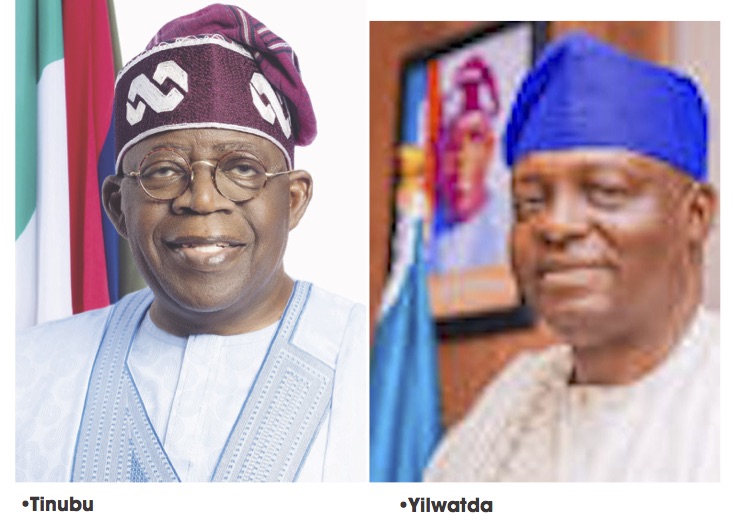
As if the venomous exchange of words were not enough warning signal, the comments credited to the party’s national chairman, Prof. Yilwatda that the state governors are not the leaders of the party in the state, contradicting the claims of the party’s chief scribe, Senator Basiru, clearly contributed in escalating the troubled situation and signal that the development might get out of control.
Perhaps, in an attempt to create a line of distinction between him and his state governor, Yilwatda, apparently caught up in the crossfire, had claimed that; “Across the country, no one can take over any section of the party. Whatever is done at the state level is planned at the national level. That is how the APC works. We follow structure, not sentiments or emotions.”
However, the position of the party’s boss, Prof Yilwatda, was clearly in contradiction with that of his scribe, Basiru, who had earlier said that; “all members of the National Working Committee (NWC) must accord any sitting governor his due respect because they remain the leaders of the party in their states.”
Although the sudden collapse of peace in the ruling party due to the clash of the political gladiators may have deteriorated to such a disturbing extent due to the absence of President Tinubu in the country, the matter is capable of degenerating into the magnitude of disintegrating the party if not urgently nipped in the bud.
From all indications, only an insignificant few of the national leadership of the ruling party seem to admit to the precarious nature of the situation posing any impending danger to the future of the party in the build-up to the 2027 polls.
And in the words of the party’s deputy national organising secretary, Hon. Nze Chidi Duru, several antidotes are already in place to avert any possible implosion from the misunderstanding among the gladiators at the State chapters.
Dismissing any possibility of the ruling party imploding in a chat with the Daily Sun, Duru said: “If we do recognise that membership of a political party is not a guarantee to win an election, it only means that we are going beyond membership to innovating policies that will affect the lives of Nigerians, put food on their table, and ensure that they have a good feel of the party.”
Also corroborating the impression that there is peace in the APC fold, the party’s National Publicity Secretary, Felix Morka, told the Daily Sun that, “there is peace in the APC. The APC is the most peaceful, cohesive party today in Nigeria. I will say that the APC is the most cohesive party because when you talk about peace, you almost suggest that peace is the absence of war or conflict.
“I will rather speak about cohesion because that is more appropriate. Some will tell you that PDP is peaceful, apart from some of the show of shames we witness, people throwing punches. I can tell you that APC is a very cohesive party.
“But does that mean that we don’t have issues and disagreements in the party? It doesn’t mean that, and that is why I said that peace is really not the way to describe an institution like a party. I would rather say that we are very cohesive and handle conflicts that may arise with some level of maturity, which is hard to find in the opposition parties. When we deal with issues like that, we are very, very intentional about stepping out to really mediate and solve those problems.
“And that is why you have a lot of people from within the opposition rightly abandoning their parties to join the APC. It is because nobody wants to waste a lifetime in a party without direction or a control system. So, yes, we are very happy with our party and what it is doing, not just to offer governance in Nigeria but also to engage in the democratic space,” Morka said.
But the big unanswered question in the minds of many curious Nigerians is how the ruling party intends to extricate itself from the quagmire threatening its very existence at this stage of the crucial build-up to the 2027 polls.