Follow Us on Google
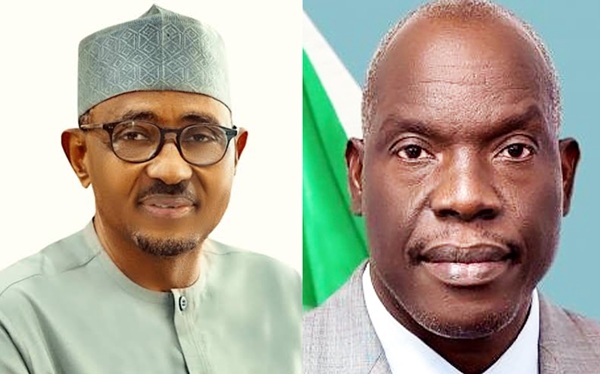
• Eyesan, Mohammed await Senate confirmation
By Adewale Sanyaolu and Juliana Taiwo-Obalonye, Abuja
In a dramatic twist, President Bola Tinubu, yesterday, accepted the resignations of Authority Chief Executive (ACE) of the Nigerian Midstream and Downstream Petroleum Regulatory Authority (NMDPRA), Mr.Farouk Ahmed and his counterpart at the Nigerian Upstream Petroleum Regulatory Commission (NUPRC), Mr. Gbenga Komolafe.
A statement by presidential spokesman, Bayo Onanuga, stated that President Tinubu, has nominated Saidu Aliyu and Oritsemeyiwa Amanorisewo Eyesan as heads of NMDPRA and NUPRC respectively for Senate confirmation.
The two outgoing chiefs were appointed by the late president, Muhammadu Buhari, in 2021 and tasked with steering agencies birthed by the Petroleum Industry Act (PIA).
Tinubu had summoned Ahmed to the Presidential Villa in Abuja over allegations of economic sabotage and corruption.
President of Dangote Industries Limited, Alhaji Aliko Dangote, had during a media briefing on Sunday called for an investigation and prosecution of Ahmed, accusing him of economic sabotage, which he said was undermining domestic refining in Nigeria.
Dangote accused the leadership of the NMDPRA of colluding with international traders and oil importers to frustrate local refining through the continued issuance of import licences for petroleum products.
Dangote alleged that Ahmed was living beyond his legitimate means, claiming that four of his children attend secondary schools in Switzerland at costs running into several million dollars.
He said such expenditure raised serious questions about potential conflicts of interest and the integrity of regulatory oversight in the downstream petroleum sector.
“I am not calling for his removal, but for a proper investigation. He should be required to account for his actions and demonstrate that he has not compromised his position to the detriment of Nigerians. What is happening amounts to economic sabotage.”
Dangote further alleged that Farouk paid as much as five million dollars in tuition fees for his children’s secondary education in Switzerland, questioning how many Nigerians could afford such costs.
“The Code of Conduct Bureau, or any other body deemed appropriate by the government, can investigate the matter. If he denies it, I will not only publish the tuition he paid at those secondary schools, but I will also take legal steps to compel the schools to disclose the payments made by Farouk. I sent my own children to secondary schools here in Nigeria. How many Nigerians can afford to pay five million dollars for secondary school tuition, not university education? In his home state of Sokoto, many parents are struggling to pay as little as N10,000 in school fees,” Dangote said.
True to his threat, Dangote on Monday published details of Ahmed’s children’s name, schools in Switzerland, and tuition fee payment structure in some national dailies.
He described the downstream petroleum sector as being under severe strain, alleging the presence of entrenched interests that profit from fuel imports at the expense of national development.
“There are powerful interests in the oil sector. It is troubling that African countries continue to import refined products despite long-standing calls for value addition and domestic refining. The volume of imports being allowed into the country is unethical and does a disservice to Nigeria,” he added.
Dangote stressed the need for a clear separation between regulatory oversight and commercial interests, warning that allowing traders to influence regulation would undermine the integrity of the sector.
“The downstream sector must not be destroyed by personal interests. A trader should never be a regulator. Forty-seven licences have been issued, yet no new refineries are being built because the environment is not conducive,” he said.
Eyesan, a graduate of Economics from the University of Benin, spent nearly 33 years with the NNPC and its subsidiaries. She retired as Executive Vice President, Upstream (2023–2024), and previously served as Group General Manager, Corporate Planning and Strategy at NNPC from 2019 to 2023.
Mohammed, born in 1957 in Gombe, graduated from Ahmadu Bello University in 1981 with a Bachelor’s in Chemical Engineering. He was announced today as an independent non-executive director at Seplat Energy.
His prior roles include Managing Director of Kaduna Refining and Petrochemical Company and Nigerian Gas Company, as well as Chair of the boards of West African Gas Pipeline Company, Nigeria LNG subsidiaries and NNPC Retail.
He also served as Group Executive Director/Chief Operating Officer, Gas & Power Directorate, where he provided strategic leadership for major gas projects and policy frameworks, including the Gas Masterplan, Gas Network Code, and contributions to the Petroleum Industry Act (PIA).
Mohammed played a pivotal role in delivering key projects such as the Escravos–Lagos Pipeline Expansion, the Ajaokuta–Kaduna–Kano (AKK) Gas Pipeline, and Nigeria LNG Train.