Follow Us on Google
From Juliana Taiwo-Obalonye, Abuja
In a clear call for a more unified, efficient government, the Secretary to the Government of the Federation (SGF), George Akume, emphasised the urgent need for breaking down silos, aligning mandates, and fostering seamless collaboration across Ministries, Departments, and Agencies (MDAs).
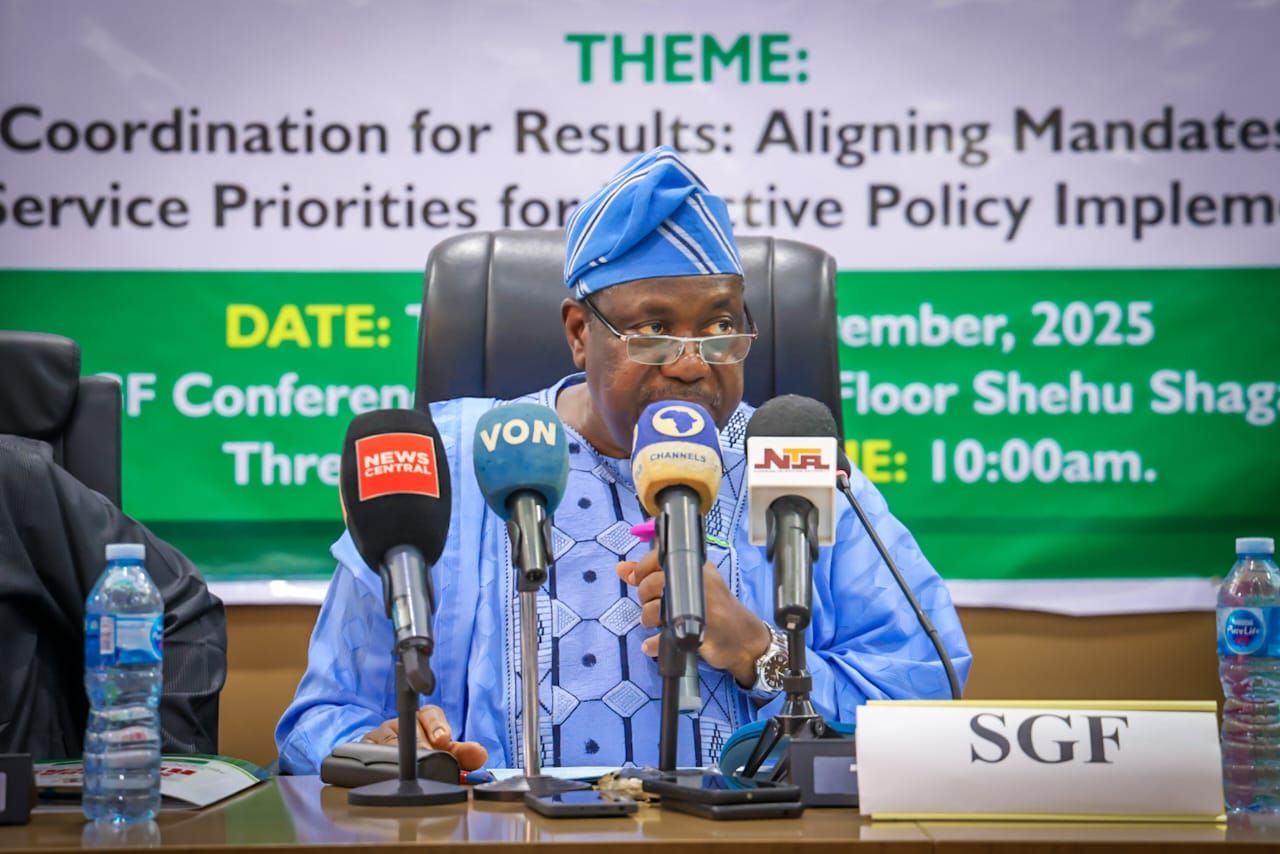
He made the call at the inaugural Sectoral Retreat held on Tuesday, November 4, at the OSGF Conference Room, Abuja, where government officials gathered to deliberate on “Strengthening Coordination for Results: Aligning Mandates with Presidential and Service Priorities for Effective Policy Implementation.”
He asserted that effective governance hinges not only on well-designed policies but also on their robust execution. He warned that even the best-intentioned policies can fail due to weak coordination, overlapping efforts, and poor performance monitoring, which erode public trust. “The success of any administration relies on how effectively those policies are executed,” Akume said. “Experience shows that even the best-intentioned policies can fail to achieve their objectives due to weak coordination, overlapping efforts, lack of inter-agency collaboration, and insufficient performance monitoring. These shortcomings reduce the overall impact of government initiatives and undermine public trust.”
He placed the administration’s vision within the Renewed Hope Agenda, emphasising economic revitalisation, social inclusion, infrastructural development, and foundational governance reform. To realise this vision, Akume advocated a true “whole-of-government” approach that breaks down silos, aligns mandates, and forges strong synergies across every Ministry, Department, and Agency.
“Aligning the OSGF’s mandate with presidential and service-wide priorities goes beyond routine compliance. It is a call to shared accountability and purposeful action,” he said. He urged all actors to internalise a national development mindset and translate it into measurable outcomes that improve Nigerians’ lives. He urged heads of agencies to reflect on two critical questions: “How does my mandate contribute to the realisation of the President’s priorities?” and “How does my office enhance the overall efficiency and coherence of government?”
Akume argued that government efficiency extends beyond cost-cutting or faster processes to the optimal use of public resources. The path forward, he said, lies in clearly defined roles, seamless cross-agency coordination, evidence-based decision-making, and a culture of accountability and performance.
The secretary highlighted a shift from activity-based administration to results-based management, anchored on three pillars: continuous performance tracking, transparent monitoring and evaluation, institutional learning and adaptation.
To operationalise this shift, Akume cited the government’s robust Performance Management System, which defines clear Key Performance Indicators (KPIs), sets targets, and regularly assesses progress. The aim is to foster a public service culture driven by outcomes, where success is measured by real improvements in citizens’ welfare rather than the volume of activities.
Digital innovation, according to Akume, is an indispensable ally in achieving coordination and transparency.
Other News
He outlined several flagship initiatives shaping the push toward data-driven governance: e-Government platforms to improve service delivery; data integration frameworks for evidence-based policy planning; digital dashboards for real-time monitoring of national priorities and performance indicators. “These tools will empower us to make better-informed decisions, track progress accurately, and communicate results effectively to the Nigerian people,” he said.
Akume reminded participants that improving government efficiency is a shared national responsibility. He urged practical, actionable steps to strengthen inter-ministerial collaboration and eliminate duplication of efforts. Key goals include enhanced monitoring and evaluation of projects, promotion of transparency and data-driven decision-making, and strengthening institutional capacity for sustainable results.
He concluded with a call for a recommitment to dismantling systemic barriers that hinder implementation. Akume urged the participants to strengthen coordination mechanisms, leverage digital tools, and institutionalise performance management as the public service’s foundation. He expressed hope that the Retreat would yield renewed purpose and concrete action points to accelerate the realisation of the Renewed Hope Agenda across sectors.
In closing, Akume affirmed, “Together, we can strengthen coordination, enhance accountability, and reinforce our collective resolve to deliver on the Renewed Hope Agenda. Let us strive to make government work better, faster, and smarter for the Nigerian people.”
Permanent Secretary, Special Services Office/Overseeing the General Services Office of the OSGF, Mohammed Danjuma, in his opening remarks, emphasised the Retreat’s timeliness amid Nigeria’s development journey. He remarked, “The role of the OSGF is clear. We are the architects of policy coherence, catalysts for inter-agency cooperation, and the standard-bearers for effective service delivery.” Danjuma posed introspective questions for the group: “Are our processes as efficient as they can be? Are our collaborations yielding tangible results? Where are the bottlenecks, and how can we eliminate them?”
He articulated the Retreat’s goal to create “a clear, practical roadmap for enhanced coordination that will be reflected in improved performance of the OSGF and its agencies, ultimately accelerating the realisation of our national objectives.” Danjuma urged participants to engage with openness and creativity to “translate policy into tangible outcomes through better alignment, increased collaboration, and shared ownership of results.”
Confident in the outcomes, he stated, “I am confident that the discussions and decisions made during this Retreat will reposition our Office for greater efficiency, accountability, and impact positively on the execution of government policies and programmes.”
In her remarks, Special Adviser on Policy and Coordination, Hadiza Bala-Usman, stressed the OSGF’s pivotal role in governance, calling it “the engine room of governance in the federal government.” She highlighted the necessity of aligning the Office’s diverse duties with presidential priorities: “This retreat we have gathered here is to ensure that we have clarity of purpose. We are looking at how we can move from mandate to impact, how every policy that the government articulates results in direct impact on Nigerians.” Bala-Usman emphasised that governance’s ultimate goal is to “impact positively on the life of Nigerians,” and thus attention must be sharpened to maintain a clear focus on the President’s priorities.