Follow Us on Google
By Damiete Braide
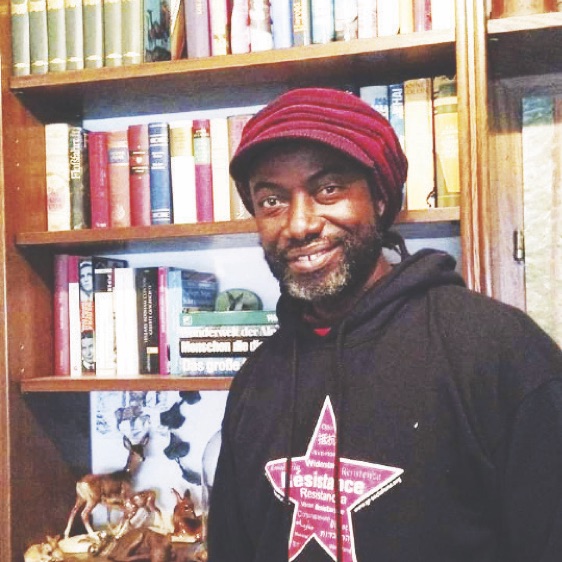
Ajegunle, the vibrant working-class suburb of Lagos, Nigeria, often referred to as the “Jungle City,” has produced its share of creative minds who turn adversity into inspiration. Among these is AJ Dagga Talor, a poet, author, and activist whose life and work reflect the struggles and aspirations of the common man. Born into a world of hardship in 1968, Dagga Talor journey is a testament to resilience, creativity, and the transformative power of art.
Dagga Talor’s childhood was shaped by the harsh realities of Ajegunle. His father, Benjamin Atulute, returned from the Nigerian Civil War only to face the challenge of reclaiming land and rebuilding a life. His mother, resourceful yet unsupported, gave birth to him under dire circumstances, struggling without the basic necessities of care. These early experiences instilled in Dagga Tolar a profound understanding of survival, determination, and the inequities of society. Growing up in a community rife with economic challenges, he observed firsthand the struggles of the working masses —a perspective that would later become central to his art and activism.
It was during his university years in the mid-1980s that Dagga Tolar discovered his passion for poetry. Influenced by the works of literary giants like J.P. Clark, Christopher Okigbo, and Wole Soyinka, he began to explore the precision and depth of language. Poetry became his medium of choice to express the pain, joy, and contradictions of life in Ajegunle. At the same time, the reggae rhythms of Bob Marley, Peter Tosh and other Jamaican legends captured his imagination. The themes of resistance, freedom, and justice resonated deeply with him, blending seamlessly with his poetic voice.
As a student at Ambrose Alli University, Dagga Tolar immersed himself in both poetry and music. Events organised by the English and Literary Students Association provided a platform for him to share his early works, such as “Virginity” and “Pepper Soup for Some and Oil for All”. These pieces, reflective of societal critiques, were influenced by Nigeria’s political landscape and his experiences of social inequality. His love for reggae further deepened, and he even became a member of ROOTRON (Rainbow Organisation of the Rastafarians of Nigeria), engaging with iconic figures like Ras Kimono and Majek Fashek.
For Dagga Tolar, poetry and music are inseparable. He views every song as a poem and every poem as a potential song. Both art forms, he argues, draw from the wellspring of life itself, though poetry often demands greater precision. His creative process is a constant interplay of observation, reflection, and imagination. He describes the poet’s mind as ever-alert, fishing for ideas in the ordinary and extraordinary, from the struggles of his neighbours to the resilience of nature.
Central to Dagga Tolar’s artistic expression is his belief in the transformative power of Marxist ideology. He sees his work as a tool to awaken the consciousness of the working masses, highlighting the contradictions of a capitalist system that perpetuates inequality.
Other News
For Dagga Tolar, Ajegunle is more than a physical space; it is a metaphor for the plight of the underprivileged across the globe. His art challenges the ruling class’s failure to govern equitably and calls for revolutionary change.
Beyond his own creative pursuits, Dagga Tolar has dedicated himself to mentoring the next generation of poets through initiatives like the AJ House of Poetry. This platform aims to nurture young minds, encouraging them to read, write, and engage critically with their environment. For Dagga Tolar, the youth hold the key to a better future. By fostering their creativity and shielding them from societal vices, he hopes to inspire a generation that will challenge the status quo and envision a more equitable world.
The challenges of Ajegunle, such as inadequate educational infrastructure and limited opportunities, only fuel his determination. Dagga Tolar advocates for public-funded education and equitable access to resources, emphasising that his own education was pivotal in shaping his identity as a poet and writer. He sees education as a powerful tool to empower individuals and transform society.
Dagga Tolar’s works have been well-received both in Nigeria and abroad. Performances at events like Poetry Africa in South Africa and CORA in Lagos have showcased his ability to connect deeply with audiences. His poetry, such as “Killing Our Dreams”, resonates with themes of resistance, hope and social justice, earning recognition for its relevance and poignancy. Yet, he remains humble, acknowledging that the true impact of written art often unfolds over time, beyond the life of the poet.
Asked about the role of art in driving social change, Dagga Tolar is unequivocal. He believes that, while poetry and music cannot directly alter systemic structures, they can inspire consciousness and solidarity among the oppressed. In Ajegunle, as in other marginalised communities, art becomes a voice for the voiceless, a beacon of hope, and a call to action.
For Dagga Tolar, the integration of activism and art is not merely a choice but a necessity. He views his work as part of a larger struggle to dismantle capitalism and build a society rooted in equality and justice. His art does not shy away from confronting uncomfortable truths but instead uses its power to provoke thought, challenge norms, and inspire action.
As he continues to write, mentor, and perform, Dagga Tolar remains steadfast in his mission to amplify the stories of Ajegunle and its people. His life and work remind us that even in the face of adversity, creativity can thrive, and art can serve as a catalyst for change. Through poetry and music, he not only captures the essence of the human experience but also envisions a better world for all.