Follow Us on Google
From Obinna Odogwu, Awka
A lot of opportunities, especially in the agricultural sector, may be unlocked for many young Nigerians if the business proposal between the Government of Thailand and Federal Cooperative College, Oji River, Enugu State, comes to fruition.
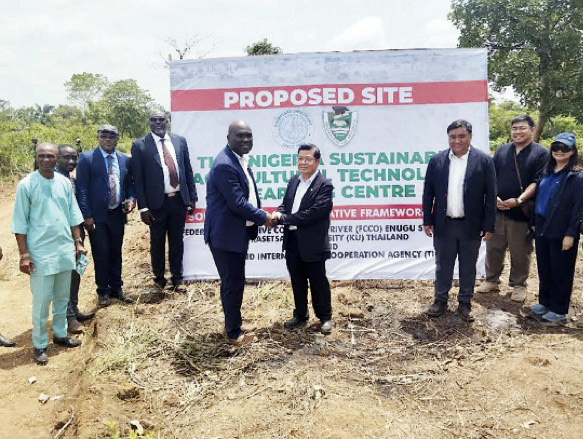
Recently, some officials from Thailand International Cooperative Agency (TICA) and Kasetsart University (KU) Thailand visited the college to inspect the proposed site for the establishment of Thai-Nigeria Sustainable Agricultural Technology Learning Centre.
The team, led by the country’s ambassador to Nigeria, Mr. Thirapath Mongtolnaun, also used the opportunity to expand its conversation with the management of the college on the way forward for the proposed business deal.
The inspection visit followed an earlier understanding by the two parties to explore opportunities in sustainable agriculture, particularly in aquaculture with emphasis on the production of African catfish and others.
It was gathered that the project, which is a collaborative framework between the two, is part of Thailand’s strategy for cooperation aimed at ensuring food security globally.
Mongtolnaun said that the Thai Embassy and TICA had considered the cooperation in aquaculture development, and then decided to initiate “this flagship project of aquaculture and sustainable agriculture” in the country.
The ambassador explained that the project aligns with the third pillar of Thailand Africa Initiative (TAI); a policy framework launched in 2013 and later re-launched in 2025 to strengthen cooperation between Thailand and African countries.
Mongtolnaun said that TAI has since been recalibrated around four pillars of cooperation, namely: political, economic, development, and global strategic cooperation.
He described the cooperative college as a fertile ground for such an investment, saying that their visit was to conduct a site survey of the institution and “to explore concrete opportunities for practical cooperation going forward.”
“I am very confident to say that food security is part of our global strategy for the cooperation”, he stated.
“And Thai Embassy and TICA have considered this cooperation in aquaculture development and have decided to initiate this flagship project of aquaculture and sustainable agriculture in Nigeria.”
The ambassador expressed optimism that the project would be further developed in every part of Nigeria and across members of the Economic Community of West African States (ECOWAS) as well.
“This project aligns with the third pillar of TAI. And Nigeria has been identified as a key priority country under this framework. And in Nigeria, you can see that Enugu State has been selected as the starting point,” he added.
The Provost/Chief Executive Officer of the college, Dr Ejikeme Obidiegwu, in his speech, said that the landmark international partnership would position the institution positively, placing it at the forefront of agricultural innovation, technology transfer, and sustainable economic development in the country.
He explained that the learning centre would serve as a hub for training, especially in aquaculture and integrated farming systems when it takes off.
“Basically, the centre will train at least 100 students every year. It is a training hub that cuts across Nigeria; and people from West Africa can access the training centre”, he added.
Obidiegwu said that the learning centre would expand opportunities for the Nigerian youth, students, and farmers by helping them develop agricultural skills which would enable them to produce sustainable livelihoods and generate income in agriculture and related industries.
The provost, who narrated some of the institution’s success stories, told his guests that the college was ready for business.
Other News
“We started with 15 hectares of land. And beyond these 15 hectares, there are a lot of prospects for expansion and we have vast agricultural fields, expansive green areas for active farming, school managed agricultural products.”
Obidiegwu said that the college, not only has a very friendly host community which has been very supportive to it, but that it’s also strategically placed in terms of the Nigerian market.
“We have easy access to the South East and South-South which represent the catchment areas that we serve because the college was set up to service the South East and South-South geopolitical zones,” he explained.
The college CEO also told his Thai guests that the Nigerian government gave approval for the expansion of the college premises after he explained the well articulated vision of the institution to its officers.
“The Minister of Agriculture and Food Security now saw the need for us to expand our current space. I had a presentation to him during which I talked about the need for the college to acquire more space and more land so that most of our vision can come into reality.
“I am showing this today because part of what we are going to be doing in our collaboration will be housed on this newly acquired land.
“So we have two campuses. We have the one on 15 hectares and the new campus on 22 hectares. So this is the extra 22 hectares that we got from the Federal Government approved by the Minister of Agriculture and Food Security”, he explained.
Going forward, the provost opined that the agro learning centre may be modelled after the Songhai Centre in Benin Republic founded in 1985 by Father Godfrey Nzamujo or at least have its ideas replicated there.
“What is the model’s core? It has an integrated farm with zero wastage to agriculture”, he pointed out.
“The crops waste feeds the livestock, the livestock waste feeds aquaculture, and they generate their own energy. They have a circular system where waste from one unit becomes input for another.
“And they focus on training youths, entrepreneurial skill development, and agribusiness development.”
The provost expressed optimism that the proposed learning centre would hopefully go beyond the innovations at Songhai Centre which he said produces its own biogas, organic fertilisers, recycles water, and also engages in agro-processing.
“Now, this model is what we are trying to replicate. And we have to go beyond this. And what is the relevance? We support food security”, he said.
Obidiegwu argued that if Songhai Centre in a country which, according to him, is an hour flight from Lagos could support food security, climate resilience, and job creation, the Thai-Nigeria centre could do much more.
“And Nigeria has more people. Benin Republic is less than 15 million people, and Nigeria is about 250 million people. If the Songhai Centre model can work with impact, I don’t see why we can’t replicate that model in Nigeria”, he added.
The college provost took his guests through the initial mandate of the institution, saying that the management was taking steps to upgrade its programmes with a view to making the college more attractive and appealing to students.
“Cooperative knowledge, vocational and entrepreneurial skills are necessary for cooperative development in the country”, he explained.
“And we are charged to train personnel armed with theoretical and technical knowledge necessary for establishing and managing cooperative and related organisations; to carry out study and research in cooperative development and related matters and to organise short training courses, workshops, and conferences.”