Follow Us on Google
By Damiete Braide
In the ever-expanding landscape of Nollywood cinema, few productions have captured the imagination of audiences, both locally and internationally, quite like King of Thieves (Agesinkole).
Produced by Femi Adebayo and directed by the accomplished duo Tope Adebayo and Adebayo Tijani, the film blends mythology, cultural heritage, and high-stakes drama with a visual ambition that pushes the boundaries of Nigerian filmmaking.
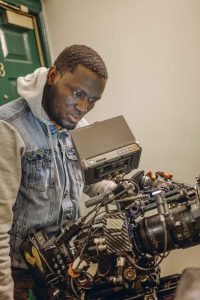
At the centre of this visual transformation is Bolade Emmanuel Olayinka, the aerial cinematographer whose breathtaking drone work elevated the film’s storytelling to new heights, literally and artistically.
As Nollywood evolves, the use of aerial cinematography has become more than just a stylistic choice, it is now an essential tool for world-building. Yet few productions have harnessed it with the narrative precision and artistic nuance displayed in King of Thieves. Olayinka’s aerial images serve not just as establishing shots, but as emotional, narrative-driven frames that deepen the viewer’s connection to the story.
From sweeping panoramas of the mythical kingdom of Ajeromi to the fluid tracking shots that follow warriors across rugged terrain, Olayinka’s work blends technical mastery with cultural sensitivity. His images create scale, depth, and movement, allowing audiences to feel the vastness of the world and the energy within it.
“Bolade’s aerial cinematography was not an add-on; it was woven into our storytelling fabric,” one crew member noted. “His shots gave the film its epic heartbeat.”
Shooting King of Thieves required navigating challenging landscapes, dense forests, rocky plains, and rapidly changing weather conditions that could either create cinematic magic or
disrupt carefully timed sequences. For Olayinka, each challenge became an opportunity.
His work required not only technical skill but the ability to anticipate motion, choreograph with actors, and collaborate closely with the directors to achieve the exact emotional tone of each scene.
The sweeping overhead shot of the village rallying in unity. The slow, deliberate rise during the ritual scenes.The visceral, fast-moving sequences of pursuit and conflict.
Every moment demanded precision, timing, and creative instinct.
Other News
Sharing insights on his experience, Bolade Emmanuel Olayinka offered a powerful reflection on the scope and meaning of his work: “Working on King of Thieves was an experience that stretched me creatively and professionally.
This wasn’t just about flying drones; we were building an entire kingdom from the sky. Every aerial shot was designed to support the story, to highlight emotion, tension, culture, and scale.
The directors wanted viewers to feel the soul of Ajeromi, and it was my job to help reveal that soul from above.
“There were days when we waited hours for the perfect sun angle, days when the winds tested our patience, and days when the terrain made it nearly impossible to position equipment safely. But every challenge pushed me to innovate. I aimed to capture not just imagery, but atmosphere, the weight of tradition, the thrill of the chase, the grandeur of the land.
“Looking back at the film, I’m proud of what we achieved. It proves that Nigerian stories deserve
world-class visuals, and with passion and commitment, we can deliver visuals that resonate far beyond our borders.”
His words reflect not only his dedication, but a broader shift in Nollywood’s technical ambitions.
The aerial work in King of Thieves has been widely praised by audiences and film critics who see it as a turning point for the industry. Olayinka’s cinematography provides visual cohesion and narrative clarity to large-scale sequences while amplifying the film’s cultural authenticity.
The drone shots reveal the spatial layout of the kingdom, guide the viewer through complex scenes, and highlight the cultural grandeur embedded in the film’s costumes, rituals, and
architecture.
Industry experts have noted that Olayinka’s contribution sets a new benchmark for what drone cinematography can achieve in Nollywood, showcasing an advanced understanding of composition, movement, and cinematic language.
As Nollywood continues to compete on a global stage, the demand for advanced technical craftsmanship has never been higher. Olayinka’s work represents the new generation of
filmmakers blending traditional storytelling with modern cinematic technique.
For King of Thieves, his aerial photography did more than elevate the film, it helped demonstrate that Nigerian epic cinema can achieve the same breathtaking scale and emotional gravitas seen in major international productions.
In a film celebrated for its strength in acting, cultural depth, costume design, and production value, Bolade Emmanuel Olayinka’s aerial cinematography stands out as one of its defining achievements. His ability to merge artistry with technical precision has left an indelible mark not only on the film, but on the evolving language of Nollywood cinematography.