Follow Us on Google

From Juliana Taiwo-Obalonye, Abuja
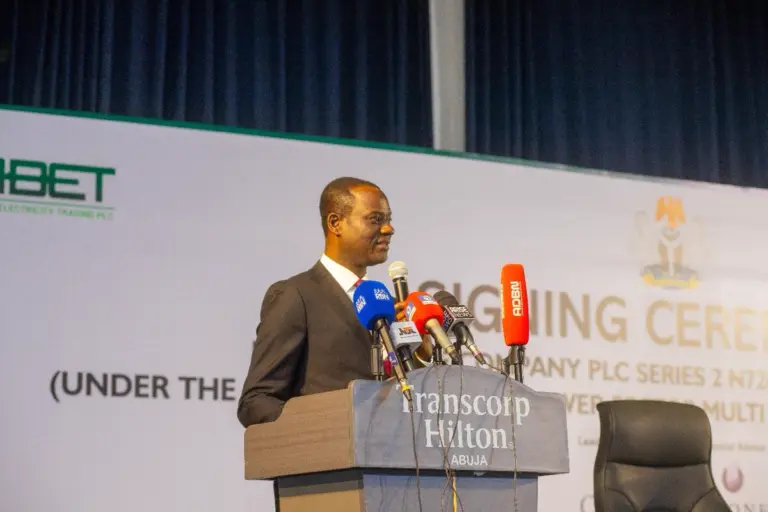
Minister of Power, Adebayo Adelabu, has tendered his resignation to President Bola Tinubu, effective April 30, to focus on his gubernatorial ambition in Oyo State.
The letter, submitted through the Secretary to the Government of the Federation (SGF), George Akume, expresses profound gratitude to the President for the appointment in 2023 and highlights significant progress in Nigeria’s power sector under the Renewed Hope Agenda.
Adelabu, former deputy governor of the Central Bank of Nigeria (CBN), noted that his decision aligns with the amended Electoral Act 2026, which bars political officeholders from contesting elections. He stated that this aspiration dates back to 2016, which led to his voluntary resignation from the Central Bank in 2018, and added that his two-and‑a‑half years as Minister of Power have equipped him with valuable experience for state administration.
Upon assuming office, he said the sector grappled with available generation between 3,500 and 4,500 megawatts against an installed capacity of over 13,000 megawatts, constrained transmission networks, high technical and commercial losses in distribution, a metering gap affecting more than half of electricity consumers, and a liquidity crisis with a debt overhang of over N4 trillion.
Under his tenure, Adelabu noted that the sector recorded measurable progress across the entire electricity value chain. The Electricity Act 2023 was implemented, decentralizing the market and creating a more investment‑friendly framework. Peak generation has increased to over 6,000 megawatts, supported by the integration of the Zungeru Hydropower Plant and the rehabilitation of several thermal power assets. Transmission capacity has also been strengthened through the installation of new transformers, substations, and major grid upgrades under the Presidential Power Initiative.
In the distribution segment, regulatory oversight has been strengthened, revenue collection efficiency has improved, and efforts to reduce Aggregate Technical, Commercial, and Collection (AT&C) losses have begun to yield positive results. Significant progress has also been made in closing the national metering gap through the Presidential Metering Initiative and the World Bank‑supported DISREP programme, with over one million meters already procured and clear pathways established for the deployment of millions more.
Other News
The minister said the sector has undergone a major financial reset through tariff reforms and the commencement of a ₦4 trillion debt restructuring programme, which increased market revenue from ₦1 trillion in 2023 to ₦1.7 trillion in 2024 and ₦2.3 trillion in the first half of 2025, restoring investor confidence and positioning the sector on a stronger path toward sustainability and long‑term growth.
Progress in rural electrification and renewable energy deployment has also expanded electricity access to underserved communities and isolated educational and health institutions across the country.
Despite these achievements, Adelabu acknowledged that the sector continues to face challenges, particularly in gas supply constraints, infrastructure vandalism, and the need for full commercialisation across the value chain.
To consolidate the gains recorded so far and accelerate sector transformation, he recommended the implementation of cost‑reflective tariffs with targeted subsidies for vulnerable citizens to ensure financial sustainability while protecting the poor, recapitalization and restructuring of the distribution segment to improve governance, technical capacity, and service delivery, and accelerated nationwide metering to eliminate estimated billing and strengthen market transparency.
He also urged sustained investment in transmission infrastructure to enhance grid stability and wheeling capacity, stronger enforcement of performance standards and contractual obligations across the value chain, and enhanced collaboration and coordination between federal and state regulators in line with the Electricity Act 2023.
He also proposed the appointment of a Coordinating Minister for Energy to provide strategic oversight and alignment across critical sectors such as power, gas, water resources, and environment, in order to unlock synergies that would boost thermal power generation through improved gas supply, optimise hydroelectric power development through better water resource management, and accelerate renewable energy deployment in a sustainable and environmentally responsible manner.
Adelabu attached a comprehensive performance report of the ministry of power covering the last two and a half years as preliminary handover notes.