Follow Us on Google
• Seek equity, reforms in FCT’s expanding cityscape
From Sola Ojo, Abuja
For decades, Nigeria’s Federal Capital Territory (FCT), Abuja, has been presented as Nigeria’s symbol of unity, a carefully planned capital city designed to bring together people from different parts of the country.
But behind the impressive roads, aesthetic flyovers, expanding districts, government offices, shopping centres and rapidly developing suburbs lies the story of the indigenous communities whose ancestral lands became the foundation upon which national rendezvous was built.
The FCT is divided into six area councils including Abuja Municipal Area Council, Abaji, Bwari, Gwagwalada, Kuje and Kwali. Official FCT documentation identifies several indigenous communities and groups, including the Gbagyi, Koro, Bassa, Gade and Ganagana.
Other documentation on the original inhabitants of Abuja identifies communities including Amwamwa, Bassa, Egbira, Gade, Ganagana, Gbagyi, Gbari, Gwandara and Koro.
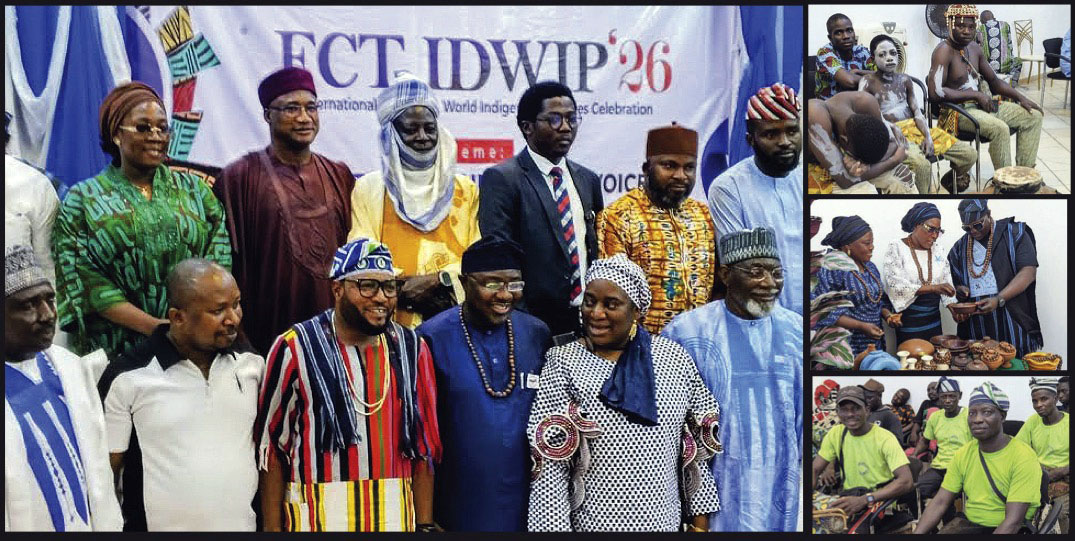
It was against this background that the Coalition of FCT Indigenous Associations used this year’s celebration of the International Day of the World’s Indigenous Peoples to demand greater recognition, participation and equity for the original inhabitants of the territory. The celebration, which brought together indigenous leaders, traditional rulers, community representatives, politicians and development advocates, was held under the theme: “Strengthening Indigenous Voices in the Governance and Development of the FCT: The Path to Equity and Institutional Reform.”
Rather than treating the occasion simply as a cultural celebration, participants turned it into a platform for examining the place of indigenous people in the political, economic and social development of Abuja.
The concerns raised were wide-ranging, from land rights and access to opportunities to political representation, youth leadership, community development and the preservation of cultural identity.
At the centre of the discussion was a question that has remained relevant throughout Abuja’s transformation: How can a city built on indigenous land develop in a manner that ensures that the people whose ancestral communities preceded the capital are not left behind?
The Coalition believed that creating stronger mechanisms for indigenous participation in decision-making and ensuring that development in the FCT is equitable, inclusive, and sustainable answers that question. The celebration also carried a message of peace, with participants expressing a unified commitment to peaceful coexistence and inclusive development in the six area councils of the FCT.
The presence of diverse stakeholders traditional leaders and community representatives, reflected a serious attempt to bring different constituencies into the conversation. Perhaps the most significant part of the gathering was the emphasis on indigenous voices as an essential component of Abuja’s future.
Other News
The rapid expansion of the nation’s capital has transformed many communities and altered traditional patterns of life. Urbanisation has created opportunities, but it has also generated concerns around land, livelihoods, cultural identity and the ability of indigenous communities to influence decisions affecting their ancestral environments.
For indigenous stakeholders, development cannot simply be measured by the number of roads constructed, bridges built, buildings erected or districts created. It must also be measured by whether the communities at the foundation of the capital can participate meaningfully in the development process and benefit from it.
Land in Abuja is not merely an economic commodity; it is also a vital resource and, for indigenous communities, it could represent history, identity, livelihood and a connection between generations. The conversion of traditional settlements into urban spaces consequently has implications that go beyond physical relocation or changes in land use.
Participants argued that institutional reforms should consider indigenous interests and create avenues through which communities can engage government on issues that directly affect them. Another important issue was youth participation.
With Abuja increasingly becoming a youthful and dynamic city, the gathering stressed the importance of preparing young people from indigenous communities to take their place in leadership and governance. The call resonates with the position repeatedly advanced by President, Helpline Social Support Initiative, Dr Jumai Ahmadu, on the importance of meaningful youth participation in formal decision-making. He argued that young people should not remain at the margins of political processes, stressing that their participation could strengthen fairness, improve policy outcomes and help restore confidence in public institutions.
She advised indigenous associations to embrace unity, inclusion and sustained dialogue among themselves and with government and traditional institutions: “Communities must find common ground, identify shared priorities and develop constructive relationships with government and traditional institution. Unity does not mean that different indigenous communities must abandon their individual identities or interests. Instead, it provides a platform for them to speak more effectively on issues affecting their collective future.”
Traditional institutions also featured prominently in the discussions. For centuries, traditional leaders have served as custodians of history, culture, customs and communal identity.
In rapidly urbanising Abuja, their role is arguably becoming even more important as communities negotiate the tension between traditional values and modern development. The gathering’s emphasis on traditional institutions suggested that development and institutional reform must not completely disconnect governance from the structures through which indigenous communities understand leadership and community relations.
The cultural component of the celebration equally showed that Abuja’s identity extends beyond its status as Nigeria’s political capital. The territory has indigenous languages, customs, festivals, traditional institutions, arts and histories that risk being overshadowed by the pace of urbanisation though some areas are yet to feel serious government impacts.
The coalition called for greater efforts to preserve indigenous identity and traditions, particularly among younger generations. This is important because cultural preservation is not simply about looking backwards. It is also about ensuring that young people understand where their communities came from and can carry aspects of that heritage into the future.