Follow Us on Google

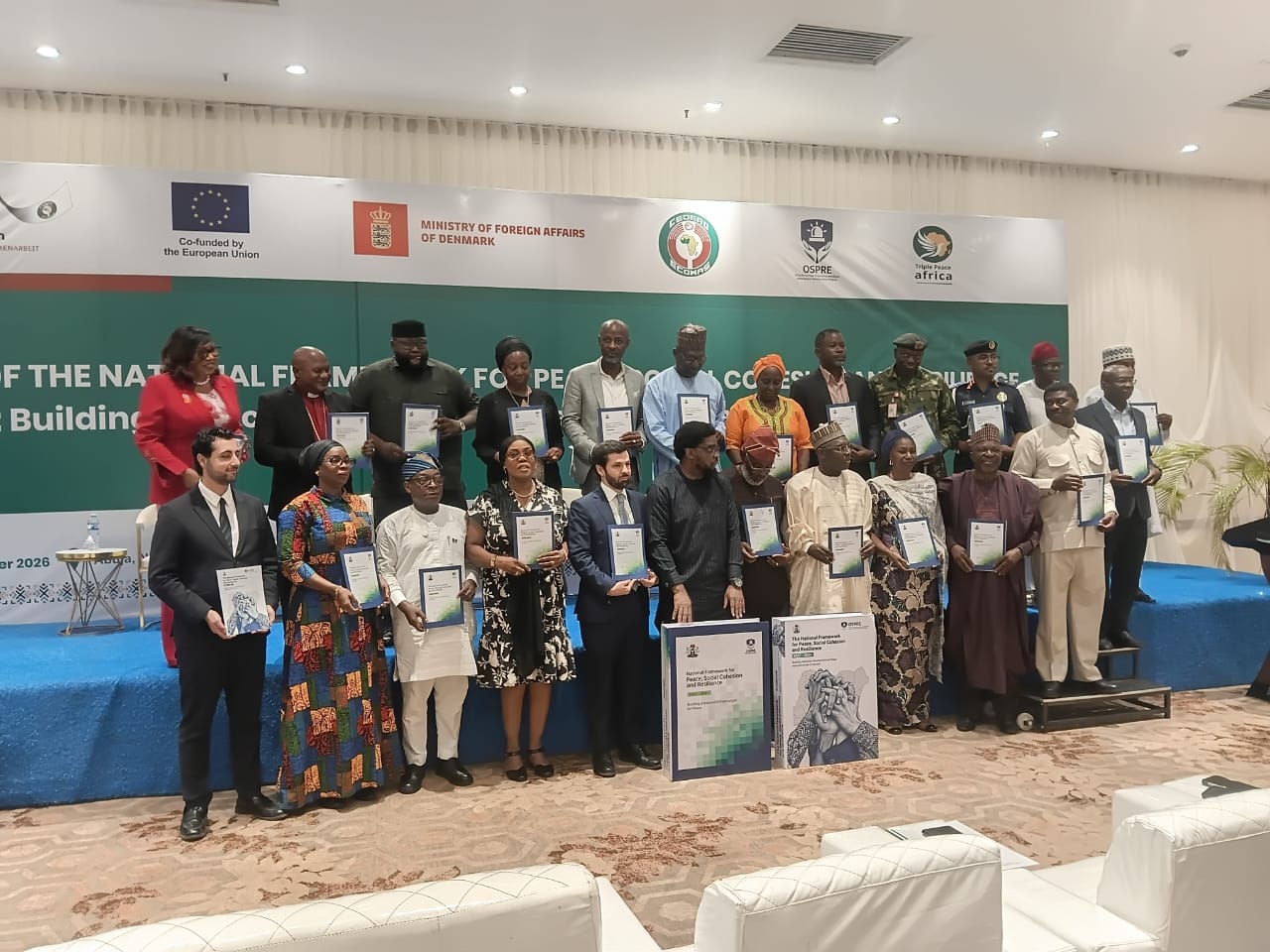
The Federal Government has unveiled a National Framework for Peace, Social Cohesion and Resilience aimed at strengthening conflict prevention and addressing security challenges that could threaten peaceful coexistence before, during and after the 2027 general elections.
The framework, launched on Wednesday in Abuja by the Office for Strategic Preparedness and Resilience (OSPRE) in collaboration with Triple Peace Africa, seeks to establish a coordinated national approach to preventing conflicts, promoting social cohesion and strengthening institutional responses to security threats.
Its introduction comes as Nigeria prepares for the 2027 elections, when political competition, communal tensions and disputes among political actors could create security challenges in different parts of the country.
Speaking at the launch, the Special Adviser to the President on Homeland Security, Major General Adeyinka Famadewa (retd.), said sustainable security could not be achieved through military and law enforcement operations alone.
He stressed that addressing the political, social and economic conditions that sustain conflicts was essential to achieving lasting peace.
According to him, the framework would help bridge the gap between national security operations and civilian-led peacebuilding while strengthening coordination among federal, state and local institutions.
Famadewa explained that sustainable security required functioning institutions, responsive governance, social trust and credible mechanisms for resolving disputes.
He added that the framework would complement the National Threat Assessment and Strategic Defence Operations Plan, reinforcing the Federal Government’s approach to national security.
The Director General of OSPRE, Mr Chris Ngwodo, described the framework as the product of nationwide consultations involving government institutions, peacebuilding practitioners and other stakeholders.
Ngwodo said the initiative began in 2025 as an effort to review the earlier National Peace Policy but evolved into a broader framework to address Nigeria’s contemporary security and governance challenges.
He explained that the framework would provide a common platform for institutions to align their responsibilities, coordinate interventions and strengthen early-warning and response mechanisms.
The development, supported by the European Union and the Deutsche Gesellschaft für Internationale Zusammenarbeit (GIZ), followed more than a year of consultations involving federal and state institutions, security agencies, civil society organisations, traditional and religious leaders, and development partners.
The framework’s emphasis on early warning, conflict resolution and community-based peacebuilding could also support efforts to identify potential electoral flashpoints, prevent political disagreements from escalating into violence and promote reconciliation after the polls.
However, its effectiveness will depend on how participating institutions adopt and implement its provisions, particularly in coordinating responses to emerging security threats at the state and community levels.
The launch marks the beginning of a new phase focused on institutional adoption, coordinated implementation and translating the framework’s objectives into practical interventions across the country.