Follow Us on Google
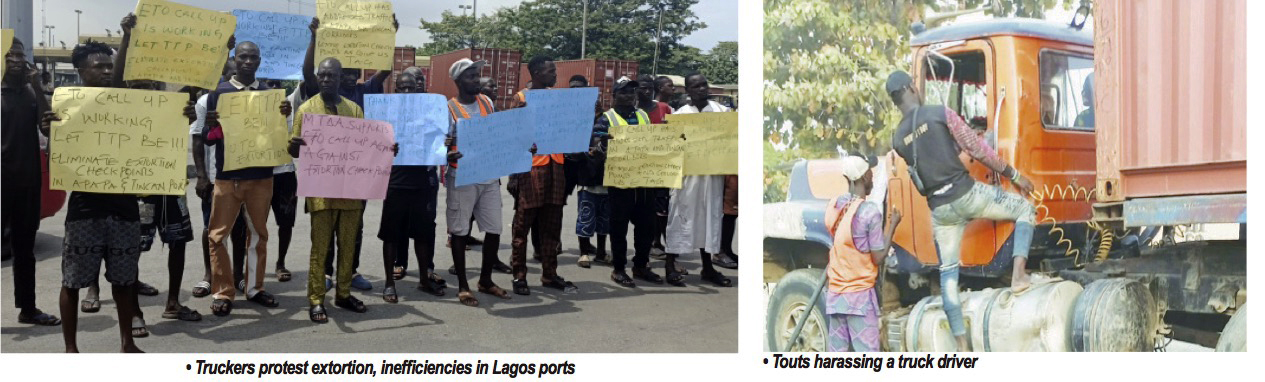
•Truckers, importers lament 34 checkpoints, N85bn annual loss
By Steve Agbota
The federal government’s sustained efforts to improve cargo evacuation, restore sanity on the Apapa and Tin Can port corridors and enhance the ease of doing business are once again facing a major test as truckers, importers and freight forwarders have raised fresh alarm over what they describe as an organised web of extortion allegedly operated by government security and traffic agencies along Nigeria’s busiest port access roads.
Despite repeated crackdowns on illegal checkpoints and several interventions coordinated by the Nigerian Ports Authority (NPA), the Lagos State Government and other stakeholders, operators say corruption has quietly returned to the nation’s maritime gateways, increasing the cost of transporting cargo, slowing evacuation from the ports and ultimately forcing Nigerian consumers to pay more for imported goods.
Central to the controversy are allegations that no fewer than 34 checkpoints have resurfaced along the Apapa and Tin Can port corridors, where truck drivers conveying containers are allegedly compelled to make unofficial payments before being allowed to proceed with their journeys.
Industry stakeholders who spoke with Daily Sun said the checkpoints have become so entrenched that truck operators now consider the illegal payments part of their operational costs, a development they described as a dangerous setback for ongoing reforms in the maritime sector.
Their concern goes beyond the inconvenience of repeated stops.
According to them, the cumulative financial impact of these unofficial collections now runs into tens of billions of naira every year, worsening inflation, reducing the competitiveness of Nigerian ports and frustrating legitimate businesses operating within the country’s maritime industry.
For many operators, the issue is no longer simply about corruption at the ports; it has become an economic challenge with direct consequences for trade, investment, government revenue and the purchasing power of ordinary Nigerians.
Costly journey from the ports
Truckers explained that transporting cargo from either Apapa Port or Tin Can Island Port to warehouses across Lagos and other parts of the country has become increasingly expensive because of numerous unofficial payments demanded at various checkpoints.
According to them, truck drivers moving containers through the Apapa corridor encounter more than 17 checkpoints, while those using the Tin Can Island Port access road pass through another 16 or 17 checkpoints, many of which are allegedly operated by personnel from different government agencies.
The operators alleged that although the agencies are officially deployed to maintain security, regulate traffic and protect public infrastructure, many of the checkpoints have gradually evolved into collection points where truck drivers are compelled to part with money before proceeding.
Failure to comply, they alleged, often results in delays, repeated inspections or unnecessary obstruction of cargo movement.
The stakeholders argued that these delays reduce truck turnaround time, increase fuel consumption, worsen congestion and ultimately translate into higher logistics costs.
How billions disappear annually
The figures presented by truckers illustrate the enormous scale of the alleged extortion.
Using an estimated daily traffic volume of about 3,000 trucks, operators said each truck is often compelled to pay around N5,000 at a checkpoint.
This means a single checkpoint could generate approximately N15 million every day.
Over one week, the amount rises to about N105 million.
In one month, collections could reach approximately N420 million.
Over an entire year, stakeholders estimate that one checkpoint alone could generate as much as N5.04 billion.
Applying the same calculation to the 17 checkpoints identified on the Apapa corridor, truckers estimate annual collections of over N85.6 billion.
They insist that this estimate does not even include the more than 16 checkpoints on the Tin Can corridor, meaning the actual financial burden on truck operators and cargo owners could be substantially higher.
Industry operators described the figures as alarming for a country trying to reduce inflation, lower logistics costs and attract investment into its maritime sector.
For them, the issue represents one of the biggest hidden taxes imposed on legitimate businesses operating within Nigeria’s port system.
Cost passed to hapless consumers
Stakeholders unanimously agreed that the financial burden does not end with truck operators.
According to them, every illegal payment made during cargo movement eventually becomes part of the overall cost of transporting imported goods.
Importers subsequently add those expenses to the selling prices of their products, while wholesalers and retailers pass the additional costs further down the supply chain until they reach consumers.
The result, they said, is that millions of Nigerians unknowingly pay for corruption every time they purchase imported food items, pharmaceutical products, industrial raw materials, electronics, spare parts and household goods.
The operators argued that while public attention often focuses on exchange rate volatility and high import duties as drivers of inflation, unofficial charges on port corridors also contribute significantly to rising prices.
They maintained that unless these leakages are eliminated, government efforts to moderate inflation through fiscal and monetary policies may continue to produce only limited results.
Gridlock making a comeback
The return of illegal checkpoints is also believed to be contributing to the gradual re-emergence of traffic congestion around the ports.
Only a few years ago, coordinated interventions by the Federal Government, NPA and Lagos State Government had significantly improved traffic flow along the Apapa and Tin Can corridors.
Illegal truck parking was reduced considerably, while cargo evacuation became more efficient.
However, stakeholders told Daily Sun that congestion has begun creeping back, particularly around the Tin Can Island Port axis.
They blamed repeated stoppages at checkpoints for reducing the speed at which trucks leave the ports.
Every unnecessary inspection, they argued, creates queues that quickly extend along already narrow access roads.
Combined with increasing cargo volumes, the delays eventually snowball into traffic gridlock that affects businesses, residents and commuters alike.
Operators warned that if decisive action is not taken quickly, the country could witness a return to the severe Apapa gridlock that crippled economic activities for years.
Reforms under pressure
The resurgence of extortion comes despite sustained efforts by the government to modernise port operations.
Over the past few years, authorities have introduced reforms aimed at reducing human interference in cargo clearance, improving truck scheduling and promoting seamless movement of containers.
Technology-driven initiatives such as the Electronic Truck Call-Up System (ETO) were introduced to regulate truck movement and minimise congestion.
Similarly, road rehabilitation projects around the ports have sought to improve accessibility.
Yet, stakeholders say corruption continues to undermine many of these initiatives.
According to them, every reform introduced to improve efficiency is quickly manipulated by individuals seeking personal gain.
Rather than disappearing, corrupt practices simply evolve into new forms.
The consequence, they noted, is that the government spends billions on infrastructure and reforms without achieving the expected improvements in operational efficiency.
“Corruption will always fight back”
Customs broker and Managing Director of Mikky Excellency Nigeria Limited, Alhaji Abdulazeez Babatunde Mukaila, believes the fundamental problem lies in weak policy monitoring.
He argued that reforms are often introduced without mechanisms for continuous review.
“Most of the policies on those access roads were just dropped, and there is no observation and review to know what is still trending about how to circumvent it by those crazy, corrupt, sharp-practicing people.
“So what the government needs to do to address this menace is to observe the trend so that they review and adjust any policy implementation. That is the problem. I want to tell you about ETO, which is a very beautiful idea, but it is always succumbing to and looking for ways to circumvent it. Lagos State has stepped in to help with the port access roads. I think they’ve relaxed a bit, and then here we go with the problem.
“So a lot of activities around the port access road suggest that our policy needs to be reviewed so that we know how to go about it. It only goes to show that corruption will always fight back. The people who have benefited are not going to relent.”
Mukaila said the government must remain proactive rather than reactive.
According to him, corruption thrives whenever enforcement weakens, making continuous monitoring essential.
For truck operators, however, policy reforms alone will not solve the problem unless there is strong enforcement against those allegedly exploiting their positions on the port access roads.
The General Secretary of the Association of Maritime Truck Owners (AMATO), Bala Muhammed, said the proliferation of checkpoints has become one of the greatest operational burdens confronting truckers despite repeated interventions by government and industry stakeholders.
According to him, drivers moving containers from the nation’s two busiest seaports are compelled to stop repeatedly at checkpoints where unofficial payments have become almost routine.
“The proliferation of checkpoints has become a major burden on truck operators despite ongoing efforts by stakeholders and government agencies to improve cargo evacuation and facilitate ease of doing business at the nation’s seaports.
“At one of the checkpoints, truck drivers are compelled to pay about N5,000 per truck. Using an estimated traffic volume of 3,000 trucks daily, collections at a single checkpoint could amount to N15 million every day. This translates to about N105 million weekly, N420 million monthly and approximately N5.04 billion annually from just one checkpoint.”
Muhammed said the figures become even more disturbing when multiplied across the numerous checkpoints identified along the Apapa corridor.
Based on industry estimates, he explained, collections across the 17 checkpoints on the Apapa axis alone could exceed N85.6 billion annually, while the addition of over 16 checkpoints on the Tin Can corridor could push the actual figure substantially higher.
According to him, the financial implications extend beyond truck owners.
Every additional cost incurred during cargo movement eventually becomes part of freight charges paid by importers and manufacturers, who ultimately transfer the burden to consumers.
He stressed that beyond the financial losses, the checkpoints also reduce truck productivity.
Other News
A truck that should ordinarily complete multiple trips within a given period now spends several hours navigating repeated inspections and delays.
This, he said, increases transport costs, reduces fleet efficiency and limits the volume of cargo that can be evacuated daily from the ports.
‘No non-state actors involved’
One of Muhammed’s strongest allegations was that the extortion is not being carried out by hoodlums or criminal gangs but by individuals attached to government institutions.
“There are no non-state actors collecting money in the port corridor. It is all state actors and security operatives.”
The allegation highlights the depth of stakeholders’ frustration.
For years, illegal collections around the ports have often been blamed on touts and miscreants operating around truck parks.
However, truck operators insist that the current challenge is largely institutional, involving personnel expected to facilitate cargo movement rather than obstruct it.
Muhammed disclosed that stakeholders have already begun taking steps to address the situation.
According to him, a multi-agency monitoring committee was recently inaugurated to identify illegal checkpoints and receive reports of extortion in real time.
He said the committee comprises representatives of the Police, Department of State Services (DSS), Lagos State Traffic Management Authority (LASTMA), Federal Road Safety Corps (FRSC), Nigerian Ports Authority (NPA) and other relevant agencies.
A dedicated communication platform, he added, has also been created to enable truckers to report incidents immediately they occur.
Industry stakeholders believe the success of the committee will depend largely on whether erring officials are identified, investigated and sanctioned without interference.
They argue that previous exercises failed largely because enforcement was inconsistent and offenders rarely faced consequences.
When local transport costs exceed overseas shipping
Perhaps the most vivid assessment came from the President of the Shippers Association of Lagos State (SALS), Rev. Nicodemus Odolo, who said moving cargo from Nigerian ports to warehouses can sometimes cost more than transporting the same cargo thousands of kilometres from China to Nigeria.
“You can’t believe it. From port to cargo warehouse, the cost can be more than the freight cost from China to Nigeria.”
The statement reflects a reality many importers say has persisted for years.
Industry experts explained that while international freight charges have become relatively competitive due to improved shipping efficiency and economies of scale, domestic logistics remain weighed down by poor infrastructure, multiple checkpoints, congestion, delays and unofficial payments.
As a result, cargo owners often spend huge amounts moving containers over relatively short distances after they have arrived in Nigeria.
Odolo lamented that cargoes already examined and released by relevant agencies inside the ports are frequently subjected to repeated roadside checks by different officials.
According to him, every additional inspection translates into lost time, increased transport costs and avoidable operational inefficiencies.
He warned that these inefficiencies reduce Nigeria’s attractiveness as a trading destination.
In a competitive regional market where neighbouring countries are investing heavily in efficient port systems, he said Nigeria cannot afford avoidable delays that discourage investors.
Importers feeling the pressure
The South-West Chairman of the Importers Association of Nigeria (IMAN), Joseph Ajoku, also expressed concern over the increasing cost of moving cargo from the ports.
According to him, repeated interception of containers after Customs clearance has become a major source of frustration for importers.
He said many operators are forced to incur additional expenses arising from delays, repeated examinations and unofficial demands.
“All this money that we spend here and there from one point to another is part of the expenses which we are going to add to the cost of the goods. At the end of the day, the price of the goods will go up. Who is going to bear the brunt? It is the end consumer.
“The amount we pay to these checkpoints varies, but the truth is that it’s a problem. If you insist on your rights, they can delay you. They will say one thing or the other. The point is that it is a problem, and it is part of the challenges importers are facing at the ports.”
Ajoku warned that the rising cost of compliance is discouraging legitimate businesses.
Some importers, he noted, are gradually reducing their activities because profit margins continue to shrink under mounting logistics expenses.
Others are exploring neighbouring ports where cargo clearance is faster and transportation costs are relatively lower.
According to him, such developments ultimately reduce Nigeria’s competitiveness within the West African sub-region.
Inflationary consequences
Economists have consistently argued that logistics account for a significant proportion of the final cost of goods.
When transportation becomes more expensive, producers, importers and distributors rarely absorb the additional costs.
Instead, they transfer them through the value chain.
Stakeholders say this is precisely what is happening on Nigeria’s port corridors.
Every unofficial payment made by truck operators increases transport costs.
Those higher transport costs are reflected in warehouse charges, wholesale prices and eventually retail prices.
The cumulative effect is rising inflation, particularly for imported consumer goods, industrial machinery, pharmaceutical products and manufacturing inputs.
Manufacturers relying on imported raw materials also face higher production costs, making locally manufactured goods more expensive.
In the long run, the entire economy bears the consequences.
Threat to government revenue
Beyond the impact on consumers, stakeholders believe persistent extortion also undermines government revenue.
Nigeria has invested heavily in expanding Customs revenue, improving trade facilitation and encouraging compliance among importers.
However, industry operators argue that high logistics costs discourage legitimate trade.
Some cargo owners reduce import volumes, while others divert shipments through neighbouring countries before bringing goods into Nigeria through informal channels.
Such cargo diversion, they warned, reduces Customs revenue and weakens the country’s position as the preferred maritime hub in the Gulf of Guinea.
Need for institutional reforms
Stakeholders insist that addressing the problem requires more than dismantling illegal checkpoints.
They called for institutional reforms that would strengthen accountability among agencies operating within the port environment.
Among the measures proposed are continuous electronic monitoring of port corridors, deployment of surveillance cameras, stricter supervision of field officers, periodic rotation of personnel and stiffer disciplinary measures for officials found engaging in extortion.
They also advocated greater automation of cargo clearance processes to minimise physical interactions between officials and transport operators.
According to them, technology remains one of the most effective tools for reducing opportunities for corruption.
Protecting gains of reform
Over the past decade, successive administrations have invested billions of naira in rehabilitating port access roads, expanding infrastructure and introducing digital platforms aimed at improving cargo movement.
The success of those investments, stakeholders argue, depends on preserving the integrity of the entire logistics chain.
If corruption continues unchecked along access roads, they warned, the benefits of road rehabilitation, electronic truck scheduling and Customs modernisation could be significantly eroded.
For many operators, restoring sanity to the port corridors has become as important as expanding port infrastructure itself.
Test of political will
Ultimately, stakeholders believe the current situation presents another opportunity for the Federal Government to demonstrate its commitment to fighting corruption and improving the ease of doing business.
While they acknowledged previous interventions by the Nigerian Ports Authority, the Lagos State Government and security agencies, they insisted that more sustained enforcement is required to prevent illegal checkpoints from re-emerging.
For truckers, freight forwarders and importers, dismantling the checkpoints would not only reduce transport costs but also improve cargo turnaround time, strengthen investor confidence and enhance Nigeria’s competitiveness as a regional maritime hub.
More importantly, they argued, it would ease the financial burden on millions of Nigerian consumers who unknowingly pay the price for inefficiencies embedded within the country’s logistics system.
As Nigeria pursues economic diversification through trade, manufacturing and non-oil exports, stakeholders maintain that the country’s ports must function as efficient gateways rather than costly bottlenecks.
Their message is clear and unambiguous, which is that unless corruption on the Apapa and Tin Can port corridors is decisively confronted, the benefits of ongoing maritime reforms may remain elusive, while businesses and consumers continue to shoulder the enormous cost of a system weighed down by illegal checkpoints and unofficial levies.