Follow Us on Google
…As prices of foodstuffs skyrocket
By Agatha Emeadi
With just eight days left before Christmas, families are still striving to buy foodstuffs for the festivity despite the astronomical rise in prices.
Nonetheless, people in the lower income group would be worse hit by the soaring prices, thus presenting a bleak celebration for them.
Sunday Sun undertook a tour of several markets in Lagos to get a picture of the situation of food prices as families look for where to get the most affordable prices of foodstuffs that they can buy with the meagre family purse.
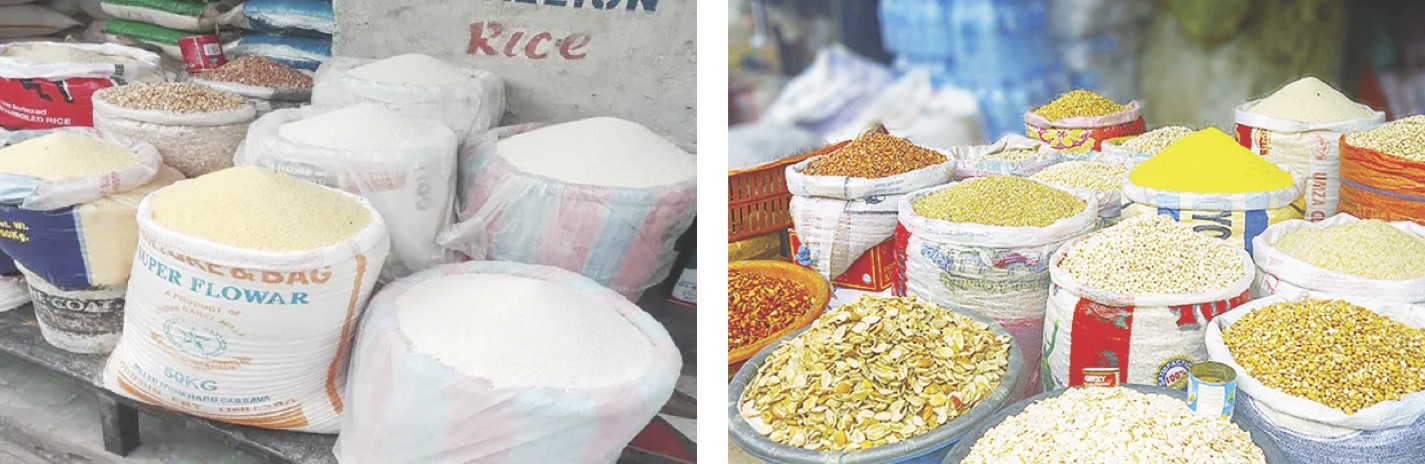
At the Daleko-Mushin market, Iyana-Isolo, which is generally seen as the sales and distribution headquarters of staple foods like rice, beans and groundnut oil, prices have skyrocketed.
The market is the home base of Otiloleke Market Association and Iya Dolapo, one of the members, is a major distributor of rice, a business she took over from her husband many years ago.
In the course of conversing with her, she told Sunday Sun about the different types of rice being sold in the market and also talked about the growing sharp practice of re-bagging less desirable rice in the bags of popular brands.
She also talked about the level of patronage. Asked about the current price of foreign rice for a joint purchase of up to 20 bags by a group of workers, Iya Dolapo said: “Well, I will give you today’s price because even as a major distributor, I cannot tell you what the price will be tomorrow because rice has no definite price anymore. Today, some of us are selling foreign long-grain rice between N60,000 and N63,000 while foreign small short grain is sold between N50,000 and N53,000.”
Nigerian rice, which is popularly called Lagos rice and has the ‘Eko Rice’ logo prominently displayed on the bag, is grown and processed in the North under a joint venture agreement between Lagos State and Kebbi State governments.
A bag of this type of rice is sold for N48,000. Eko rice comes in two colours and is not very clean, but in these bleak times, people who cannot afford polished imported rice cannot afford to be picky.
Anyway, Iya Dolapo dismissed the remark about the colour of rice with a wave of the hand, saying, “We sell it like that.”
For families that are unable to afford one full bag of rice, there is the option of buying retail portions measured out with a particular size of plastic paint can. A full bag contains 12 paint cans, which are of the same size as Custard plastic cans. Each can cost N5,000 while a Derica of foreign rice is sold at N1,000.
While the conversation with Iya Dolapo progressed, some rice sellers were observed re-bagging unpopular rice brands into the bags of popular brands like Stallion and Caprice, in full view of customers who thronged the market for their Yuletide purchases.
Sunday Sun learnt from one of the men doing the re-bagging that the ones being re-bagged were not for sale. Instead, he said, some companies need them to be used as Yuletide gifts and for that reason, the bags must be presentable, regardless minding the quality and content. He also corroborated what Iya Dolapo said that rice does not have a fixed price for now.
Just like every business has its secrets, he said that it is also possible to convert 18 bags of rice into 20 bags because some quantities can be removed from the original size to make new bags.
Surprisingly, even with skyrocketing prices, traders in the market are still getting reasonable patronage from both individuals and companies.
“People are still rushing to buy rice as if it did not add money. If vehicles are still on the road despite the suffering inflicted on the masses by the removal of the fuel subsidy, man must also eat rice and give out as the season demands it,” Iya Dolapo said.
Initially, the price of rice and other food commodities rose after the removal of the petrol subsidy by the Bola Tinubu administration, a move that instantly shot up the cost of transportation.
The removal made the price of petrol jump from N240 per litre to N568 per litre and even N630 in some cases. Expectedly, the direct impact was felt on agricultural produce. The higher cost of transporting the agricultural goods was simply passed on to the final buyer in the form of higher foodstuff prices.
Both the rich and the poor are experiencing the pain of the astronomical rise in the price of foodstuffs, though to very different degrees. The poor are groaning under the weight of the sharply increased prices. Meeting the family’s food needs is a much heavier burden for the poor citizens who essentially live on day-to-day incomes.
As Iya Dolapo explained, one fact to note regarding the price of rice is that the country does not have rice-producing firms.
She said: “Do not forget that Nigeria does not have enough rice production companies, and the borders are closed. So, a few who managed to smuggle in some bags would increase the price. Other smuggled frozen foods like chicken and turkey are in the same category of price increase.”
Also, the fall in the exchange rate of the naira to the dollar affected the cost of all goods and services, including transportation and foodstuff.
Therefore, in comparison to last year’s prices of foodstuffs, especially rice, both foreign and local, the long grain was sold at N32,000 while the Nigerian rice was sold at N28,000.
At another section of the market, Alhaja Kekere sells groundnut oil. As at the time of filing this report, a carton of Power oil sold at N22,700 as against N19,900 last month while one carton of the 1-litre version made up of 12 plastic bottles is sold for N19,000; 2.6 litres version that has eight cans in a carton is sold at N42,000. For the 25-litre jerrycan, the price at the time of the visit to the market was N37,500.
However, Alhaja Kekere carefully noted that the prices were company prices, adding that wholesalers and retailers might not give you the same price. To this end, the big Eva bottle of groundnut oil is N2,400 while the small bottle is N1,200 as against the N500 and N1,000 that these sizes were sold early this year.
Across the city, Mile 12 Market towards Ikorodu axis, is the main place for sales of yam tubers, potatoes, beans, fresh tomatoes, pepper and onions.
At the market, Sunday Sun learnt from Alhaji Muhammed, a yam dealer, who made a profound statement about the price of yam: “The price of a lorry-load of yam cannot be ascertained, except the bulk buyers who supply to us inform us from the farm in the far North.
“But today, a lorry load of yam tubers runs into millions of naira depending on the size. It is not a very common place for one person to buy a lorry load of yam. Rather, interested dealers contribute money to make such a huge purchase and then share the consignment among themselves, when it arrives. One lorry might have 6-10 contributions from different buyers in different parts of Lagos. When the vehicle arrives at Mile 12 here, owners would come to share according to what they contributed.”
Just like rice and groundnut oil, the prices of different sizes of yam tubers also increased. The size usually sold for N800 has gone up to N1,200 in the shops of wholesalers in Mile 12 while retailers sell them at N1,500.
In the same market where tomatoes and peppers are supposed to sell at cheaper rates because of the concentration of the market, and the current dry season, the price of tomatoes should have been more affordable. Usually, a big basket of tomatoes is made up of two crates. One crate is currently sold for N13,000. If a buyer does not want a full basket, such a buyer can then get a half basket.
Another major seller who deals in onion, Alhaji Ado, said that the case of onion is a different matter completely.
He said: “Onion is now the king of foodstuffs. Everyone is managing to sell and eat it. Even the people who make Suya (a popular roasted meat snack) have greatly reduced the quantity of onions they add to the meat because of the price. A sizable 60kg basket of onions costs between N55,000 and N60,000. This has caused low sales of onions. You can hardly find anybody willing to sell just N100 worth of onions to a buyer in the market because of the high cost of the commodity.”