Follow Us on Google
…As NPC seeks more registrars, engages traditional birth attendants
By Chinenye Anuforo
No fewer than 3.5 million children across Lagos, Ogun, Oyo, Osun, Ondo, Ekiti and Edo States are without birth certificates, leaving them without legal identity and effectively “invisible” in government records, the United Nations Children’s Fund (UNICEF) has said.
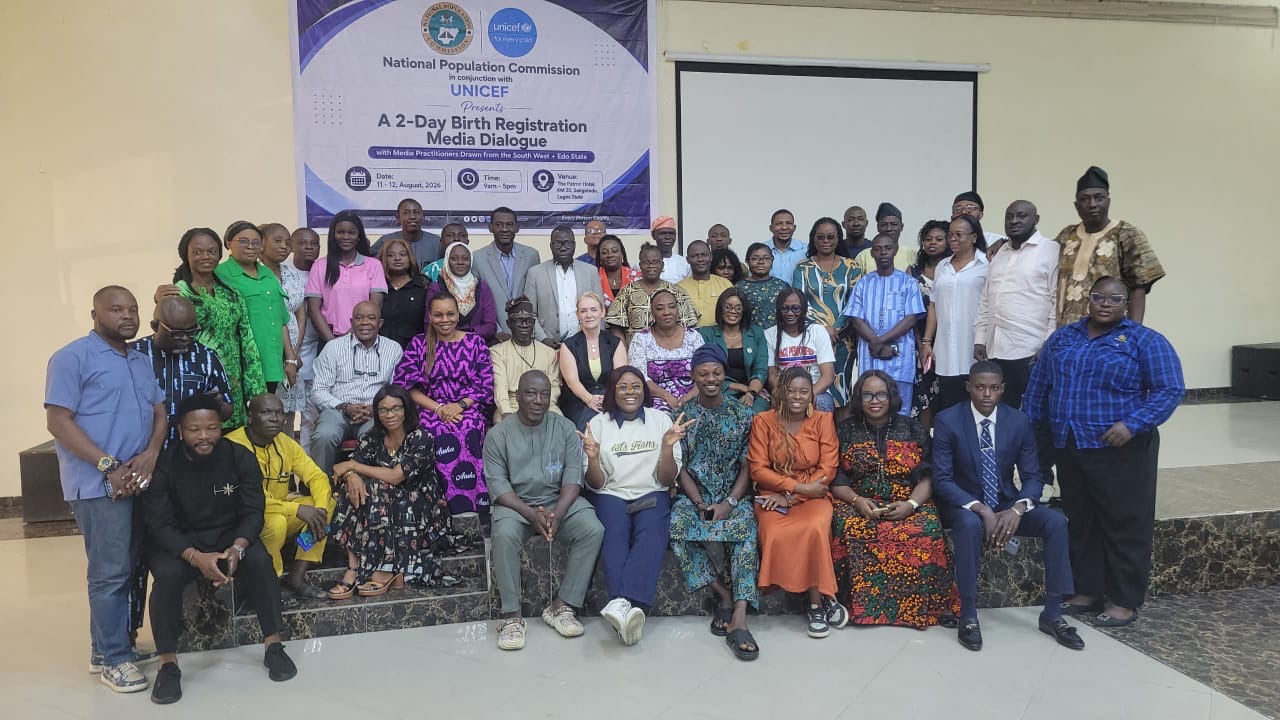
UNICEF Chief of Lagos Field Office, Celine Lafoucriere, disclosed this in Lagos Tuesday at a two-day Birth Registration Media Dialogue organised by the National Population Commission (NPC) in conjunction with UNICEF.
Lafoucriere said the affected children were alive and living with their families but had no official record proving their existence.
“Right now, across your various states, some babies born even this morning will end this day with no name on any government record,” she said.
According to her, the problem cuts across urban and rural communities, with some children born in hospitals but never registered.
She stressed that birth registration was more than obtaining a document, describing it as the foundation of a child’s access to essential rights and services.
“A birth certificate is not a piece of paper. It is a child’s ticket into school. It is what allows a doctor to put a name on a patient file. It is how a family proves their child is theirs,” she said.
She added that without proper documentation, children could later face difficulties obtaining passports, voting or establishing their right to inherit property.
“They go through life, having to prove they exist over and over again,” she warned.
Lafoucriere noted that progress had been made, citing Lagos State’s collaboration with NPC and the Association of Local Governments of Nigeria (ALGON) to launch birth registration for children under one.
She said the birth certificate issued under the initiative now comes with a National Identification Number (NIN), describing it as “a meaningful step forward.”
However, she said the gap between registered and unregistered children remained wide and urged journalists to investigate the reasons behind low registration figures.
According to her, many parents are unaware that registration is free, that it can be done at nearby health facilities or that digital registration is now available in some communities.
“They do not know because no one has told them in a language they trust, on a platform they use, in a voice that sounds like their own,” she said.
She urged journalists to go beyond statistics and tell the stories of families and communities affected by the lack of birth registration.
“Find the children behind the statistics and depart from here to write the stories that need to be written,” she told journalists.
Also speaking, Lagos State Director, NPC, Kekere Ekun Abiola, said the Commission was working to deploy more registrars to health facilities across the state to bring registration closer to where children are born.
He said while registrars had been deployed to many facilities, some still lacked registration personnel, adding that the need also extended to private health facilities.
He explained that once a child is born and the health facility issues a birth notification, the parents are directed to the registrar for formal registration.
Abiola said the registration system also captures births outside conventional health facilities, including those at home and those assisted by traditional birth attendants (TBAs).
“We have situations where births take place at home or are assisted by TBAs, and these births also have to be captured within the national civil registration system,” he said.
He said NPC was working with TBAs because of their importance in communities where access to formal health facilities is limited.
“The objective is not simply to register children who are born in hospitals. The goal is to ensure that every child is counted and recognised, regardless of where the child was born,” he said.
Abiola called for stronger collaboration among government agencies, development partners, foundations and the media to drive public awareness on birth registration.
He urged journalists to investigate gaps in the system and keep the issue in public discourse, stressing that when children are not registered, they can become invisible in government planning.
“Every child must be counted,” he said.
According to him, the Commission has continued to expand birth registration coverage from the low 20 per cent range recorded in the past, with plans to increase coverage further.
“Our goal is to achieve universal birth registration and ensure that every child in Nigeria is recognised within the civil registration system,” he said.
Meanwhile, UNICEF Child Protection Specialist, Denis Onoise, said accurate civil registration data was essential for effective government planning, including provision of schools, healthcare, immunisation and social protection.
He identified limited access to registration services, particularly in hard-to-reach communities, inadequate capacity and other logistical challenges as some of the factors affecting registration.
Onoise said digitisation and decentralisation were being pursued to address the challenges, with registration officers using tablets to capture and transmit children’s information digitally.
He also advocated stronger integration of birth registration with primary healthcare services, noting that not every child is born in a major hospital.
He urged journalists to investigate why children remain unregistered and identify whether the gaps are linked to lack of registration centres, personnel, equipment, awareness or coordination.
“If a child is not registered, ask why,” he said.
The two-day dialogue was organised to strengthen media advocacy and public awareness on birth registration for children under one year. The programme also featured a live demonstration of the e-birth registration system by Lagos State NPC.