Follow Us on Google
By Stanley Uzoaru, Owerri
In the intricate theatre of Nigerian politics, few contests capture the imagination quite like a battle where the combatants know each other intimately, share the same party colours and yet regard one another with barely concealed hostility. Imo West, otherwise known as Orlu Zone, has become precisely that theatre ahead of the 2027 general elections, and what is unfolding there carries consequences that stretch far beyond the boundaries of a single senatorial district.
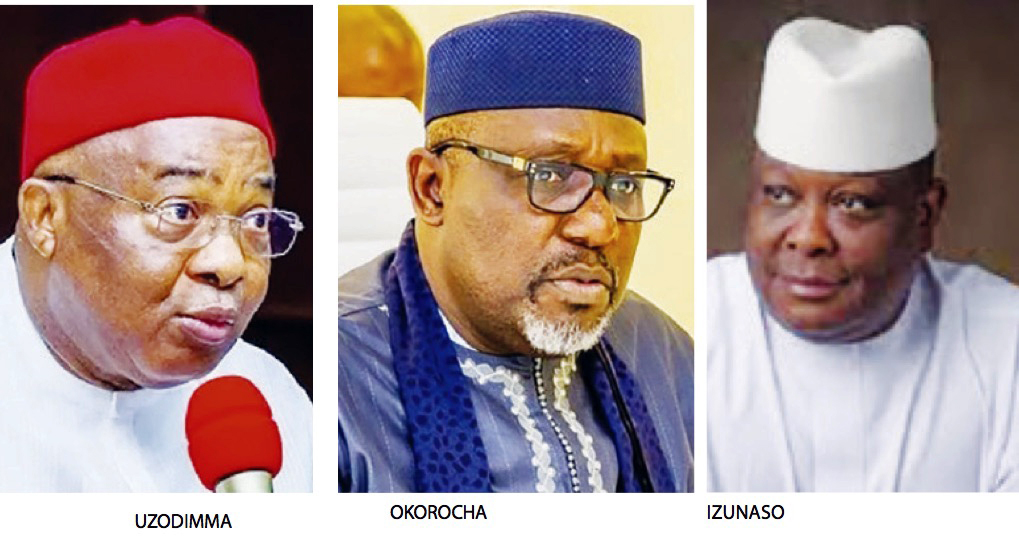
At the centre of the storm is Governor Hope Uzodimma, who has made no secret of his intention to return to the Senate upon completing his tenure. APC leaders in Orlu have already purchased nomination forms on his behalf and declared him the consensus candidate, with the Orlu Political Consultative Assembly describing the decision as “total, unanimous and irrevocable.”
In the language of Nigerian party politics, such declarations are designed to close conversations before they open. In this instance, they appear to have done precisely the opposite.
Former Governor Rochas Okorocha has responded by purchasing his own nomination form under the same APC platform, making explicit what his supporters have barely attempted to conceal: this is a direct confrontation with Uzodimma. For Okorocha, the contest is not simply about a senatorial seat. It is about reclaiming political relevance that has steadily eroded since 2019, and about ensuring that the man he regards as a political adversary does not ascend further up the national ladder. Between them sits incumbent Senator Osita Izunaso, who was initially seeking re-election but has grown conspicuously quiet since Uzodimma’s intentions became public.
Whether Izunaso steps aside or remains in the contest will significantly shape the arithmetic of what promises to be a bruising primary.
Other News
What makes this more than a local power struggle is the question of the Senate Presidency, which hovers over the entire contest like an unspoken ambition. Uzodimma represented Orlu in the Senate between 2011 and 2019 and clearly believes that a return to the chamber, backed by the organisational weight of a sitting governor, positions him for the topmost legislative office.
However, the Senate recently amended its rules to restrict principal offices to ranking senators who have served at least two consecutive terms, with one being the immediately preceding term. That amendment effectively bars Uzodimma from the Senate Presidency even if he wins in 2027, since he is not a member of the current 10th Assembly. The rule change is widely interpreted as a deliberate pushback by the legislature against governors who seek to parachute into the Senate and immediately claim its leadership. The amendment raises a legitimate question about the nature of Uzodimma’s ambition. If the Senate Presidency is no longer immediately attainable, what precisely is being sought? Defenders of the governor argue that his presence in the Senate would give Imo State and the broader South-East a commanding voice in national legislative affairs. Critics counter that a sitting governor contesting a Senate seat before his tenure expires raises genuine questions about governance continuity and where his attention and energy truly lie during the remainder of his mandate.
These are not unreasonable concerns, and they deserve to be weighed honestly alongside the legitimate political calculations at play. Orlu Zone comprises 12 local government areas and is the largest senatorial district in Imo State. A disorderly three-way primary contest between Uzodinma, Okorocha and potentially Izunaso risks fracturing the APC base in a zone the party cannot afford to lose. Okorocha retains grassroots networks and genuine sympathy among party members who feel that ticket allocation has become the exclusive preserve of the governor’s office. Should he contest vigorously and subsequently feel aggrieved by the outcome, the consequences for APC’s unity in the South-East could be severe. The parallel with Ogun State is instructive. There too, a sitting governor’s senatorial ambitions have placed him on a collision course with an incumbent senator, former Governor Gbenga Daniel, creating the kind of intra-party tension that opposition parties do not need to manufacture. They merely need to observe and position themselves as the more orderly alternative. The PDP and Labour Party do not need to win Orlu outright to benefit from APC’s internal contest. They need only wait whilst the ruling party expends financial resources, political capital and organisational energy fighting itself, then present their own candidates as voices of stability and fresh representation. The broader South-East dimension of this contest deserves sober reflection. The Tinubu administration has made visible efforts to deepen APC’s roots in a region that has historically resisted the party, through infrastructure commitments, strategic appointments and sustained political courtship. A high-profile, publicly contested civil war within APC’s most prominent Imo structure risks undermining that patient work. Conversely, a managed consensus that delivers a South-East senator with genuine national influence could become one of the administration’s most compelling arguments to the region ahead of the presidential election.
The tension between these two possibilities is what makes Orlu so consequential. It is, in essence, a stress test for two propositions that the APC has staked considerable credibility upon: first, that governors can anchor the party’s electoral machinery in difficult regions; and second, that the South-East has a meaningful place in the party’s power-sharing arrangements. If the Orlu contest is resolved with discipline and genuine consultation, both propositions are strengthened. If it degenerates into an open war of attrition between powerful figures pursuing personal agendas, both are weakened in ways that may prove difficult to repair before the 2027 votes are cast.
What Imo West is really asking, beneath all the political noise, is a question that the APC has yet to answer convincingly: can a party that was built on the grievances of the marginalised resist becoming the very thing it once stood against?