Follow Us on Google

From Ndubuisi Orji, Abuja and Oluseye Ojo, Ibadan
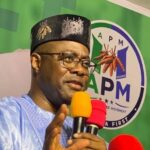
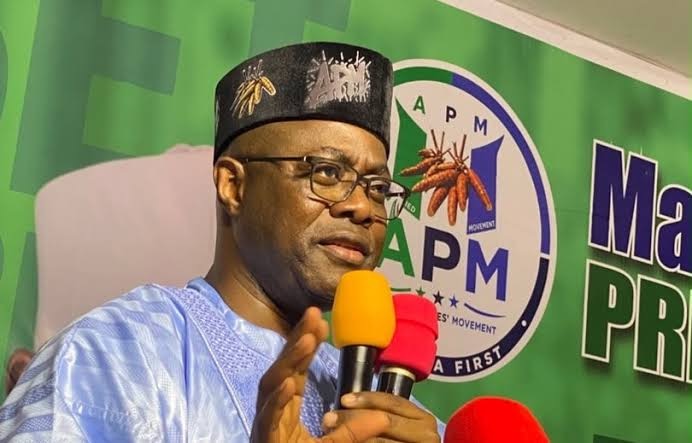
The presidential candidate of the Allied Peoples Movement (APM), Seyi Makinde, has declared that Nigeria needs a fundamental reset to overcome insecurity, poverty, hunger and infrastructural deficiencies, as his party challenged President Bola Tinubu to defend his administration’s record rather than resort to political insults ahead of the January 16, 2027 presidential election.
Makinde, who spoke in Abuja on Sunday, said Nigerians dissatisfied with the prevailing economic and security situation should embrace his Reset Nigeria Agenda, while urging citizens to pray for divine intervention in the country’s affairs rather than his personal victory at the polls.
His remarks coincided with a statement by the APM condemning Tinubu’s reported use of the Yoruba expression, “Egbe palemo,” at Saturday’s All Progressives Congress (APC) presidential campaign rally at Mapo Hall Arcade, Ibadan, which the opposition party interpreted as a disparaging reference to its political platform.
Speaking to journalists after attending a service at the headquarters of Dunamis International Gospel Centre, Makinde maintained that Nigeria was no longer providing the opportunities and benefits of governance that citizens deserved, insisting that a change in direction had become necessary.
“My message still is, if Nigeria is not working for you, then join me to press the reset button.
“Or if it’s working for you, okay, keep doing what you are doing, but I know Nigeria is not working,” he said.
The Oyo State governor explained that his presidential ambition was informed by the desire to restore public confidence in governance and recreate the opportunities that once enabled Nigerians to pursue their aspirations across the country.
He, however, maintained that the outcome of the election should ultimately reflect God’s will, stressing that his appeal for prayers was not intended to secure personal political advantage.
“When I came out to declare to run for president, what I asked people for was to pray that God should show mercy onto this country.
“I don’t even pray for me to be president of Nigeria, but pray that God’s will and God’s will alone be done.” Makinde said the spiritual dimension of national development could not be separated from the physical challenges confronting the country, urging Nigerians to remain committed to prayers while participating in efforts to improve governance.
“You can’t take this spiritual aspect away from the physical,” he said.
Makinde, who also attended a service at the Nongo u Kristu u i Ser u sha Tar (NKST), the Universal Reformed Christian Church, in Mabushi, Abuja, recalled his experience of moving from Oyo State to Rivers State as a young man in the 1990s before returning home and eventually becoming governor in 2019.
He cited the experience as an example of the opportunities he believed Nigeria should once again provide for its citizens.
Receiving him at the church, the resident pastor, Basil Orkpe, encouraged Makinde to remain committed to his presidential ambition, describing it as an opportunity to serve the country and alleviate the suffering of Nigerians.
“Without a shadow of a doubt, this great movement that God Himself has orchestrated has a purpose.
“Many people may have said, ‘Stop this, concentrate on something else’, but your heart’s desire and your cry to Jesus Christ have been that you would be able to serve this nation and, by extension, the rest of the world, and bring relief to the suffering of the people of this great land,” Orkpe said.
Other News
The cleric urged him not to be discouraged by opposition to his aspiration but to remain focused on what he described as the task of salvaging the country.
Meanwhile, the APM accused Tinubu of attempting to divert attention from the performance of his administration through political name-calling, arguing that Nigerians were more concerned about economic hardship, unemployment and insecurity than exchanges between rival political parties.
In a statement issued by the Director of Communication and spokesperson of the Oyo State APM Campaign Council, Yinka Oladoyinbo, the party said the President should explain what his administration had achieved since assuming office on May 29, 2023, rather than ridicule political opponents.
“We consider the expression a curious choice of words from a President whose administration has become synonymous with economic hardship, public frustration, political manoeuvring and an increasingly desperate search for electoral validation,” the statement said.
The party explained that the Yoruba word palemo could suggest hurriedly gathering or packing belongings, sometimes in preparation for departure, and questioned the President’s choice of expression.
“Mr President may wish to explain why such vocabulary comes so readily to him. As the saying goes, it takes a master of a craft to recognise the language of fellow practitioners. And when an accuser points one finger at another, the remaining four are invariably directed at himself,” it stated.
APM insisted that the challenges confronting Nigerians demanded concrete policy responses rather than political exchanges, maintaining that the rising cost of essential commodities, declining purchasing power and insecurity should dominate public debate ahead of the election.
“The APM will not be distracted by presidential name-calling. Nigerians are far more concerned about the cost of living, the purchasing power of their incomes, insecurity, unemployment, collapsing economic confidence and the daily struggle to survive than the linguistic theatrics of a campaign podium.
“A President seeking another mandate should be explaining what he has done with the first, not trading taunts with political opponents,” the party declared.
It further argued that Tinubu should have used his visit to Oyo State to address the economic difficulties confronting Nigerians and explain how his administration intended to improve living conditions.
The opposition party also rejected suggestions that the reception accorded Tinubu by the Olubadan of Ibadanland, Rashidi Ladoja, and the Soun of Ogbomoso, Ghandi Afolabi Olaoye, amounted to an endorsement of his re-election bid by the monarchs or their communities.
According to APM, traditional rulers are custodians of culture, history and communal harmony whose institutions should remain accessible to citizens irrespective of their political affiliations.
“A royal handshake does not constitute a ballot. A palace audience does not confer electoral authority. Political choreography cannot manufacture the consent of the people,” the statement said.
The party maintained that traditional institutions should preserve their neutrality and continue to provide platforms for dialogue, mediation and reconciliation rather than become instruments of partisan mobilisation.
“Their palaces must remain places where the ruling party, the opposition, the undecided and the politically disenchanted can find counsel, mediation and a sense of belonging. They are not campaign surrogates, electoral assets or instruments for manufacturing political legitimacy,” it added.
Invoking the Yoruba proverb, “Bi ikun lo ni oko, bi pakute, ipade d’ojo ibo,” APM maintained that neither presidential visits nor public appearances with traditional rulers could substitute for the freely expressed choices of voters.
It insisted that the January 16 presidential election would provide Nigerians an opportunity to assess the records and promises of the competing candidates and determine the country’s political direction.