Follow Us on Google
By Godwin Tsa, Abuja
As a cornerstone of any democratic system, the judiciary serves as the guardian of the rule of law and the protector of citizens’ rights. The judiciary plays a critical role in upholding democratic principles, maintaining checks and balances on governmental powers, and ensuring justice prevails in society.
In contemporary Nigeria, the judiciary’s responsibility extends far beyond mere dispute resolution. It has become the gatekeeper of democratic values, the protector of constitutional order, and the mediator between conflicting interests within the state.
Indeed, the judicial process in Nigeria plays a fundamental role in electoral integrity, which is a core pillar of democracy. From pre-election disputes, qualification of candidates and post-election litigation, to issues of voter suppression and electoral fraud, the judiciary has been entrusted with the power to determine the legitimacy of electoral outcomes.
As an arm of government with such constitutional powers, the judiciary is expected to safeguard its credibility by playing a stabilising role in the electoral process ahead of the 2027 elections. Therefore, pre-election disputes is expected to be resolved with clarity and balance to maintain public order.
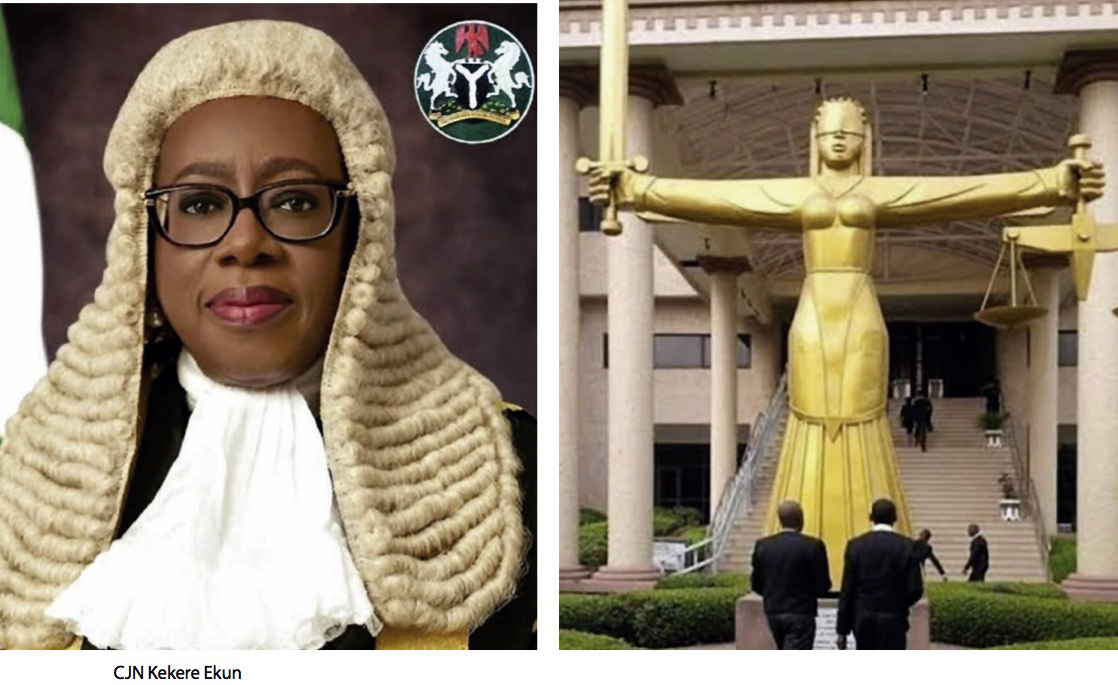
Speaking on 15 December 2025, the Chief Justice of Nigeria, while calling on the judiciary to play a stabilising national role ahead of the 2027 general elections, stressed the need for courts to maintain discipline, consistency and strict adherence to constitutional timelines in resolving pre-election and election-related disputes. She emphasised that pre-election disputes must be resolved with clarity and balance in order to maintain public confidence.
The Chief Justice reiterated this position while declaring open the 2025/2026 Legal Year of the Federal High Court, with a warning that election-related disputes must be handled with discipline, consistency and strict adherence to constitutional and statutory timelines.
Justice Kekere-Ekun said: “The nation looks to the courts for clarity and balance at such critical moments. This court has a crucial role to play in pre-election dispute resolution. Conflicting interim orders, forum shopping, and the abuse of ex parte processes undermine the credibility of the entire justice system and weaken public confidence.
“Heads of Divisions must therefore enforce procedural discipline firmly and fairly. The judiciary must never be perceived as a theatre for political gamesmanship; it must remain a sanctuary of constitutional order,” she added.
Another important role the judiciary is expected to play ahead of the forthcoming polls, is to assert its independence and credibility. It is crucial and important for the judiciary to purge itself from the stronghold of executive influence and maintain neutrality and good conscience, so as to avoid the perception of being manipulated by politicians.
This call is important as the judiciary appears to be gradually metamorphosing from a neutral arbiter into a critical player on the political stage. A former President of the Nigerian Bar Association, Mr. Paul Usoro, emphasised the need for judicial independence when he admonished judges not to allow themselves and their courts to be dragged into the murky waters of politics and, in the process, embarrass the justice sector.
“As we go into another season of elections with its attendant contentions and cases, we respectfully urge Your Lordships to always keep in mind the weighty responsibilities that rest on Your Lordships’ shoulders. Through Your Lordships pronouncements, you continually save us from ourselves and, in no small measure, assist in maintaining the peace, unifying, and welding us together as one nation,” Usoro pleaded.
As the 2027 general elections beckon, the judiciary is also expected to equally exercise scrutiny and not willingly donate its jurisdiction when invited to intervene in disputes that are fundamentally political and within the internal affairs of political parties. This is very important as it will not only preserve its moral sanction, but also ensure that its jurisdiction is not invoked to cloak partisan goals in judicial garments.
Unfortunately, there is an emerging trend by politicians and lawyers who are bent on subverting the clear and unambiguous letters of the Electoral Act and judicial precedent by dragging courts into the internal affairs of political parties through disingenuous litigation, forum shopping and mala fide applications with the evil intention of obtaining undemocratic political advantage.
The danger of these practices is that if not immediately curbed, they would directly contradict the clear intendment of the Electoral Act and risk transforming judicial processes into avenues for political score-settling or electoral manipulation.
The filing of actions intended to draw courts into internal political party disputes, particularly where jurisdiction is expressly excluded, constitutes an abuse of court process and a violation of professional responsibility.
The judiciary must therefore stay vigilant and resist being drawn into political theatrics. Courts should firmly decline invitations, no matter how artfully crafted, to intervene in matters the law explicitly bars them from.
When statutes limit judicial involvement in party affairs, judges must show restraint, adhere to the law, and focus on cases properly before them. The Supreme Court has in various decisions frowned at this practice, as seen in the case of Military Governor, Lagos State v. Ojukwu (1986) JELR 51747 (SC), where it held that the judiciary must remain blind to political colouration and partisan calculations if it is to preserve its moral authority.
Other News
The idea that political cases should not be litigated is a core tenet of the political question doctrine in law and the theory of political constitutionalism, which posits that certain decisions are better left to the political branches of government, namely the legislature and the executive, rather than the judiciary.
In addition, the apex court in the case of PDP v. Sylva (2012) 13 NWLR (Pt. 1316) 85 restated clearly that the right to nominate or sponsor a candidate for an elective position is a domestic right of a political party.
“It follows therefore that the issues of leadership and membership are internal affairs of a political party. In other words, it is not open for a court to inquire into the membership or leadership of a political party.
“It is therefore our understanding from many judicial pronouncements, including Ufomba v. INEC and Ors (2017) LPELR-42079 (SC), pp. 30-33, Paras. A-C (per Ogunbiyi, J.S.C.), that the court does not have jurisdiction to make appointments of persons to hold party offices, represent a party in elections, or to determine any dispute arising from the internal affairs of a political party.
“This court must therefore continue to insist that its jurisdiction cannot be manipulated as a substitute for political will, party leadership, party discipline, or internal democracy. Not every quarrel within a political party is justiciable, and not every grievance constitutes a legal dispute.
“Judges must exercise prudent restraint to ensure that political actors do not convert this court into the first port of call for political strategy, rather than a forum for the resolution of genuine legal issues which the court has jurisdiction to entertain.”
The judiciary is expected to equally refrain from the reckless granting of restraining orders and interim injunctions, as well as from issuing conflicting decisions on the same subject matter.
It was the late former Chief Judge of the Federal High Court, Justice Adamu Abdul-Kafarati, of blessed memory, who as far back as 2018 restrained judges of the court from granting ex parte orders in political cases.
In a legal directive, he further directed that interim ex parte orders should not be granted in political cases brought before the court.
“I urge your Lordships to be wary in handling all cases, and especially cases concerning political parties and the upcoming general elections. We should again use this court and the constitution to regulate our society for the good of our children and mankind.
“I still believe that the judiciary remains the hope of all people, whether common or uncommon.
“It is important that extra care is taken in handling these political cases because of their nature. Actions or inactions by a judge, no matter how honestly done, are capable of misinterpretation. It is therefore necessary and important that we guard our loins in order not to be caught unawares,” the late jurist added.
In addition, the Electoral Act 2026 clearly stipulates in Section 83 that no court in Nigeria shall entertain jurisdiction over any suit or matter pertaining to the internal affairs of a political party.
Not only are courts denied jurisdiction to entertain any matter pertaining to the internal affairs of a political party, but they are also precluded from granting any interim or interlocutory injunction even where any action has been brought in violation of the Act.
The section further provides that where such an action is brought in negation of this provision, no interim or interlocutory injunction shall be entertained by the court, but the court shall suspend its ruling and deliver it at the stage of final judgement and shall give accelerated hearing to the matter.
It is unfortunate that despite these clear statutory provisions and court decisions, interim injunctions and orders of status quo ante bellum are being issued by the courts on matters bordering on intra-party disputes.
The National Judicial Council must, in addition to its ongoing positive interventions, come forward with regulations that will not only sanction lawyers but also judicial officers who operate in clear contempt of statutory provisions.