Follow Us on Google
From Fred Itua, Abuja
On Thursday, April 30, 2026, a five-member panel of the Supreme Court of Nigeria sat in Abuja and, in the space of a few hours, altered the trajectory of opposition politics in ways that will be felt long after the courtroom fell silent. In two separate sets of judgments, one concerning the Peoples Democratic Party (PDP), the other, the African Democratic Congress (ADC), the apex court drew a line between the legal and the political, between what parties are permitted to do and what the Constitution demands of them. The implications, as Nigeria marches towards the 2027 general elections, are as profound as they are unsettling for the opposition.
For the PDP, the court’s 3-2 majority decision formally nullified the party’s national convention held in Ibadan, Oyo State, on November 15 and 16, 2025, which had produced Tanimu Turaki as national chairman. For the ADC, the court restored the leadership of former Senate President David Mark as national chairman and former Osun State governor Rauf Aregbesola as national secretary, prompting INEC to immediately reverse its earlier position and recognise the Mark-led structure. In both cases, the judgments did not merely settle legal disputes; they set the stage for a new phase of political conflict, realignment, and electoral calculation as the countdown to 2027 truly begins.
The Supreme Court’s majority ruling on the PDP was, at its core, a judgment about institutional discipline. Justice Stephen Adah, who read the lead majority opinion, supported by Justices Mohammed Garba and Chidiebere Iheme, was unsparing in his assessment of the Turaki faction’s conduct. The convention held in Ibadan was conducted in defiance of not one but two separate Federal High Court orders that had restrained the party from proceeding with the exercise. Former Jigawa governor, Sule Lamido had obtained an injunction barring the convention after he was denied access to nomination forms for the chairmanship race, a move he correctly argued violated internal party democracy and due process.
Rather than appeal those orders, the Turaki camp went to a court of coordinate jurisdiction in Ibadan and sought a counter-order. The Supreme Court found this to be a brazen abuse of court process. “Political parties must strictly comply with constitutional provisions, electoral regulations, and valid court orders in the conduct of conventions and internal party affairs,” Justice Adah declared. “The conduct of the national convention of November 15, 2025, is null and void and is hereby nulled.” The ruling was decisive, the outcomes of that convention, including the Turaki-led National Working Committee, were wiped from the legal register.
Two justices, Haruna Tsammani and Abubakar Umar, dissented. Both maintained that the dispute was essentially an internal party matter that should never have been admitted by the lower courts. Justice Tsammani was philosophical in his warning: “If our courts continue to indulge them, it will damage our political environment.”
His concern is not without merit; every election cycle in Nigeria seems to generate more party crisis litigation, stretching judicial capacity and, arguably, creating perverse incentives for political actors to weaponise the courts rather than negotiate internally.
“Political parties are the vehicle through which politicians get to public office; hence they have a responsibility to obey court orders in deference to the rule of law,” Justice Stephen Adah, Supreme Court.
The ADC ruling was on its face simpler but conceals layers of complexity that seasoned political observers are already beginning to unpack. The Supreme Court set aside the Court of Appeal’s “status quo ante bellum” order, which had effectively stripped David Mark and Rauf Aregbesola of formal recognition and led to INEC derecognising their leadership. By vacating that order, the apex court restored the Mark-Aregbesola structure as the recognised leadership, triggering INEC’s swift about-face.
The ADC itself was jubilant. Its National Publicity Secretary, Bolaji Abdullahi, declared the ruling “a clear affirmation that our party, its structures, and its leadership under our National Chairman, Senator Mark, and our National Secretary, Ogbeni Aregbesola, are legitimate.” Former Vice President Atiku Abubakar, whose political footprint within the ADC coalition is unmistakably large, welcomed the ruling on his X handle, framing it as a victory for Nigerians rather than just the party.
But not everyone read the judgment in such triumphant terms. ADC chieftain Dumebi Kachikwu offered a significantly more restrained interpretation. His view is that the Supreme Court did not actually endorse either faction as the rightful leadership; it merely vacated the preservative order and remitted the substantive dispute back to the trial court.
“In vacating the order of status quo ante bellum, all the Supreme Court has said is that they are not stopping any of the factions from calling themselves any name they choose to call themselves, but they should allow the lower court to determine if any of the two factions is the rightful leadership of the ADC,” Kachikwu argued.
This is not a trivial distinction. If Kachikwu’s reading has merit, the ADC’s internal war is not over, it has merely moved to a different arena. What the judgment has achieved is operational clarity for now; INEC recognises Mark and Aregbesola. That matters enormously because INEC has already released a timetable for the 2027 general elections, with party primaries scheduled between April and May 2026, meaning the window for the ADC to put its house in order and conduct credible primaries is extremely narrow.
The most enduring significance of these rulings, particularly the PDP one, is constitutional. The apex court has, with finality, rejected the doctrine that political parties are immune from judicial scrutiny in the management of their leadership processes. The minority justices disagreed, and their position has historical backing in several Supreme Court precedents. But the majority view now stands: parties cannot use the fiction of “internal affairs” to insulate themselves from the consequences of violating court orders. This will embolden members who feel wronged by party leadership to seek judicial redress rather than accept the heavy hand of party godfathers.
The ADC’s statement called for the resignation of INEC Chairman, Joash Amupitan, accusing him of compromising the neutrality of the Commission during the leadership dispute. Whether or not that call gains traction, the judgments have revealed serious deficiencies in how INEC manages split-recognition disputes.
The speed with which INEC reversed course after the Supreme Court ruling will invite scrutiny about institutional independence. The electoral umpire must, as the 2027 cycle intensifies, demonstrate that its decisions are driven by the law and not by political winds.
Other News
Thursday’s rulings have not resolved Nigeria’s opposition crisis; they have reconfigured it. The PDP enters the 2027 electoral season with no legally-confirmed leadership, but a politically fractured soul. The Makinde-Bala Mohammed axis, which controls two of the remaining PDP governorship states, retains enormous grassroots power and will not simply capitulate to Wike’s presumed triumphalism. The Turaki faction’s ominous declaration that the party is now “without defined leadership”, despite the ruling, signals that litigation and resistance will continue, consuming party energy that ought to be directed at organising for elections.
Meanwhile, the ADC coalition has the structural clarity it needs to proceed towards primaries. The key question dominating opposition circles is who will carry the coalition’s presidential standard against President Bola Ahmed Tinubu in 2027. The answer is not yet settled, and the battle lines are fiercely drawn.
Atiku Abubakar has all but announced his intentions. In mid-April, he declared publicly that 2027 would be his final run for the presidency. His loyalists are reportedly entrenched in key positions within the ADC’s National Working Committee, Board of Trustees, and several state structures, a deliberate machine-building exercise to ensure the ticket tilts his way. Peter Obi, who joined the ADC coalition after his impressive 2023 performance under the Labour Party (LP), is his chief rival for the ticket. A leaked memo from the Obidient Movement had earlier warned that Obi’s supporters were being sidelined from critical coalition decision-making, a sign of the internal tensions that complicate any notion of seamless coalition unity.
Rotimi Amaechi has declared openly for the ADC ticket, positioning himself as the candidate who best understands Tinubu’s vulnerabilities. In the background looms the spectre of former President Goodluck Jonathan, whose name surfaces in every election cycle. Reports indicate that some powerful interests within the coalition have been holding discreet talks with Jonathan, though Atiku’s insistence on contesting has been cited as a factor complicating those overtures.
A constitutional question also clouds any Jonathan candidacy. Legal scholars have warned that a run by the former president could expose the ADC to the risk of fielding a candidate who might be judicially disqualified under Section 137(3) of the 1999 Constitution as amended.
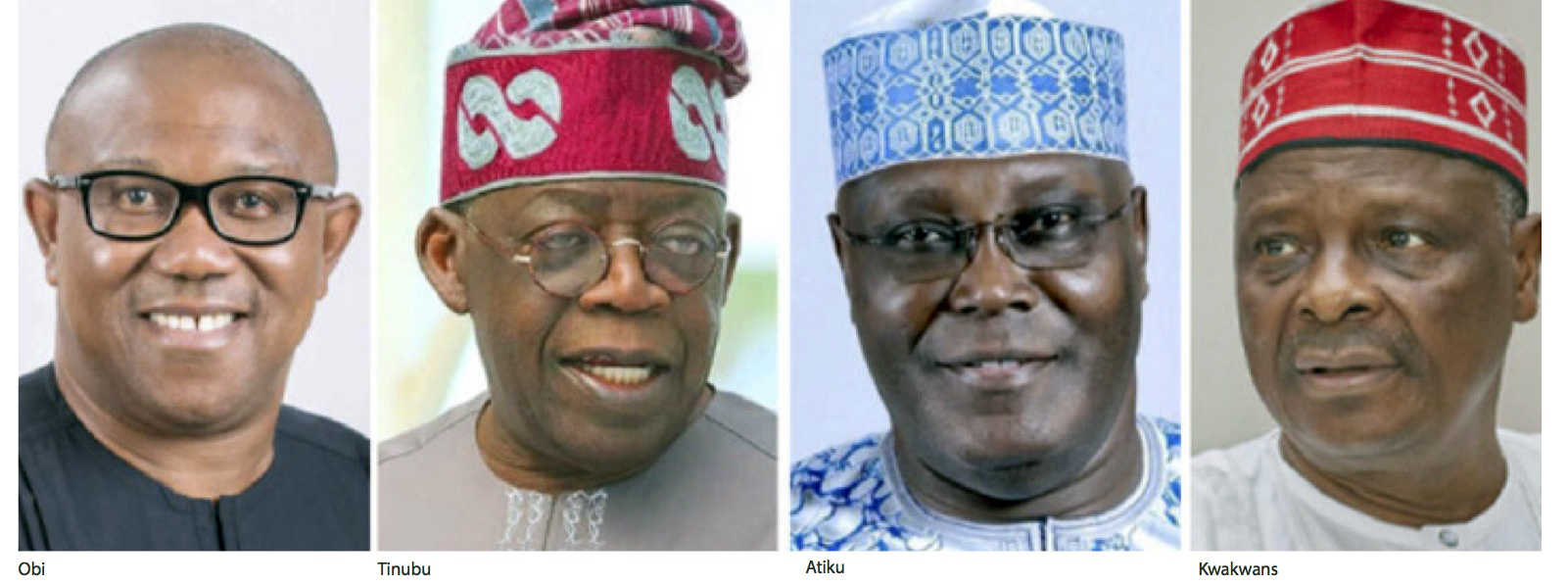
The combined votes of Atiku, Obi, and Kwankwaso in 2023 exceeded 15 million, nearly double Tinubu’s tally. On paper, a unified opposition is formidable. But elections are not won on arithmetic alone.
The arithmetic of the 2027 election, on paper, is seductive for the opposition. In 2023, President Tinubu won with 8.7 million votes, representing 36.61 per cent of total votes cast. Atiku Abubakar secured 6.9 million, Peter Obi garnered 6.1 million, and Rabiu Kwankwaso obtained 1.4 million. The combined opposition tally dwarfed Tinubu’s. Importantly, the top three candidates each won 12 states, satisfying the constitutional requirement of 25 per cent of the vote in at least 24 states.
But the 2023 lesson is precisely why the 2027 opposition should be cautious about treating these numbers as destiny. In 2023, the opposition was equally fragmented and it lost. The personal ambitions, regional calculations, and institutional interests that kept Atiku, Obi, and Kwankwaso on separate tickets in 2023 have not disappeared. They have, if anything, intensified. The ADC coalition was built expressly to prevent a repeat of 2023’s mutual self-destruction, but the cracks are already visible.
The zoning argument is the single most explosive fault line. There is a broadly held view in Southern Nigeria and in parts of the Middle Belt, that the presidency should remain in the South for a second term to complete an informal rotational cycle. Under this logic, Tinubu, a southerner, should serve his second term, after which the North can present a candidate in 2031. Atiku’s determination to contest in 2027, for a sixth presidential attempt, cuts directly against this grain. It risks alienating the very Southern voters whose enthusiasm is critical to any credible opposition challenge.
There is also the matter of Wike’s alignment. The FCT Minister, whose capacity for political disruption is legendary, has already signalled that Atiku and other former PDP figures who defected to the ADC are “not welcome back” in the PDP. He has simultaneously indicated that the PDP will field its own presidential candidate rather than coalesce with the ADC. A PDP presidential candidate drawing from the same Northern voter pool as the ADC could fragment the anti-Tinubu vote precisely as occurred in 2023, with potentially fatal consequences for the opposition’s chance.
Against all this, President Tinubu holds the structural advantages of incumbency, control of the federal apparatus, patronage networks, and a security architecture that defines the operational environment of elections. His administration has made deliberate moves to address perceived political imbalances: Northerners occupy key security positions while prominent Christians head major economic institutions, moves widely interpreted as an effort to neutralise anxieties created by the 2023 Muslim-Muslim ticket.
The Supreme Court has done its work. It has left the PDP without a legally recognised leadership. It has given the ADC an operationally functional one. What it cannot do and what no court can do, is give the opposition the discipline, the sacrifice of ego, and the strategic coherence that is the actual prerequisite for electoral victory. Nigeria’s opposition has, for more than a decade, suffered not from a shortage of individual talent or voter dissatisfaction with the ruling party, but from an inability to subordinate personal ambition to collective purpose.
The same leaders building opposition coalitions today are, in many cases, the same leaders whose individual decisions in 2023 handed Tinubu a presidency he won with barely more than a third of the votes cast. History, if nothing else, demands that they learn from that failure.
The judgments of April 30 have cleared the legal underbrush. The field is now more visible. Whether the opposition can navigate it with greater wisdom than it has shown before is the defining question of Nigeria’s political season and the answer will not be found in any courtroom.
Displaying 1006409947.jpg.