Follow Us on Google
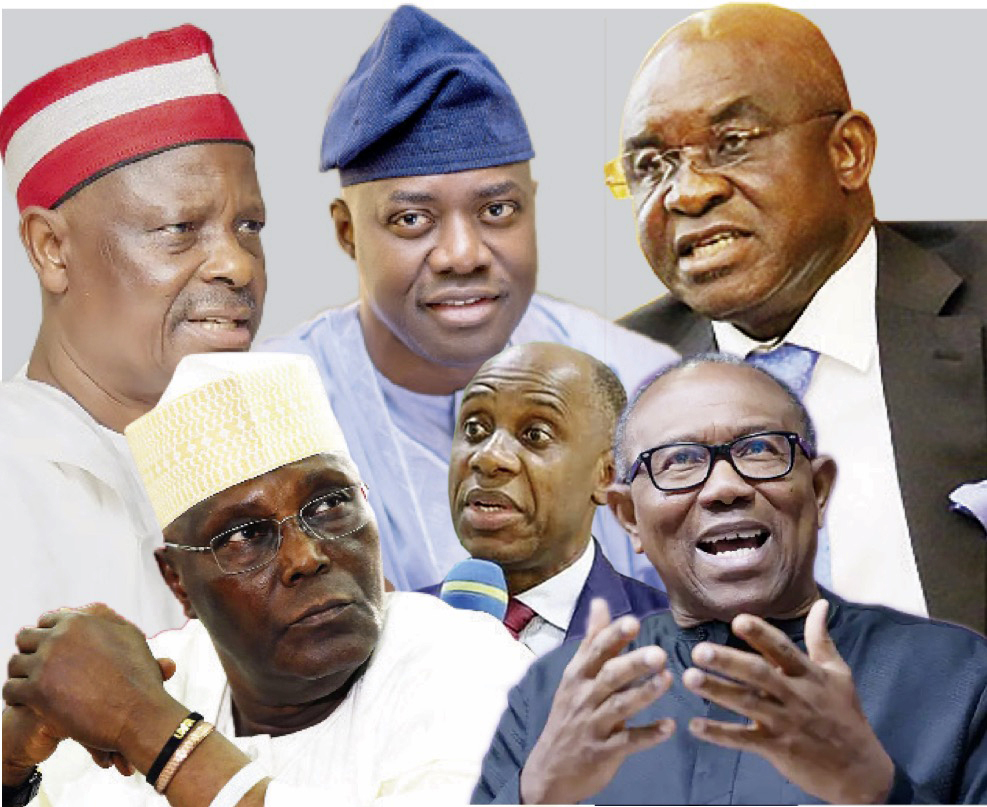
• Obi, Kwankwaso plot exit from ADC, may settle for NDC
• Kwankwaso to formally defect this week, ally says Obi still consulting
By Fred Itua, Abuja; Desmond Mgboh, Kano; and Omoniyi Salaudeen, Lagos
The grand opposition project assembled under the African Democratic Congress (ADC) is cracking. What was sold to Nigerians barely months ago as a formidable, unified front capable of unseating President Bola Ahmed Tinubu in 2027 is now the scene of a bitter internal war, one pitting Peter Obi and Rabiu Musa Kwankwaso against the powerful political machinery of former Vice President Atiku Abubakar and his allies in a battle over who controls the party’s presidential ticket.
The first formal break appears imminent. Documents circulating last night suggested that Kwankwaso and Obi might have resigned from the ADC and moved to the Nigeria Democratic Congress (NDC). But the camps of the two former governors insisted that no formal resignation had taken place.
Asked to confirm whether Obi had indeed dumped the APC, a close ally of the former Labour Party’s presidential candidate said: “Meetings are on; no final decision yet.”
The spokesman for the Kwankwasiyya Movement, Dr. Habibu Saleh Mohammed, confirmed to Sunday Sun in Kano on Saturday that Senator Kwankwaso had travelled to Abuja to hold final consultations, and was expected back by Sunday evening, after which a formal announcement of his defection from the ADC would be made on Monday.

“The decision to seek another political platform was reached on Friday evening at a stakeholders meeting held at the Miller Road-Bompai residence of Engineer Rabiu Musa Kwankwaso in Kano,” Mohammed said, explaining that the essence of the move was to find “a viable political party that would challenge the present APC administration and give Nigerians a collective platform to oppose the continued misrule of the APC government.”

In a wider statement issued by the Movement, it disclosed that it was “actively exploring all lawful and strategic options” to protect its principal’s participation in the 2027 elections, including aligning with “other progressive political platforms such as the NDC and the People’s Redemption Party (PRP).”
The Movement also confirmed it is in talks with some PDP elements, including Oyo State Governor Seyi Makinde and Bauchi State Governor Bala Mohammed.
The statement was careful not to name Atiku Abubakar directly. But its message was unmistakable to anyone tracking the behind-the-scenes manoeuvres inside the ADC. Sources within the Obi-Kwankwaso camp, now increasingly referred to in Abuja political circles as the “OK Movement”, told Sunday Sun that there is a coordinated effort by Atiku’s associates and a cluster of Northern governors to use the ADC’s on-going leadership litigation as a tool to shape the party’s internal primaries in the former Vice President’s favour.
“The plan is simple,” one source said. “Keep the legal crisis simmering long enough to create confusion, then use that confusion to impose a preferred outcome at the primary. Obi and Kwankwaso are not going to sit and watch that happen.”
The backdrop is the Supreme Court’s ruling of April 30, which vacated the Court of Appeal order that had briefly led INEC to derecognise the David Mark-led ADC leadership. While the ruling was hailed as a lifeline, the apex court stopped short of resolving the substantive leadership dispute, sending the matter back to the Federal High Court. That unresolved core is precisely what Obi and Kwankwaso’s camps say is being exploited.
Mohammed pointed to the tightening INEC calendar as decisive. “Counting from yesterday, all political parties have only eight days to conclude and present the list of their registered members to INEC,” he said, adding that parties have no more than 28 days to conclude primaries and submit candidates.
He also noted a separate suit before the courts, reportedly backed by the Attorney-General of the Federation, seeking the deregistration of the ADC entirely. “Given the prevailing atmosphere of litigations and organised disruptions, there are so many uncertainties surrounding the ADC,” Mohammed said. “There is no way the party would survive all the booby traps and still find itself on the election sheet come 2027.”
Former FCT Minister Nyesom Wike had offered a blunter verdict after the Supreme Court ruling: “The crisis in the ADC is far from over, as the matter will continue at the Federal High Court.”
A party chieftain, Fabiyi Oladimeji, went further still, publicly dismissing the viability of an Obi-Kwankwaso joint ticket altogether.
Obi has been unequivocal about his own intentions. “I’m going to contest for the President of the Federal Republic of Nigeria, and I believe I am qualified for it,” he declared at the height of the coalition’s formation. “Nobody has ever discussed with me whether I am going to be A or B or C.”
Multiple sources confirmed to Sunday Sun that he is now in advanced discussions with the NDC, which has reportedly offered him an unchallenged presidential ticket. “All things being equal, between now and next week, he is expected to dump the ADC for the NDC,” one source said. “It will be a massive move.”
The National Coordinator of the Obidient Movement, Yunusa Tanko, reinforced the message: “He is going to contest in 2027, and his name will be on the ballot.”
The Kwankwasiyya Movement’s statement ended with a note of contained defiance: “Nigeria’s democracy must be protected not only by the strength of its institutions but by the courage of its people to stand firm in the face of uncertainty.”
What Supreme Court ruling means
The legal entanglement surrounding the African Democratic Congress (ADC) presents a classic race-against-the-clock scenario that could redefine the coalition’s plan to field a single candidate in the 2027 election. By reinstating the David Mark-led leadership through the reversal of the status quo ante bellum order, the Supreme Court has provided a temporary lifeline, but it hasn’t cleared the runway for the party’s participation.
The situation creates three critical bottlenecks for the ADC as a viable coalition platform. While the Mark faction currently holds the reins via the apex court’s intervention, prolonged litigation from the rival faction acts as a permanent asterisk. Given INEC’s timeline, it is uncertain whether the party will meet the deadline for submission of candidates. This uncertainty makes the ADC a high-risk investment for coalition partners who cannot afford disqualification on technical grounds.
INEC operates on a rigid statutory timetable and may not entertain any request to extend the deadline for conducting party primaries. Even with judicial backing, the Mark-led leadership must navigate these challenges with dispatch to avoid a repeat of the Zamfara experience. This is bearing in mind that INEC’s candidate nomination portals close automatically. If the final determination of the leadership tussle extends beyond this window, the ADC risks being boxed out of the ballot entirely, regardless of who eventually wins the legal battle.
For the coalition to be taken seriously, there must be leadership stability. For now, that stability is yet to be seen. A party divided at the top rarely inspires confidence in the electorate or among smaller parties seeking a stable umbrella for 2027.
The ADC is currently in a state of suspended animation. Until the rival faction’s challenge is fully exhausted or a political settlement is reached, the party remains a fragile platform. The question is no longer just who leads the party, but when the leadership becomes legally unassailable. Without that certainty, the ADC’s role as a major 2027 contender remains in doubt.
The single-candidate paradox
The opposition’s collective resolution to field a single presidential candidate against the incumbent is a significant step in its drive to consolidate influence against the ruling party. But it leaves critical questions unanswered: Who will step down for whom? What ideological persuasion binds the parties involved? Do they have the luxury of time to consummate the deal?
The National Opposition Summit hosted by Oyo State Governor Seyi Makinde was tumultuous, echoing the ancient city’s history as a political hotbed. Yet the attendees could not articulate an ideology that offered something refreshingly different from the administration they seek to oust. Because these alliances are built on slots and positions rather than a shared vision for the economy or security, the ultimate result may be a fragmented house.
Currently, negotiations among the coalition forces, the ADC, a faction of the Labour Party (LP), and the fragmented PDP are less about promoting good governance than about pursuing personal slots, leaving the opposition hollowed out. By the time the rescue mission rhetoric reaches the campaign stage, the actual seats of power will have been traded in private boardrooms, leaving the national interest as a secondary concern.
Barely a week after the resolution, the alliance is already buckling under the weight of personal ambition. Unconfirmed reports suggest Atiku Abubakar may have reached an agreement with Governor Makinde as his running mate, while Peter Obi and Rabiu Kwankwaso are said to be considering a joint ticket.
The focus of these key coalition figures on personal ambition over a shared, coherent ideological vision poses the biggest challenge to the opposition’s effort to coalesce under a single platform. This is a valid concern for many observers.
When political alliances are transactional, prioritising who gets a slot rather than how to solve systemic issues like economic hardship, infrastructure, or insecurity, they struggle to gain genuine public trust. Instead, the electorate grows cynical about the possibility of meaningful change.
Other News
While a single candidate may be necessary to defeat the incumbent, the process of choosing one will surely exacerbate infighting. If the selection is based on who can pay the highest political price or who commands the most loyalist base, the resulting alliance may lack the cohesion to govern effectively if it does win.
Because the focus is on the who rather than the how, coalition figures have not presented a clear alternative. The public has yet to see a comprehensive, costed, actionable plan from these groups on how they would specifically fix the exchange rate or address the root causes of insecurity in a way that differs from current policies.
The core issue remains: Can a coalition built on personal ambition ever transition into one built on trust? History in Nigeria shows that alliances born of necessity often collapse once the personal interests of key figures diverge.
With divergent interests, the possibility of leading opposition figures like Atiku Abubakar, Peter Obi, and Rotimi Amaechi stepping down for a consensus candidate remains one of the most volatile and speculative elements of the 2027 landscape.
At present, the situation is defined by a clash between the strategic necessity of a unified front and the individual political ambitions of these figures.
Atiku’s position has been fluid. While he has previously declared that 2027 may be his final bid and has publicly stated he would step aside for a consensus candidate, his actions often contradict the retirement narrative. He remains a central, driving force in coalition discussions, but his insistence on remaining a primary contender, or at least the kingmaker, continues to complicate the emergence of a fresh candidate.
Peter Obi, on the other hand, has been consistent in rejecting the traditional running-mate path. The Obidient Movement has maintained a hardline position that he is not interested in being a vice-presidential candidate again, positioning him as an alternative to the current political establishment. His refusal to accept a subordinate role creates a significant roadblock to any merger that assumes he would serve under someone else.
Rotimi Amaechi operates as part of the broader coalition. Unlike Obi, he has yet to take a definite position on whether he will accept a running-mate slot. His political influence remains rooted in his experience as a former governor and minister.
The difficulty in these leaders stepping down stems from several structural and personal realities. A coalition agreement essentially requires one person to lead and others to follow. However, for leaders who have either held the highest executive offices or built massive, independent national followings like Obi, stepping down is viewed as an existential threat to their political relevance.
Beyond that, there is no established, impartial mechanism within these coalitions to determine who is the best candidate. Without a transparent process, any selection will be viewed by the losers as a betrayal or a rigged deal, which almost guarantees the coalition will fracture before the election.
While these leaders frame their alliance as a rescue mission for Nigeria, public discourse heavily emphasises their personal refusal to compromise. When the public sees leaders who cannot agree on a hierarchy, the rescue narrative loses its moral authority, appearing as a fight for control rather than a fight for the nation.
As of today, the likelihood of a major figure stepping down voluntarily to support a consensus candidate is low, unless the political cost of continuing becomes demonstrably higher than the benefit of winning as part of a team.
The current scenario suggests a high-stakes standoff. Each leader is keeping their presidential ambition viable as a bargaining chip.
APC’s dismissive response
Makinde’s invocation of “Operation Wetie,” a historical reference to the political violence of the mid-1960s in Western Nigeria, drew fierce condemnation from the ruling APC. By framing the current political struggle in such a volatile historical context, the governor shifted the narrative from a policy-driven debate to one of confrontational and potentially dangerous brinkmanship.
The APC dismissed attendees as clownish characters lacking a serious agenda. This highlights the fundamental scepticism with which the ruling party views these alliance efforts. They are betting that internal contradictions, the competing ambitions of Atiku, Obi, and others, will cause the coalition to collapse long before it can present a viable electoral threat.
Former Ogun State Deputy Governor, Senator Gbenga Kaka, introduced a historical dimension to the proposal in a telephone interview with Sunday Sun, declaring that the arrangement would imminently collapse.
He argued: “History is not in favour of those plotting to present a single candidate. We have had several alliances among political parties, yet none has achieved its purpose. For example, in the First Republic, UPGA and the NCNC had a working understanding, but the ruling party dissolved them. During the Second Republic, we had the Progressives Governors’ Forum. Until the military intervened to rescue the political space, they couldn’t achieve anything with that association.
“Even when Babangida decreed two political parties, NRC and SDP, expecting everyone to coalesce, it didn’t work as planned. Though MKO Abiola won the election, they still scuttled it.”
Mocking the crisis in the ADC as a platform for the coalition, he added in a cynical tone: “I agree with Mr President that it is his pleasure to see all opposition parties in disarray. Already, they are almost in disarray. If they are in disarray and about 32 states are under the control of the ruling APC, who are the people they want to gather?
“I think they haven’t started yet. If they are serious and want to start effectively, let them merge into one single party against the incumbent. Only then will people take them seriously. Without dissolving into one party, nobody in the country will take them seriously. God forbid, if they accidentally take over power, they will fight to the very end. I can assure you of that. It is better we don’t jump from frying pan to fire. The devil we know is better than the saint that is yet to come.
“You cannot give what you don’t have. These are the people who destroyed this country beyond imagination. There is no way they can provide better alternative solutions to the problems confronting the country. If they had better ideas, they wouldn’t have run the country down in the first place. They brought the country to her knees. Definitely, the solution is not with them.
“Whether they come together or stay independent, it is of no consequence. They don’t deserve people’s votes. It is even already too late for them to coalesce now. If for 11 good years they couldn’t come together, what is bringing them together now will actually tear them apart, which is mad ambition.”
Also, APC chieftain in Ekiti State, Senator Anthony Adeniyi (SAN), speaking within the legal scope, declared outright that the idea of presenting a single candidate by the opposition parties is dead on arrival, citing the looming uncertainty surrounding the ADC’s litigation battle.
“The idea of opposition parties fielding a single candidate cannot work because they lack a unified party structure. It will be almost impossible for the ADC to overcome its crisis given the Supreme Court ruling.
“Even if they switch to another platform, they cannot beat INEC’s timetable. Such an arrangement has never worked in our political history. Again, I doubt the leading figures in the coalition can subsume their interests and queue behind a single candidate. So, the proposal is dead on arrival,” he posited.
However, Afenifere Renewal Group leader, Hon Wale Oshun, in a moderate position, situated the proposal within normal democratic norms. “It is within democratic norms to have competition like this while seeking the people’s mandate. The opposition parties, like any other contending party, are free to field a single candidate if they so wish. It depends on the discipline they can bring to the table. They can all come under one party, or they can decide to go on an individual basis.
“However, the time is too short for such an arrangement if they don’t already have a party. If they have a party, it will be within their normal ambit to present a candidate. If they are just initiating the process, it may fall outside the electoral timetable announced by INEC.
“In all of this, it is the people of this country that will make up their minds on what they want. When the time comes, the people will be able to separate the corn from the chaff. They will know whether the opposition parties are serious or not, whether they have an agenda that will benefit their lives or ruin them. They will surely take the right decision on election day. What benefits the generality of the people will be the deciding factor,” Hon Oshun stated.
Emerging cracks in the alliance
The idea of fielding a single candidate presents a classic political paradox: the more vital unity becomes, the harder it is to maintain. While the recent Ibadan summit initially signalled a unified front for the 2027 elections, the one-candidate strategy is notoriously fragile.
Already, the PDP National Working Committee led by FCT Minister Nyesom Wike, the Peoples Redemption Party (PRP), Accord Party, the Labour Party faction led by Nenadi Usman, and the Nafiu Gombe faction of the ADC have all distanced themselves from the plan to field a single candidate.
The Labour Party’s involvement is particularly messy because of on-going leadership disputes. While the Abure/Apapa camps allegedly signed on to the alliance, the opposing faction dissociated itself immediately to protect its legal claim over the party’s structure. For them, joining a coalition isn’t just about 2027; it’s a tactical move to prove who the real leaders are in court.
The PRP said the alliance prioritises power-sharing over ideology and offers Nigerians no real alternative. Historically, the Peoples Redemption Party prides itself on distinct ideological roots in Talakawa politics. It is often wary of big-tent alliances it perceives as driven by the same political class it opposes.
Similarly, the Accord Party, led by Professor Chris Imumolen, denied any involvement in the decision reached at Ibadan and insisted its name and symbol were used without authorisation. In a statement issued by National Secretary Muktar Abdallah, Imumolen described the use of the party’s flag at the summit as political impersonation rather than a misunderstanding, warning that it may pursue legal action against those responsible.
These cracks have two immediate consequences for the opposition. One, every time a party pulls out, the ruling APC scores a narrative win, framing the opposition as disorganised and unfit to lead.
More concerning is the spoiler effect. If Accord and PRP run independent candidates in 2027, they may not win the presidency, but they can siphon crucial votes in specific regional strongholds, making the path much harder for whatever unified candidate eventually emerges.
It seems the opposition is relearning the hard lesson of 2014: a merger only works when the constituent parts are willing to lose their individual names and logos, something these parties clearly aren’t ready to do yet.