Follow Us on Google
From Ndubuisi Orji, Abuja
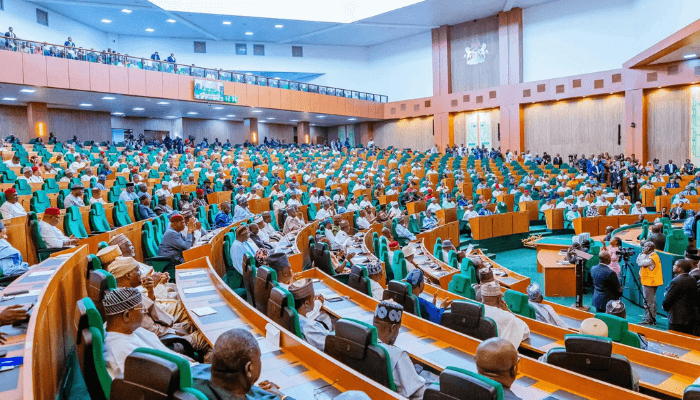
House of Representatives has approved the ₦58.18 trillion 2026 Appropriation Bill christened, “Budget of consolidation, renewed resilience and shared prosperity” for second reading.
Thereafter, the Green chamber adjourned plenary for two weeks to enable the various Ministries, Departments and Agencies (MDAs), appear before relevant House Committees for the defence of their budget proposals.
House Leader, Julius Ihonvbere, while leading debate on the general principles of the Appropriation Bill, expressed support for the budget proposal.
The key components of the budget, which was laid before a joint session of the National Assembly on December 19, 2025, include N4,097,381,103,856 for statutory transfers and N15,909,361,631,657 for debt servicing.
The N58,472,628,944,759, Appropriation Bill also consists of N15,251,538,827,423 recurrent (non-debt) expenditure and N23,214,347,381,824 to the development fund for capital expenditure.
The key assumptions for the 2026 budget include an oil benchmark of $64.85 per barrel and oil production of 1.84 million barrels per day.
President Tinubu, while addressing the National Assembly, had noted that the 2026 Appropriation Bill is guided by four objectives, including consolidation of macro economic stability, improved business and investment stability, promotion of job‑rich growth and poverty reduction; and strengthening of human capital and protecting the vulnerable.
According to him, “key sectoral provisions include: Defence and Security: ₦5.41 trillion; Infrastructure: ₦3.56 trillion; Education: ₦3.52 trillion
Health: ₦2.48 trillion. These priorities are interlinked. Without security, investment will not thrive. Without educated and healthy citizens, productivity will not rise. Without infrastructure, jobs and enterprise will not scale. This is why the Budget is designed as one coherent programme of national renewal.”
The House leader hailed the allocation of capital expenditure, describing it as “a departure from the past where recurrent spending outweighed capital investment. Here, capital expenditure is higher, which is what drives real development.”
He stated that the President Bola Tinubu administration has shown commitment towards stronger revenue performance, better tax administration, blockage of financial leakages and consolidation of macroeconomic stability amongst others.
The Edo-born lawmaker, while stating that economic growth is often challenging and painful, especially in an administration that inherited distorted political, social, and economic structures, noted that repositioning the country would have its own pains.
According to him, under the present administration, the naira had remained relatively stable, pointing out that the exchange rate had fallen from over N1,800 to about N1,400.
He added that the government has also shown fiscal discipline, which has helped in the stabilization of the economy, noting that “We have not printed a single naira since this government came into office. That fiscal discipline has helped stabilise the economy.”