Follow Us on Google
By Maduka Nweke, [email protected]
With economic hardship biting harder by the day in the country, not a few people are of the view that the massive demolitions that occurred in Lagos in 2023 alone amounts to economic leakage. This is, not considering the fact that demolitions deny the occupants of shelter thereby contradicting the government impression that it is fighting to reduce housing deficit in the country.
In Lagos State alone, aside from the disasters of building collapse that also ejected housing occupants, aided building disaster in form of demolition now a nightmare to the city dwellers.
This year alone, no fewer than 677 houses were completely demolished in Festac Town in the Awumo-Odofin area of the state alone.
Lagos State demolished over 13 properties in Ajao Estate, Banana Island had over 20 properties destroyed, and Festac Extension with 65 properties within a space of three months excluding other areas not recorded.
This stands as an indication that the hardship Nigerians living in Lagos face as a result of building collapse and demolition cannot be quantified not to mention the psychological and physiological trauma suffered in that direction by citizens.
Happenings in the real estate sector seem to suggest that the built environment is still being plagued by ethical compromises. The figures aboveare excluding what demolitions and collapses not recorded.
For instance the Federal Housing Authority, FHA, Southwest Zonal Manager, Akintola Olagbemiro, remarked that aside the 677 houses earmarked for complete demolition, 744 others will be partially demolished due to developers’ infringement in Festac Town, Awumo-Odofin area of Lagos State. During an on-the-spot assessment of the affected areas, he said efforts will be made to rid the state of illegal constructions irrespective of the level of work already done on the project.
In the words of Mr. Kunle Awobudu, former President Building Collapse Prevention Guild (BCPG), it is unfortunate that nobody has been successfully prosecuted for building collapse offences in Nigeria. He said, quackery, compromise and impunity proceed unchecked. “When human beings are not subjected to the law of consequence, misdeeds are absolved in sentiments, so loss of life and property becomes a continuum. BCPG updated its record of building collapse in Nigeria from 1974 – 2023 to sum it up to 552, with Lagos State accounting for 59.06 per cent (that is, 326 collapsed buildings). While waiting for more information on the collapse, I sympathize with anybody who may have been unfortunately affected by this incident, “he said. Like Awobodu, many practitioners are worried about the state government’s lack of political will to tackle the menace, amid glaring breaches and the attendant loss of lives. Awobudu had noted that, “On the safety board of a collapsed site at Oniru, marked LSC/CON/B/0309, the name of the contractor, his contact, and details of the artisans were not displayed as stipulated by the state’s building guidelines. This means that the culprit is shielded by the authorities.
Awobodu stated that in the minds of true professionals in the sector, the prevailing scenario of building collapse is an indictment of professionalism, another evidence of the government’s lip service and gross lack of political will to regulate the building sector.
Professionals in the built environment have stressed that the frequency and intensity of building collapse in the state now constitutes a perennial source of worry to Nigerians. According to Awobodu, “buildings collapse within the most expensive terrains like Banana Island, a well-organised or deemed well-organised area in Nigeria sounds like an aberration. The ostentatious Nigerians admire the denizens of this peculiar area of Ikoyi. Banana Island residents are special in their class. The image and reputation of those in the Nigerian building industry are at stake before the whole world when you consider that for buildings to collapse there could be technical errors emanating from the professional handling of the project. When we talk of building collapse for instance, Banana Island is the pride of all who admire the environment so if a building could collapse in such areas; your guess is as good as mine what most people think of other areas.
Also expressing frustration over the state government’s obvious lack of political will to address the malaise, the former chairman of the state branch of the Nigerian Institute of Estate Surveyors and Valuers (NIESV), Mr. Adedotun Bamigbola, said, even though details of the causes of the latest collapse are not out, the root causes of the menace are many as observed over time, even in high-income neighbourhoods. He noted that the overbearing influence of owners/developers in dictating actions, which should be strictly under the responsibility of construction professionals to their taste, or for maximising income, is a serious challenge.
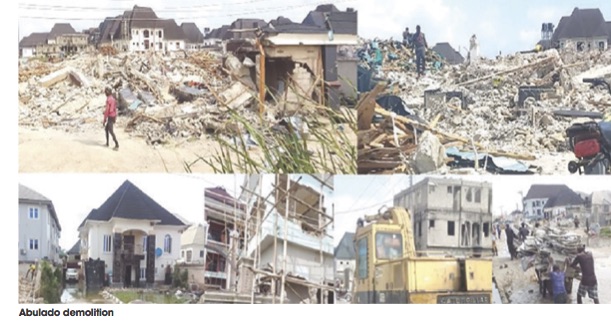
While discussing the building collapse which is not orchestrated or planned and expected, we also remember some of the buildings that were purposely planned. For instance, the recent demolitions carried out in the Abulado axis of Amuwo-Odofin, affected a lot of people. The residents and the FHA are still in controversy over the real number of buildings demolished. While the authority is saying that only 40 buildings were demolished, on the ground assessment of the area of demolition revealed that more than 40 buildings were demolished. The FHA may be talking of the number of plots not remembering that some people could accommodate more than one block in a plot.
The South West Assistant General Manager/Zonal Head, Survey and Mapping, of the Federal Housing Authority (FHA), Mr. Umar Lawal, in a press briefing while recent demolition was raging advised the public to do something on their own to avoid the disaster by not patronizing land grabbers who pose as authorities to speculate on lands. Lawal gave the advice at a meeting it organized for the FESTAC original allottees and those said to be encroaching on the land at Abule Ado and other major stakeholders.
One of the stakeholders who spoke on grounds of anonymity complained that they would have called for the stakeholders’ meeting before the demolition. According to him, “Calling for the meeting after demolition has gone far was a medicine after death. The idea is to make the public feel that they acted justifiably,” he said.
Lawal also accused the media who he said hyped the figures to achieve public sympathy adding that the demolition affected 40 buildings which had irredeemable physical planning infractions or Right of Way (RoW) encroachment issues. He said the 40 demolished houses were built on NNPCL pipelines, major roads and drains. He advised Lagos residents to purchase land only after diligent search with both the FHA and the state government is completed to escape traps of land grabbers and touts. “My advice to the general public is that they should desist from further construction stressing that the exercise is a continuous one and whoever continues to build is doing so at his/her own risk.
They should stop wasting their money because whatever news that they are hearing from people that is not from FHA is false and should be taken seriously as false. FHA acquired 2024.64 hectares and 363 hectares is under litigation; the portion under litigation is on 6th avenue, we are very careful and are not entering into that section,” he said.
He said, “In April 2022, a drone was flown on FESTAC to carry out an aerial survey to ascertain the level of distortion of the redesign of the area because the town planning layout had been bastardized. Even new buildings that had reached lintel levels were captured in the new layout. We earlier convened the meeting after where we advised the stakeholders to stop any further construction for the authority to be able to redesign the layout to save several buildings from demolition through regularisation. We did that and out of the 18,000 houses captured, 14,000 qualified for likely regularization and verification so regularisation exercise began and residents were advised to come to the FHA to perfect the process,” he said.
He noted that it was agreed at the stakeholders’ meeting between the residents and FHA that the only buildings that could not be saved were those on major roads, drainage paths and NNPCL pipelines. Lamenting that in a bid to reduce economic loss, the FHA further compromised by accepting to reduce its roads from 15 to 10 metres to save more buildings that had encroached into the roads. “To the amazement of FHA, the stakeholders and representatives of estates within the area in question did not comply with the agreement as new buildings erupted without approvals and supervision. In that regards, FHA had no option than to take proactive measures by embarking on the recent demolition to prevent the physical planning infractions, substandard construction and likely consequences. Contrary to allegations in the media space, FHA served contravention notices and conditions for regularisation on affected buildings,” he noted.
Nonetheless, the magnitude of losses recorded in recent time irked a lot of people who were saying, “If FHA feels the builders were wasting their money, they wouldn’t have waited until a building got to the level that about N300 million have been committed before they came for demolition? This attitude shows jealousy and with ulterior colouration. People criticise Nigerian Police because they will see some motorists or citizens on the verge of committing offence, they will not stop them; rather they will be perfecting strategies and evidence to arrest them. This is exactly what the FHA has done. It does not show patriotism rather animosity and vilification, “one who did not want her name mentioned said.
Also not in tandem with process of punishment of building offenders, the Chairman, Coalition against Corruption and Bad Governance (CACOBAG) Mr. Toyin Raheem, in a letter addressed to Lagos State Governor and made available to Daily Sun, stated that there are; Lagos State Building Control Agency (LASBCA), Nigerian Institute of Building, Shelter Rights Project and others that are authorities to consult on building construction issues but each time, building owners will bear the brunt of such errors.
He lamented that corruption, no doubt, has become a monster affecting every facet of lives of Nigerians. According to CACOBAG, “Its corrosive effects on the country cannot be overemphasized. 1999 Constitution of the Federal Republic of Nigeria as altered despite its flaws are unambiguous when it declares in Section 15 sub section 5, “the state shall abolish all corrupt practices and abuse of office.