Follow Us on Google
From Juliana Taiwo-Obalonye, Abuja
The European Union has disclosed that it has contributed over N1 billion in support of Sexual Assault Referral Centres (SARCs) across the country, assuring of further advocacy for more centres and for appropriate funding allocations at federal and state level to make them operational and sustainable.
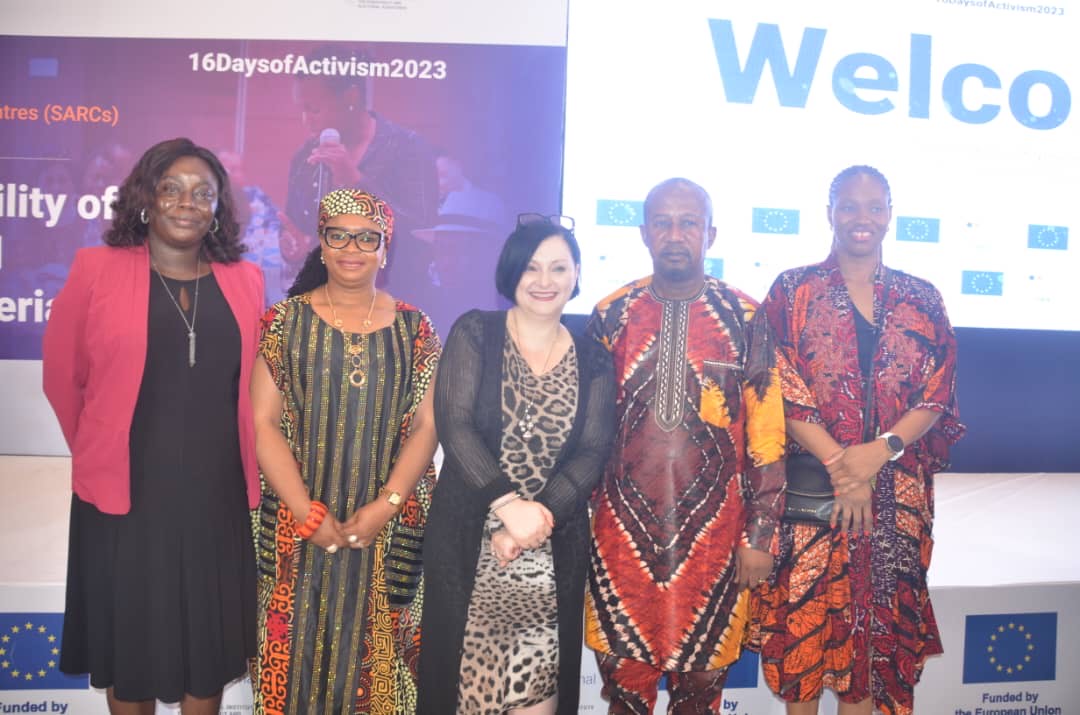
Ambassador of European Union to Nigeria and Economic Community of West African States (ECOWAS), Samuela Isopi, made the disclosure in Abuja at the one-day Network Conference of the Sexual Assault Referral Centres (SARCs), hosted by the International Institute for Democracy and Electoral Assistance (International IDEA), a not-for-profit inter-governmental organization, as part of the European Union-funded Rule of Law and Anti-Corruption Programme-Phase II (RoLAC II).
The conference is part of the “16 Days of Activism against Gender-Based Violence”, an annual international campaign that launches on November 25, aiming to amplify advocacy against all forms of violence, discrimination, and human rights abuses, particularly sexual violence against women and girls. This period concludes on December 10, observed as Human Rights Day.
Isopi disclosed that during her visits to some States, she met survivors and listen to their stories, to exchange with frontline workers.
“I have seen the suffering and the trauma, but also the support and the hope that these centres can bring to survivors.
“We must all be proud of the impressive work and progress made since the launch of the first SARC in 2013. Today, there are 41 SARCs across 21 states, with over 35,500 survivors that have benefitted from their services.
“This demonstrates the importance of providing facilities for survivors and the added value of these centres that are at the heart of SGBV response.”
The EU and ECOWAS envoy, noted that sexual and gender violence is the most serious crime affecting women, girls and young boys.
She regretted that despite the scale of the problem, there are still very few facilities to help survivors, and the number of cases that are extremely limited (less than 1%).
“This is why for us, at the European Union, sexual assault referral centres are the first, essential tool in the fight against SGBVs.
“Providing a safe environment is the first step to break the silence and the stigma that surrounds violence against women.
“SGBV is not a private issue, it is not a women’s issue. It affects the whole society.
“Speaking openly about SGBV still can bear a huge risk for victims.
“That is why it is so important to invest in creating an environment where women and children feel safe and empowered to break the silence.
“The EU is committed to ensuring that their voice is heard. In Nigeria, the European Union has contributed over a billion naira in support of SARCs across the country and we will continue to advocate for more centres and for appropriate funding allocations at federal and state level to make them operational and sustainable.
“Addressing violence against women and girls requires a comprehensive and collective approach. We will continue to collaborate with key stakeholders in supporting legislative instruments – we hosted last week a successful Parliamentary Summit to reflect on the role that the National Assembly can play in addressing SGBV – and responsive policies.
“Every year the SARC Network Conference provide the opportunity to take stock of the results achieved but also to look ahead, at gaps and new entry points to continue strengthening SGBV response.
“Ending impunity must definitely come to the front. The number of convictions for cases of SGBV remains abnormally low.
“Justice must not only be done. But it must be seen to be done”.
She commended Federal Government’s commitment to prioritise justice, increase access to justice for survivors of SGBV and to work closely with the States, to organize the necessary response and replicate the good practices that already exist.
The envoy also commended Lagos State for being a worthy example by setting up specialised SGBV courts. And Adamawa, Anambra, Edo and Federal Capital Territory (FCT) for following suit by designating special courts to handle cases of rape and other forms of violence against women. There are also ongoing conversations about mobile courts.
“SGBV cases require a different approach, they require special protection measures, to improve victims’ experience and confidence in the criminal justice system and reduce the “insensitive treatment” that is often extended to survivors, witnesses and complainants in their pursuit of justice.
“When a trial takes too long, coupled with the absence of special protection measures, survivors and complainants lose faith and give up on their quest for justice. This doesn’t help to end impunity!
“There are good processes in place to build on”, she said.
Attorney General of
the Federation and Minister of Justice, Lateef Fagbemi, reiterated that the sustainability and existence of SARCs is Justice for victims/ survivors of gender-based violence, saying “and if our ultimate goal is getting justice for victims of SGBV then we must collaborate and join our collective power to support the active existence of this centres and this we solicit from stakeholders and development partners.”
Represented by Head of the SGBV Response Unit, Federal Ministry of Justice; Yewande Gbola-Awopetu, The AGF noted that several regional and international instruments, provides that access to health is a human right, and this particular right gives rise to the other human rights viz: right to life, right to association, right to freedom from discrimination, right to education and the sexual and reproductive health rights of citizens.
Minister of Women Affairs, Uju Kennedy-Ohanenye, noted that as impressive as the efforts of the Federal Government are, the common challenge faced by these centers according to a recent survey is the weak commitment by sub – national governments to strengthen the multisectorial and inter-Agency collaboration mechanisms that will sustain the delivery of SARCs services to the victims.
The minister, who was represented by Assistant Director, Gender Affairs, Federal Ministry of Women Affairs; Iheanyichi Amanambu, she said implication is that the Centers lack the requisite funds needed to ensure optimal services delivery.
She called on participants to consider the trauma victims of SGBV goes through, empathise with them and develop a financial roadmap that will guarantee the functionality of all 33 SARCs Centers.
“To this end, I enjoined all the State Ministries of Women Affairs in States where these 33 SARCs Centers are located to as a matter of urgency and in the spirit of gender responsive budgeting specifically allocate funds to these Centers during the 2024 Budget year.
“I assure you that the Federal Ministry of Women Affairs will continue to mobilize the support of critical Ministries, Departments and Agencies (MDAS) as well as friendly Donors to support the funding and efficient management of SARCs Systems in Nigeria.”
Oluwatoyosi Giwa, Project Manager, Access to Justice & Coordinator, Network of Sexual Assault Referral Centres (SARCs), RoLAC II said We still have a situation where state governments as well as the Federal Government is still not funding largely, SGBV response in Nigeria. And what I mean is that when it comes to emergency rescue, response, shelter services, medical, trauma counseling we still have that significant gap where state government, federal government is still not putting the money where the legislation is. So, all of the different mechanisms that are supposed to respond are there, they are just not properly or adequately funded”.
She objective of conference is to: “Examine governance issues that continue to limit the impact and sustainability of Sexual Assault Referral Centers (SARCs) in Nigeria.
“To establish clarity on where and how to focus state-level advocacy for funding existing SARCs by state governments.”
The International Institute for Democracy and Electoral Assistance (International IDEA) is an intergovernmental organization established in 1995, with 34 Member States. RoLAC II, a $30 million 5-year Programme (2023-2027) funded by the European Union, aims to contribute to the consolidation of Rule of Law and Good Governance reforms in the Federal Republic of Nigeria.
Building on the success of RoLAC Phase I (2017 – 2022), funded by the European Union, the Programme significantly enhanced good governance in Nigeria.
“It played a pivotal role in strengthening the rule of law and curbing corruption by supporting reform initiatives across federal and state institutions, anti-corruption agencies, civil society, citizens, and the media.